
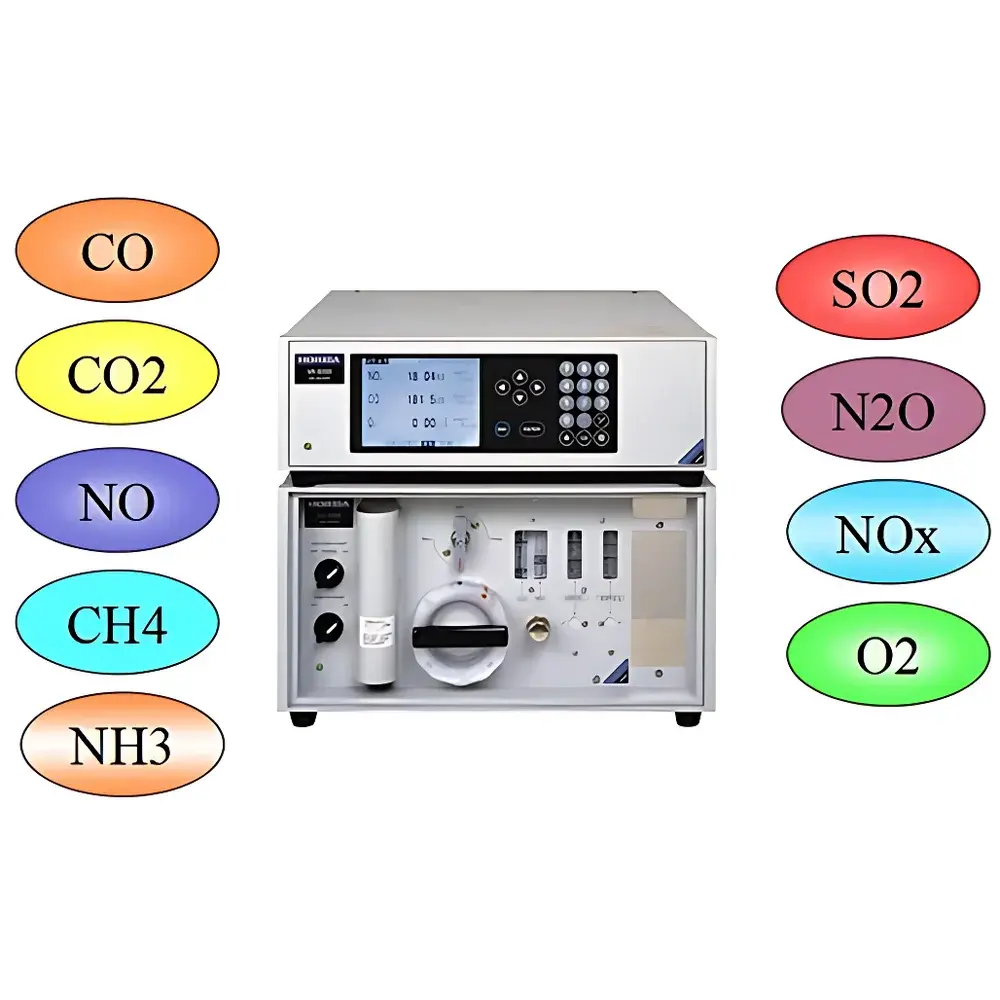
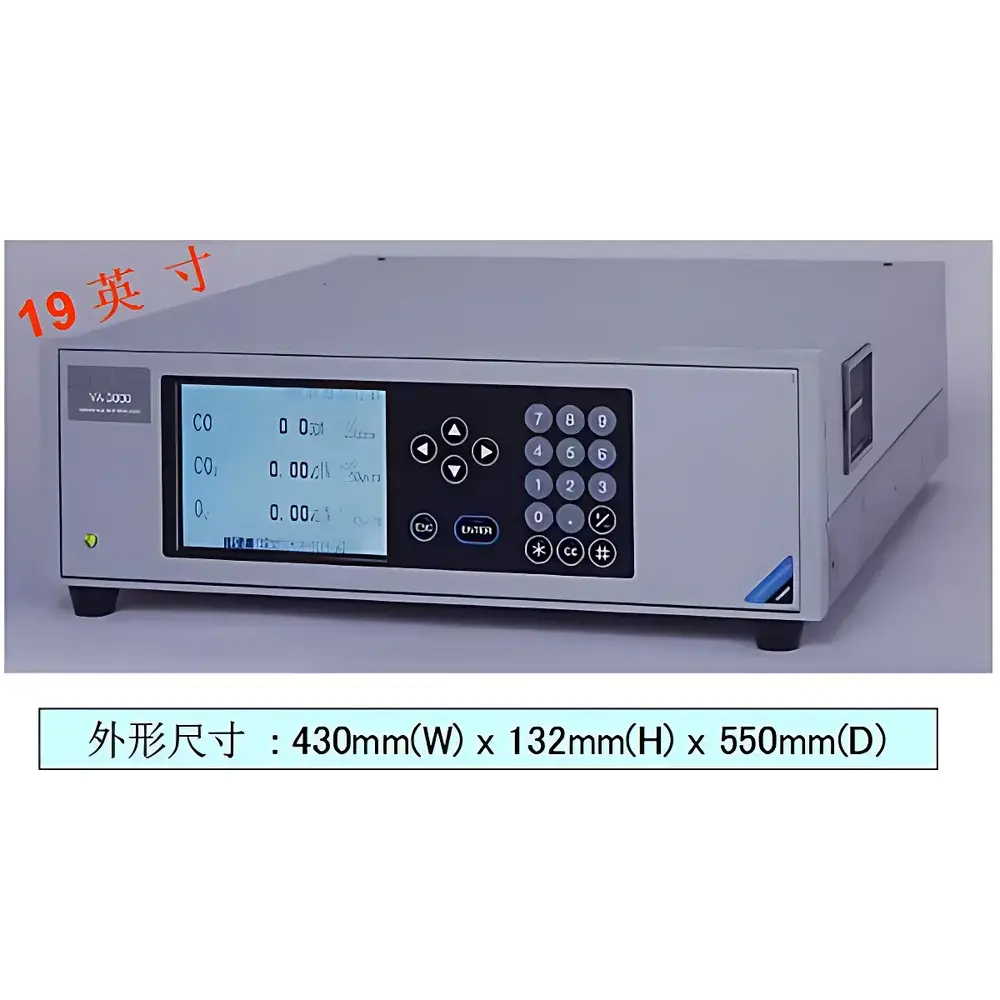
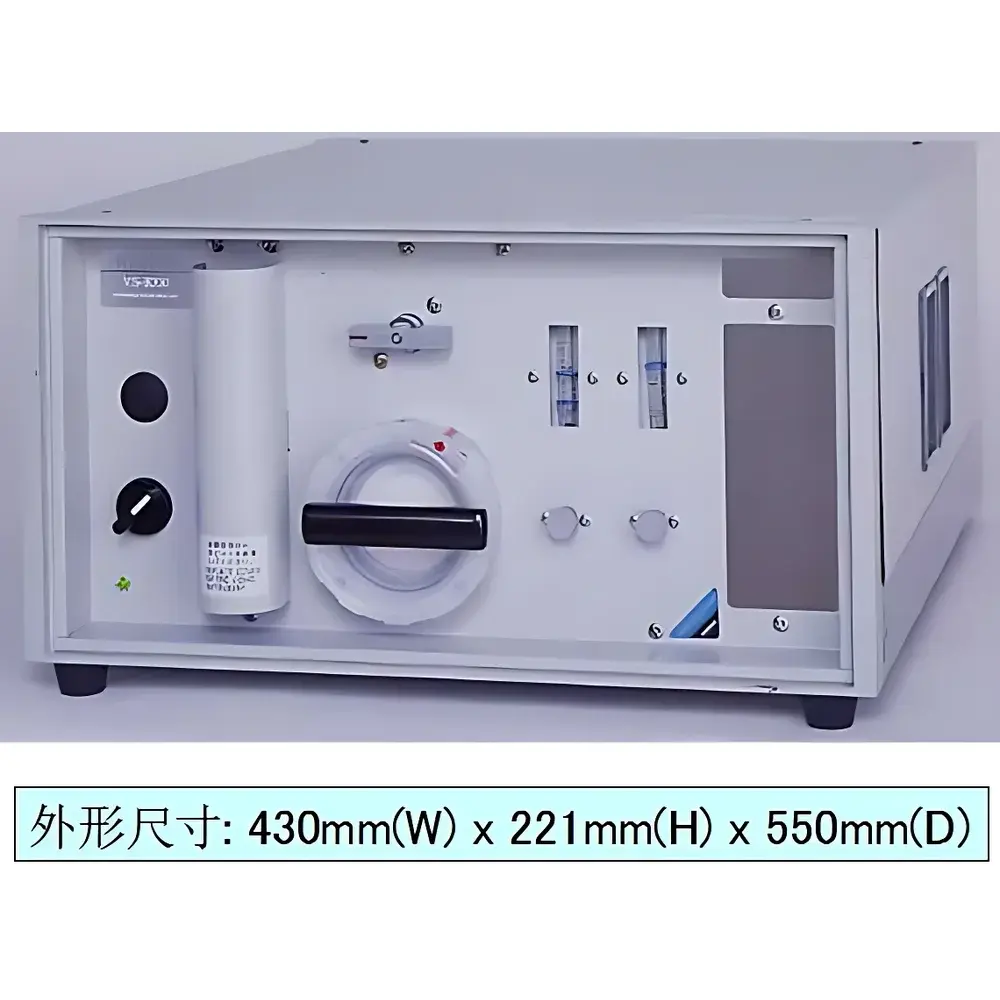
HORIBA VA-3000 Series Multi-Gas Analyzer with VS-3000 Preconditioning Unit
| Brand | HORIBA |
|---|---|
| Origin | Japan |
| Model | VA-3000 / VS-3000 |
| Measurement Principles | NDIR, CLA, MPA, Galvanic, Zirconia |
| Zero/Span Drift (NDIR) | ±2.0% F.S./week |
| Repeatability | ±0.5% F.S. |
| Linearity | ±1.0% F.S. |
| T90 Response Time | ≤30 s |
| Sample Flow Rate (VA-3000) | ~0.5 L/min |
| Sample Flow Rate (VS-3000) | 1.5–5.0 L/min |
| Gas Ranges | CO (0–200 ppm to 0–100 vol%), CO₂ (0–100 ppm to 0–100 vol%), N₂O (0–100 ppm to 0–5000 ppm), CH₄ (0–200 ppm to 0–100 vol%), SO₂ (0–200 ppm to 0–10 vol%), NOₓ (0–20 ppm to 0–5000 ppm, CLA), MPA (0–5 vol% to 0–100 vol%), Galvanic O₂ (0–5 vol% to 0–25 vol%), Zirconia O₂ (0–5 vol% to 0–25 vol%) |
| Range Switching | Up to 4 ranges (CLA up to 8) |
| Analog Outputs | 0–1 V DC, 4–20 mA DC |
| Digital Interface | RS-232C |
| Warm-up Time | ~20 min (NDIR/Galvanic), ~40 min (Zirconia), ~60 min (CLA/MPA) |
| Power Supply | 100–240 VAC, 50/60 Hz |
| Power Consumption | 100–350 VA (VA-3000), 250–450 VA (VS-3000) |
| Display | LCD, 320 × 240 pixels |
| Enclosure | 19-inch rack-mount |
| Dimensions (VA-3000) | 430 × 132 × 500 mm (W×H×D) |
| Dimensions (VS-3000) | 430 × 221 × 550 mm (W×H×D) |
| Operating Environment | 0–40 °C, ≤90% RH |
| Weight | ~20 kg (VA-3000, 3-component configuration), 14–20 kg (VS-3000) |
Overview
The HORIBA VA-3000 Series Multi-Gas Analyzer is a high-integrity, modular continuous emission monitoring system engineered for precision measurement of multiple gaseous components in ambient air, industrial process streams, and research-grade exhaust applications. Integrated with the VS-3000 series sample preconditioning unit, this platform employs complementary analytical technologies—including Non-Dispersive Infrared (NDIR), Chemiluminescence Analysis (CLA), Magnetic Paramagnetic Analysis (MPA), electrochemical galvanic cells, and zirconia-based oxygen sensors—to deliver simultaneous, stable quantification across diverse chemical species. The system’s architecture supports trace-level detection (e.g., 100 ppm N₂O) and high-concentration volumetric analysis (up to 100 vol% CH₄ or CO₂), making it suitable for both regulatory compliance monitoring and dynamic reaction environment characterization. Its design adheres to fundamental metrological requirements for long-term stability, including low zero/span drift (±2.0% F.S./week for NDIR channels) and fast T90 response times (<30 seconds), enabling real-time process feedback without compromising accuracy.
Key Features
- Modular sensor architecture supporting up to eight independent gas measurement channels—configurable via NDIR, CLA, MPA, galvanic, or zirconia sensing modules.
- Dual-stage sample handling: The VA-3000 analyzer couples with the VS-3000 preconditioning unit to ensure consistent sample conditioning—including thermoelectric cooling to 5 °C, particulate filtration (<0.1 mg/m³), dew point control (<60 °C), and pressure stabilization (±980 Pa).
- Multi-range capability per channel: Up to four programmable ranges on most sensors; CLA channels support up to eight ranges for extended dynamic coverage across NOₓ emissions monitoring.
- Rack-mount 19-inch enclosure compliant with EN 60297-3-100 and IEC 60950-1 standards; front-panel LCD (320 × 240 pixels) provides real-time concentration readouts, status indicators, and diagnostic menus.
- Industrial-grade analog and digital interfaces: Isolated 0–1 V DC and 4–20 mA outputs compatible with DCS/PLC systems; RS-232C port enables bidirectional communication for remote calibration, firmware updates, and data logging.
- Robust warm-up protocol management: System self-calibrates based on sensor type—20 minutes for NDIR/galvanic, 40 minutes for zirconia, and 60 minutes for CLA/MPA modules—ensuring thermal equilibrium prior to measurement validation.
Sample Compatibility & Compliance
The VA-3000/VS-3000 platform accommodates complex, humid, and particulate-laden sample matrices typical of combustion flue gases, biogas streams, catalytic reactor effluents, and laboratory-scale emission sources. Sample inlet materials—including SUS316, PTFE, PVDF, FKM, and borosilicate glass—are selected to resist corrosion from acidic gases (SO₂, NOₓ), hydrocarbons (CH₄, HC), and condensable organics. The system meets core performance criteria referenced in ISO 12039 (CO, CO₂, NOₓ, SO₂), EPA Method 3A (O₂), and ASTM D6522 (NOₓ by CLA). While not pre-certified for U.S. EPA PS-11 or EN 15267, its documented repeatability (±0.5% F.S.), linearity (±1.0% F.S.), and drift performance align with GLP-aligned QA/QC protocols required for method validation under ISO/IEC 17025-accredited laboratories.
Software & Data Management
Data acquisition and instrument control are managed through HORIBA’s proprietary PC-based software suite, which supports time-synchronized multi-channel recording at user-defined intervals (1 s to 1 h resolution). The software implements audit-trail functionality compliant with FDA 21 CFR Part 11 requirements—including electronic signatures, session logs, and immutable record archiving—when deployed in regulated pharmaceutical or environmental testing environments. Raw analog outputs can be interfaced with third-party SCADA platforms via Modbus RTU (via RS-232C-to-Modbus gateway) or OPC UA integration. All calibration events—including span gas verification, zero adjustment, and range switching—are timestamped and stored locally on the analyzer’s internal memory (non-volatile EEPROM), ensuring full traceability for ISO 9001 or GMP audits.
Applications
- Catalyst development and deactivation studies: Real-time tracking of NO/NH₃/O₂ ratios during SCR catalyst evaluation; CO₂/NO₂/SO₂/HC profiling over Pt-based oxidation catalysts.
- Fuel cell R&D: Quantification of CO (ppm-level poisoning risk), CO₂, and CH₄ in reformate gas streams; O₂ monitoring in cathode feed lines.
- Biomass and anaerobic digestion: CH₄/CO/CO₂/SO₂ co-monitoring in biogas upgrading facilities and landfill gas collection systems.
- Wastewater treatment: Dissolved O₂ and off-gas composition analysis in activated sludge basins to optimize aeration efficiency and nitrification/denitrification control.
- Coal gasification and syngas production: Continuous surveillance of NOₓ, SO₂, O₂, CH₄, and H₂S concentrations for combustion safety and environmental reporting.
- Combustion efficiency optimization: Stoichiometric ratio calculation via simultaneous O₂, CO, and CO₂ measurements in boiler and kiln exhaust ducts.
FAQ
What sample preparation is required before connecting to the VA-3000?
The VA-3000 must be paired with the VS-3000 series preconditioning unit, which handles filtration, moisture removal (to ≤60 °C dew point), and temperature stabilization. Direct raw stack sampling is not supported.
Can the system measure both NO and NO₂ independently?
Yes—the CLA module measures total NOₓ; when configured with a built-in molybdenum converter, it enables selective NO₂ quantification via thermal conversion to NO, meeting ASTM D6522 specifications.
Is the VA-3000 compliant with EPA or EU emissions monitoring regulations?
It is not pre-certified under EPA PS-11 or EN 15267-3, but its documented metrological performance satisfies technical prerequisites for site-specific certification and QAL2 validation per EN 14181.
How many gases can be measured simultaneously?
Up to eight gases concurrently, depending on sensor module selection—e.g., NDIR for CO/CO₂/CH₄/SO₂, CLA for NOₓ, MPA for O₂, and galvanic/zirconia for redundant O₂ verification.
What maintenance intervals are recommended for long-term operation?
Filter replacement every 3 months under typical industrial conditions; annual sensor verification using certified span gases traceable to NIST standards; quarterly zero checks recommended for critical applications.







