
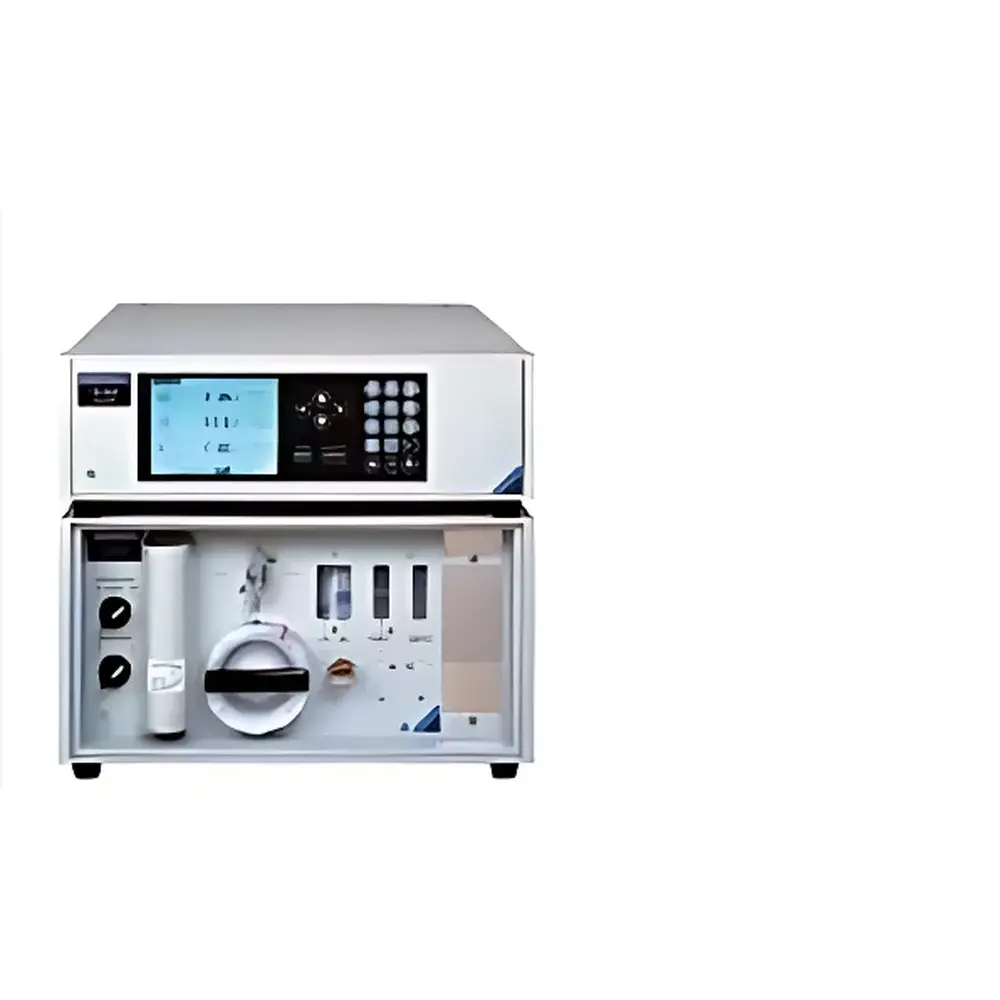
HORIBA VA-3000/VS-3000 Series NDIR & CLA Multi-Gas Continuous Emission Monitoring Analyzer
| Brand | HORIBA |
|---|---|
| Origin | Japan |
| Model | VA-3000/VS-3000 |
| Instrument Type | Online Fixed-Mount Gas Analyzer |
| Detection Principle | Non-Dispersive Infrared (NDIR), Chemiluminescence (CLA), Magnetic Pressure (MPA), Electrochemical (Galvanic), Zirconia Oxide |
| Measurable Gases | CO, CO₂, NOₓ, SO₂, CH₄, N₂O, C₂H₄, O₂ |
| Minimum Range | 0–5 ppm |
| Repeatability | ±0.5% of Full Scale |
| Resolution | 0.1 ppm |
| Response Time (T90) | ≤30 s |
| Zero Drift | ±2.0% of Full Scale per Week |
| Warm-up Time | 20–60 min (varies by sensor type) |
| Analog Output | DC 0–1 V / 4–20 mA (isolated optional) |
| Digital Interface | RS-232C |
| Sample Flow Rate | ~0.5 L/min |
| Operating Temperature | 0–40 °C |
| Power Supply | AC 100–120 V or 200–240 V, 50/60 Hz |
| Weight | ~20 kg (VA-3000) |
Overview
The HORIBA VA-3000/VS-3000 Series is a modular, high-integrity online gas analysis platform engineered for continuous emission monitoring (CEM), environmental compliance verification, and industrial process control. It integrates multiple detection technologies—including Non-Dispersive Infrared (NDIR), Chemiluminescence (CLA), Magnetic Pressure (MPA), Galvanic electrochemical, and Zirconia-based oxygen sensing—within a single 19-inch rack-mountable architecture. This multi-technology design enables simultaneous or sequential quantification of up to three gas components (e.g., CO, CO₂, NOₓ) in a single analyzer unit, eliminating the need for parallel standalone instruments and reducing footprint, calibration overhead, and long-term maintenance complexity. The system operates on the fundamental physical principles of molecular absorption (NDIR), light-emission kinetics (CLA), magnetic susceptibility (MPA), redox current generation (galvanic), and oxygen ion conductivity (zirconia). Its engineering reflects decades of HORIBA’s domain expertise in trace gas metrology, with attention to optical path stability, thermal management, and interference mitigation—particularly critical when measuring low-concentration species (e.g., 0–5 ppm NO) in complex matrices containing H₂O, CO₂, or hydrocarbons.
Key Features
- Modular Sensor Architecture: Supports up to three interchangeable sensor modules (NDIR, CLA, MPA, galvanic, or zirconia) within one VA-3000 analyzer chassis—enabling flexible configuration for site-specific regulatory or process requirements.
- Wide Dynamic Range Capability: Offers programmable range selection across up to 8 segments (CLA) or 4 segments (NDIR/MPA/galvanic/zirconia), with maximum span ratios of 100:1 (CLA) or 20:1 (NDIR, optional). Dual identical sensors can be installed to extend effective dynamic range without hardware replacement.
- High Metrological Performance: Guarantees repeatability of ±0.5% FS, linearity of ±1.0% FS (≤10× span), and zero drift of ≤±2.0% FS/week (NDIR/CLA/MPA/zirconia) or ±1.0% FS/day (galvanic O₂)—validated under controlled laboratory conditions per ISO 12039 and ASTM D6522.
- Ruggedized Sampling Integration: The VS-3000 series sampling units (VS-3001–VS-3004) provide conditioned sample transport via heated, corrosion-resistant wet/dry sampling trains (SUS, PTFE, PVDF, FKM), with flow control, particulate filtration (<0.1 mg/m³), and dew point management (≤5 °C saturation).
- Regulatory-Ready Outputs: Standard RS-232C serial interface and analog outputs (0–1 V, 4–20 mA) support integration into SCADA, DCS, and EPA-compliant data acquisition systems. Optional isolated analog outputs meet IEC 61000-4 immunity standards.
Sample Compatibility & Compliance
The VA-3000/VS-3000 system is designed for use with clean, non-corrosive, non-explosive sample streams meeting strict conditioning criteria: temperature within ambient range, moisture content ≤5 °C dew point, particulate loading 50 ppm), NO₂ (>6 ppm), or halogenated compounds. For zirconia O₂ measurement, coexistence of H₂O and O₂ must satisfy the thermodynamic constraint (THC + CO + H₂ < H₂O + O₂) to prevent sensor degradation. Cross-sensitivity mitigation strategies—including catalytic converters for N₂O/CO interference correction and spectral deconvolution algorithms in NDIR—are implemented per manufacturer specifications. The platform supports compliance with EU Directive 2010/75/EU (IED), US EPA Methods 3A, 6C, 7E, and 10, and ISO 14064-3 for GHG quantification. Full audit trails, calibration logs, and user-accessible diagnostics align with GLP and 21 CFR Part 11 data integrity expectations when paired with validated third-party software.
Software & Data Management
HORIBA provides dedicated PC-based configuration and data logging software compatible with Windows OS, supporting real-time parameter monitoring, remote sensor calibration, alarm threshold setting, and report generation (PDF/CSV). The software records time-stamped analog outputs, digital status flags (e.g., fault, warm-up complete), and diagnostic codes compliant with MODBUS RTU protocol over RS-232C. Raw sensor signals—including detector voltage, reference cell output, and thermistor readings—are accessible for advanced validation. All calibration events (zero/span) are timestamped, user-identified, and stored locally with checksum verification. While the base system does not include FDA 21 CFR Part 11 electronic signature functionality, it provides the foundational data structure required for integration into validated LIMS or MES environments where electronic signatures and role-based access control are externally managed.
Applications
- Continuous emission monitoring at coal-, gas-, and biomass-fired power plants (NOₓ, SO₂, CO, O₂)
- Greenhouse gas (GHG) reporting per ISO 14064: CO₂, CH₄, and N₂O quantification in landfill gas, biogas upgrading, and cement kiln stacks
- Automotive exhaust R&D and certification testing (CO, CO₂, NOₓ, O₂)
- Industrial furnace combustion optimization and safety interlock (O₂, CO)
- Controlled atmosphere storage and food packaging (O₂, CO₂)
- Research-grade atmospheric chemistry studies requiring sub-ppm resolution and long-term baseline stability
FAQ
What detection technologies are supported in a single VA-3000 unit?
The VA-3000 accommodates up to three independently configurable modules: NDIR (for CO, CO₂, CH₄, SO₂, N₂O), CLA (for NOₓ), MPA (for O₂), galvanic (for O₂), or zirconia (for O₂). Combinations are constrained by physical module dimensions and electrical interface compatibility.
Can the system measure NH₃ or C₂H₄?
NH₃ is not supported by standard NDIR or CLA modules due to spectral overlap and lack of certified calibration standards; C₂H₄ measurement is possible using custom NDIR configurations but requires prior technical consultation and factory validation.
What is the warm-up time for full specification performance?
NDIR and zirconia modules achieve specified accuracy within 20 minutes; CLA requires ~45 minutes; galvanic O₂ sensors require ~60 minutes. Warm-up time assumes stable ambient temperature (23 ±2 °C) and uninterrupted power.
How is zero and span calibration performed?
Zero calibration uses certified N₂ or synthetic air; span calibration employs traceable gas standards (e.g., NO in N₂, CO in air) delivered via the dedicated RC1/8 calibration port. Automated sequence execution is supported via software command or dry-contact trigger.
Is explosion-proof certification available?
The standard VA-3000/VS-3000 series is rated for general-purpose indoor use (IP20). ATEX or UL Class I Div 2 hazardous area variants are available as custom-engineered solutions—contact HORIBA Technical Support for regional certification documentation and mechanical interface requirements.
Related Products







