
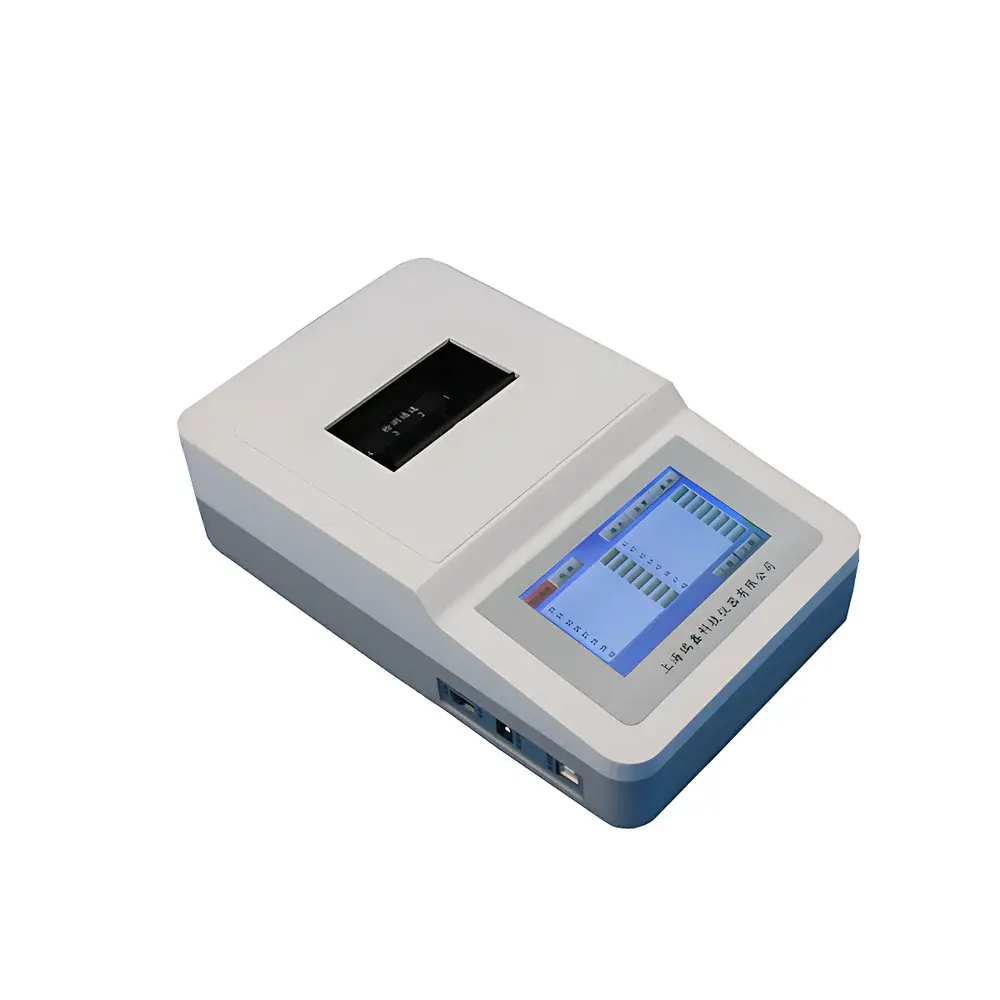
Ruixin SZ-ZD2 Portable Turbidity Analyzer
| Brand | Ruixin |
|---|---|
| Origin | Shanghai, China |
| Manufacturer Type | Authorized Distributor |
| Country of Manufacture | China |
| Model | SZ-ZD2 |
| Price Range | USD 4,200 – 7,000 |
| Function Type | Single-parameter Analyzer (Turbidity Only) |
| Sample Throughput | Single-sample mode |
| Wavelength Range | 380–630 nm |
| Measurement Time | ≤ 180 seconds |
| Repeatability | ≤ 0.2% (Transmittance) |
| Detection Channels | 1 |
| Absorbance Range | 0.000–4.000 AU |
| Transmittance Range | 0.00–100.00% |
| Transmittance Resolution | 0.01% |
| Absorbance Resolution | 0.001 AU |
| Photometric Accuracy (Transmittance) | ±2.0% |
| Stability (3-min drift) | ≤0.3% |
| Turbidity Measurement Range | 0.5–60.0 NTU |
| Communication Interfaces | RS-232, USB |
| Power Options | AC 220 V / DC 5 V / Rechargeable Li-ion Battery |
| Display | 4.5-inch high-resolution color TFT touchscreen with full Chinese GUI |
Overview
The Ruixin SZ-ZD2 Portable Turbidity Analyzer is a field-deployable, single-parameter photometric instrument engineered for rapid, reliable turbidity quantification in drinking water, source water, and process water applications. It operates on the principle of nephelometry—measuring the intensity of light scattered at 90° by suspended particles in aqueous samples—calibrated against Formazin Standard (FTU/NTU scale) per ISO 7027-1:2016 and EPA Method 180.1. Designed for compliance-driven environments including municipal water utilities, food & beverage production facilities, and third-party testing laboratories, the SZ-ZD2 delivers traceable, repeatable results without requiring optical alignment or warm-up time. Its compact aluminum housing meets IP65-rated ingress protection for dust and water resistance, enabling consistent performance in humid field conditions or controlled lab settings.
Key Features
- 4.5-inch high-brightness color TFT touchscreen with intuitive Chinese-language interface and stylus/touch-keyboard input support for direct annotation of sample IDs, operator names, and location metadata
- Integrated thermal printer for immediate hard-copy reporting—supports timestamped, GLP-compliant printouts with measured NTU value, calibration status, and instrument ID
- Dual power architecture: operable via AC mains (220 V), external DC 5 V supply, or internal rechargeable lithium-ion battery (≥8 hours continuous operation)
- Preloaded calibration curves optimized for low-, mid-, and high-range turbidity standards (0.5–60.0 NTU), eliminating manual curve fitting during routine use
- Onboard data management system stores ≥500 test records with automatic time/date stamping, searchable by sample ID or measurement date
- RS-232 and USB 2.0 interfaces enable bidirectional communication with LIMS, SCADA systems, or PC-based QA/QC software—supports ASCII protocol for seamless integration
Sample Compatibility & Compliance
The SZ-ZD2 is validated for use with clear to moderately turbid aqueous matrices, including potable water, groundwater, surface water, and rinse water from food processing lines. It complies with key regulatory frameworks governing food safety and water quality: ISO 7027-1:2016 (nephelometric turbidity measurement), GB/T 5750.4–2023 (Chinese standard method for drinking water analysis), and FDA Guidance for Industry: Control of Nitrate and Nitrite in Bottled Water (where turbidity serves as a surrogate indicator for particulate load affecting disinfection efficacy). While not intended for highly colored or viscous samples (e.g., fruit juice concentrates or dairy effluents), its 380–630 nm broadband LED source minimizes interferences from natural organic matter absorbance compared to fixed-wavelength 860 nm systems.
Software & Data Management
The embedded firmware supports audit-ready data handling: all measurements are automatically logged with instrument serial number, calibration timestamp, user ID (if configured), and environmental temperature (via integrated sensor). Data export via USB mass-storage mode generates CSV files compatible with Excel, JMP, or Minitab for statistical process control (SPC) analysis. The RS-232 interface supports Modbus RTU protocol for remote monitoring in centralized water quality dashboards. Although the device does not implement full 21 CFR Part 11 electronic signature controls, its immutable record structure—including write-once memory allocation and absence of editable fields—aligns with GLP documentation requirements for non-GMP food safety screening.
Applications
- Routine verification of filtration efficiency in municipal water treatment plants prior to chlorination
- Pre-shipment quality checks of bottled water and carbonated beverages per Codex Alimentarius Standard CXS 222–2001
- Monitoring clarity of CIP (clean-in-place) rinse water in dairy and meat processing facilities
- Field validation of point-of-use (POU) filter integrity in foodservice establishments
- Educational use in university environmental science labs for teaching photometric principles and water quality assessment protocols
FAQ
Does the SZ-ZD2 require annual factory recalibration?
No—its solid-state LED light source and calibrated photodiode detector provide stable photometric output over ≥2 years under normal use; however, daily verification with primary Formazin standards (0.1, 10, and 40 NTU) is recommended per ISO 7027-1.
Can the instrument store custom calibration curves?
No—the firmware includes only factory-loaded curves aligned to Formazin-equivalent NTU values; user-defined curve entry is disabled to maintain metrological traceability.
Is the thermal printer compatible with label stock?
It accepts standard 57 mm wide thermal paper rolls only; adhesive-backed labels are not supported due to thermal head clearance constraints.
What is the minimum sample volume required per test?
15 mL of well-mixed, particle-free sample is required to fill the standardized 10 mm pathlength cuvette; no dilution is needed within the 0.5–60.0 NTU range.
Does the device meet CE or UKCA marking requirements?
It carries CCC (China Compulsory Certification) and RoHS compliance marks; CE/UKCA certification is not held, as the unit is designed and tested to GB standards for domestic and export markets where formal EU conformity is not mandated.





