
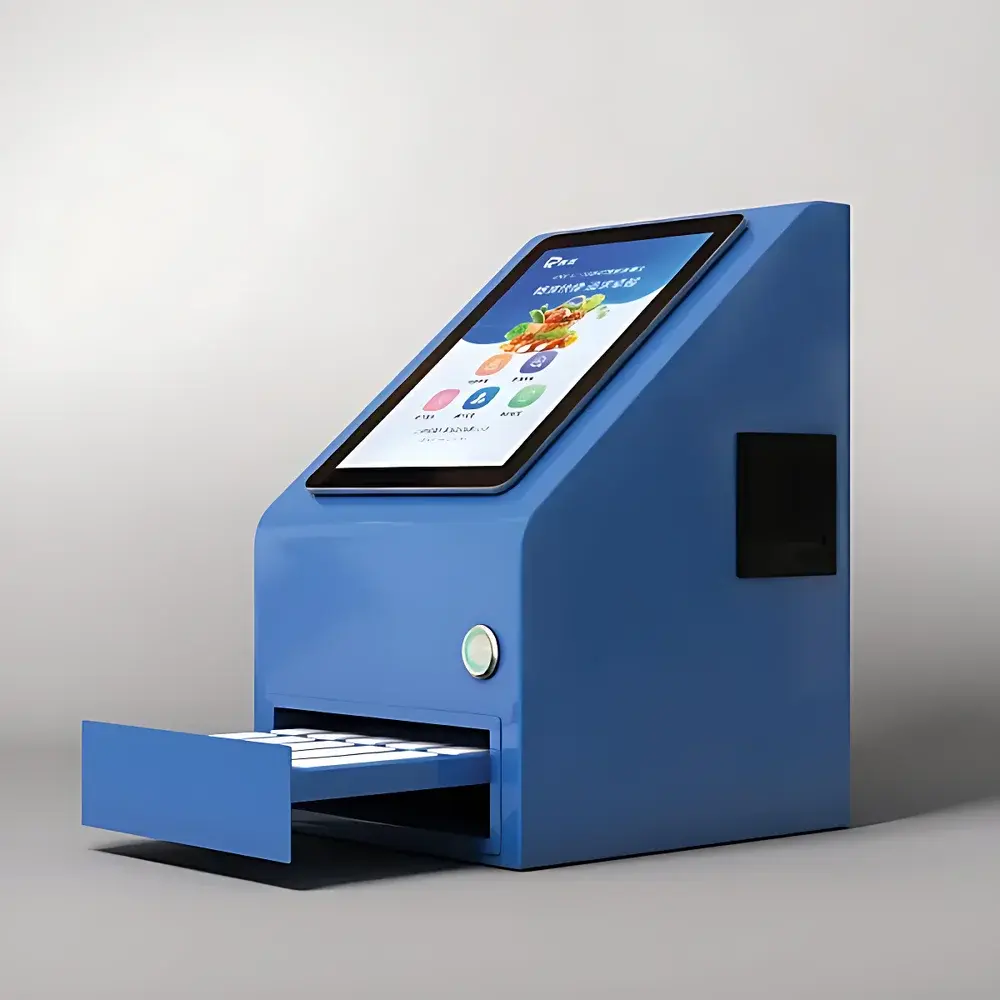
Ruixin JT-108NY Immuno-Colloidal Gold Pesticide Residue Analyzer
| Brand | Ruixin |
|---|---|
| Origin | Shanghai, China |
| Manufacturer Type | Authorized Distributor |
| Region of Manufacture | Domestic (China) |
| Model | JT-108NY |
| Detection Method | Colloidal Gold Immunochromatography with Spectrophotometric Quantification |
| Measurement Range | 0–100% relative signal intensity |
| Number of Channels | 10 |
| Measurement Error | <10% CV (at mid-range concentration) |
| Limit of Detection (LOD) | 0.2 ppm (matrix-dependent, typical for organophosphates and carbamates) |
| Measurement Speed | <1 s per test strip |
| Precision | Intra-assay CV <1% (standard reference strips), Inter-assay CV <3% |
| Output Parameters | Colorimetric intensity, C/T ratio, Test line (T) signal, Control line (C) signal |
| Power Supply | AC 220 V ±10%, 50 Hz (optional integrated Li-ion battery) |
| Connectivity | Wi-Fi (IEEE 802.11 b/g/n), RJ45 Ethernet, USB 2.0, optional 4G/LTE module |
| Display | 10.1-inch capacitive touchscreen, Android OS |
| Data Storage | Internal eMMC + microSD slot (up to 512 GB), >1 million records |
| Compliance | Designed to support traceability requirements aligned with China’s *Pilot Program for Edible Agricultural Product Qualification Certificate* (2020), QR code generation compliant with GB/T 38137–2019 (Traceability Code for Agricultural Products) |
Overview
The Ruixin JT-108NY Immuno-Colloidal Gold Pesticide Residue Analyzer is a dedicated rapid screening instrument engineered for quantitative interpretation of lateral flow immunoassays (LFIA) based on colloidal gold-labeled antibodies. It operates on the principle of competitive or sandwich immunochromatography, where analyte-specific binding events modulate the optical density of test (T) and control (C) lines on disposable nitrocellulose strips. Unlike subjective visual assessment, the JT-108NY employs a high-resolution CCD imaging sensor coupled with calibrated spectrophotometric algorithms to convert reflectance values into standardized C/T ratios—enabling objective, repeatable quantification across diverse pesticide classes. Its design targets field-deployable use in agricultural cooperatives, food safety inspection stations, wholesale markets, and QC laboratories where regulatory-grade screening (e.g., pre-harvest surveillance, post-harvest verification, or supplier qualification) must be performed without reliance on centralized ELISA or LC-MS/MS infrastructure.
Key Features
- 10-channel parallel detection architecture enables simultaneous analysis of up to ten independent lateral flow strips—maximizing throughput without cross-contamination or mechanical carryover.
- Automated strip recognition system distinguishes valid assay cards from expired, damaged, or non-compatible formats using optical pattern matching; no manual calibration or barcode scanning required.
- 10.1-inch industrial-grade Android touchscreen interface supports intuitive workflow navigation, multilingual UI (English, Chinese, Spanish), and embedded instructional video playback for operator onboarding.
- Integrated dual-mode thermal printer (wide-format adhesive label + standard thermal paper) generates compliance-ready qualification certificates containing GS1-compliant traceability QR codes per GB/T 38137–2019.
- Real-time cloud synchronization via Wi-Fi, Ethernet, or optional LTE module ensures encrypted transmission of raw image data, C/T ratios, metadata (sample ID, operator, location, timestamp), and certificate PDFs to configurable SaaS platforms.
- Modular firmware architecture allows over-the-air (OTA) updates for new assay validation profiles, algorithm refinements, and regulatory template revisions—maintaining long-term method adaptability.
Sample Compatibility & Compliance
The JT-108NY is validated for qualitative and semi-quantitative detection of over 40 pesticide residues—including organophosphates (e.g., chlorpyrifos, omethoate), carbamates (carbofuran, methomyl), fungicides (procymidone, thiophanate-methyl), pyrethroids (cypermethrin, deltamethrin), and plant growth regulators (forchlorfenuron, 6-benzylaminopurine)—in homogenized extracts from vegetables, fruits, grains, and herbs. Sample preparation follows AOAC Official Method 2007.01 or GB/T 5009.199–2003 protocols, with extract clarification via centrifugation or filtration. While not a confirmatory technique per ISO/IEC 17025, the system meets performance criteria outlined in China’s *Technical Specification for Rapid Screening of Pesticide Residues in Vegetables and Fruits* (NY/T 448–2021) for screening-level decision-making. All data logs include immutable audit trails (operator ID, GPS coordinates, device serial number, firmware version) supporting GLP-aligned documentation practices.
Software & Data Management
The embedded Android application provides local data management with AES-256 encryption at rest. Each test record stores original CCD images (12-bit depth, 1920×1080 resolution), processed C/T values, pass/fail thresholds, and user-annotated metadata. Export options include CSV (for statistical analysis in JMP or Minitab), PDF (certificate + image), and XML (for integration with LIMS via RESTful API). Cloud connectivity enables role-based access control, automated report generation (daily summary, batch compliance dashboard), and third-party interoperability through HL7 or ASTM E1384-compliant message structures. Audit log entries comply with ALCOA+ principles (Attributable, Legible, Contemporaneous, Original, Accurate, Complete, Consistent, Enduring, Available) for regulatory review.
Applications
- Pre-market screening of produce at origin collection points to reduce rejection rates at distribution hubs.
- On-site verification of Good Agricultural Practice (GAP) compliance during farm audits.
- Supplier qualification testing for contract manufacturing organizations (CMOs) handling organic-certified ingredients.
- Regulatory surveillance by municipal food safety bureaus conducting routine market inspections.
- Internal QC for food processors validating raw material acceptance criteria prior to blending or processing.
- Educational deployment in agricultural extension centers training farmers on residue risk mitigation strategies.
FAQ
Does the JT-108NY require external calibration standards for each pesticide?
No. The instrument uses factory-calibrated reference curves derived from certified reference materials (CRMs) for each supported analyte. Field recalibration is not required unless firmware updates introduce new assay models.
Can third-party lateral flow strips be used with this analyzer?
Only strips validated and registered in the device’s assay library are supported. Non-certified strips may yield unreliable C/T ratios due to variations in membrane composition, conjugate pad loading, or line geometry.
Is the cloud platform compatible with EU GDPR or US FDA 21 CFR Part 11 requirements?
The base configuration supports data encryption, user authentication, and electronic signature capture. Full Part 11 compliance requires deployment on a validated private cloud instance with documented SOPs and change control procedures.
What is the operational temperature range for field use?
The device is rated for ambient operation between 5 °C and 40 °C with ≤80% non-condensing humidity—suitable for mobile labs, roadside checkpoints, and greenhouse environments.
How is measurement uncertainty estimated for reported results?
Uncertainty is propagated from three sources: CCD sensor noise (±0.5% OD), inter-strip variability (≤3% CV), and reference curve interpolation error (±1.2% relative). Combined expanded uncertainty (k=2) is stated as ≤5.8% for mid-range concentrations.






