
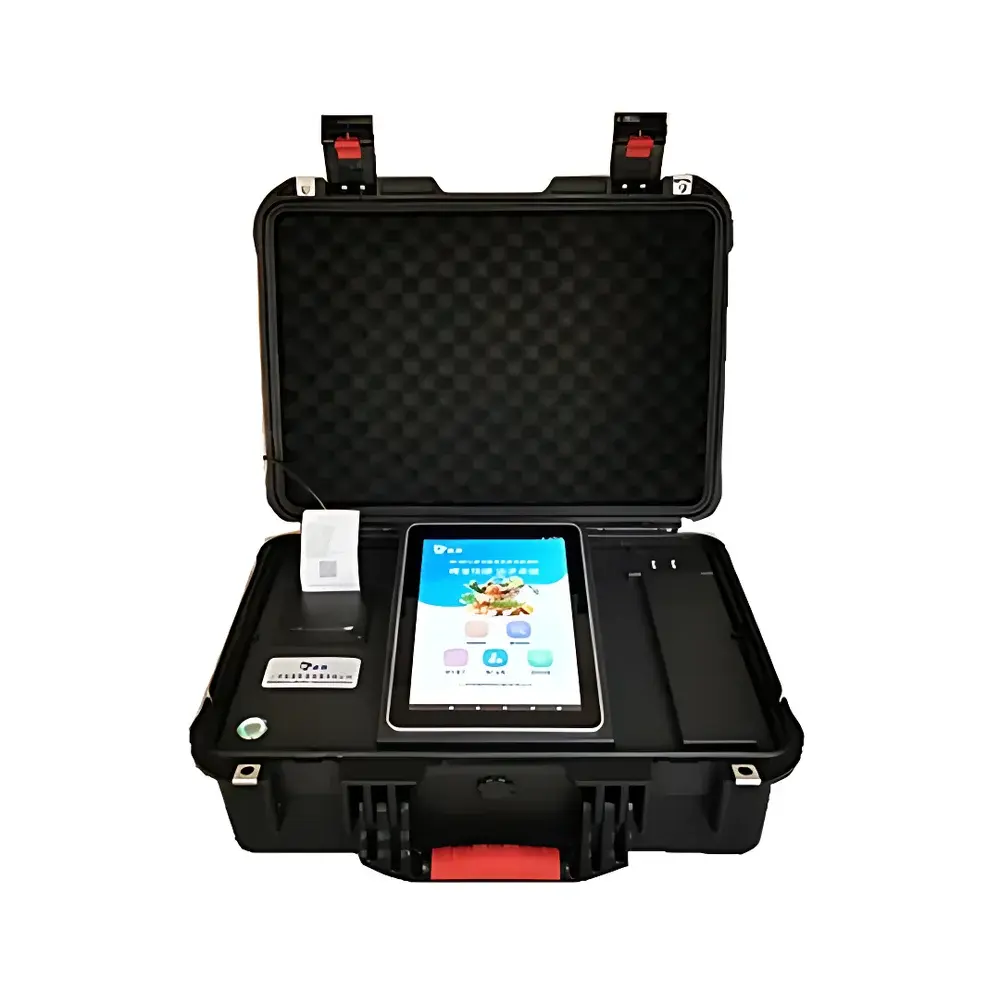
Ruixin CNY-1217D Integrated Pesticide Residue Rapid Tester & Edible Agricultural Product Compliance Certificate Printer
| Brand | Ruixin |
|---|---|
| Origin | Shanghai, China |
| Manufacturer Type | Authorized Distributor |
| Region of Manufacture | Domestic (China) |
| Model | CNY-1217D |
| Detection Method | Spectrophotometric Colloidal Gold Immunoassay |
| Measurement Range | 0–100% inhibition |
| Number of Detection Channels | 12 |
| Measurement Error | <10% |
| Limit of Detection (LOD) | 0.2 ppm |
| Display | 10.1-inch color capacitive touchscreen |
| Operating System | Android |
| Data Storage | Internal + microSD expansion (up to 200,000 records) |
| Connectivity | Wi-Fi, optional 3G/4G/5G, GPS/AGPS interface |
| Printing | Thermal label printer (compliant with MOA’s “Edible Agricultural Products Certificate Management Measures”) |
| Optical Performance | Absorbance range 0.000–4.000 A |
| Power Supply | 220 V ±10% |
Overview
The Ruixin CNY-1217D is an integrated field-deployable instrument engineered for rapid, on-site quantitative and semi-quantitative immunoassay-based detection of organophosphorus and carbamate pesticide residues in fresh produce, leafy vegetables, fruits, and other edible agricultural commodities. It operates on the principle of colloidal gold immunochromatographic assay coupled with reflectance spectrophotometry — measuring inhibition of antigen–antibody binding at test lines via optical density (OD) quantification in the visible spectrum (typically 520–650 nm). The system delivers results within 10–15 minutes per batch, supporting high-throughput screening in farm gate, wholesale market, supermarket QA labs, and regulatory inspection units. Its architecture conforms to the functional requirements stipulated in the Ministry of Agriculture and Rural Affairs (MARA) of China’s “Measures for the Administration of Edible Agricultural Product Compliance Certificates” (No. 19 [2020]), enabling automatic generation, digital signing, and thermal printing of traceability-compliant certificates embedded with dynamic QR codes.
Key Features
- 12-channel parallel detection module enabling simultaneous analysis of up to 12 samples without cross-contamination or reagent carryover.
- 10.1-inch high-resolution capacitive touchscreen running a customized Android OS interface with full Chinese language support, intuitive icon-driven workflow navigation, and context-sensitive operation prompts.
- Integrated thermal label printer producing adhesive-backed compliance certificates meeting MARA-specified dimensions, layout, mandatory fields (e.g., producer name, product type, harvest date, self-declaration statement), and QR code encoding standards.
- On-device data security framework including role-based user authentication, biometric or ID card–based identity verification (Type B contactless RFID reader compatible with PRC Resident ID, HK/Macao/TP passports, and foreign passports), session logging, and encrypted local storage.
- Embedded GPS/AGPS receiver and dual-mode wireless connectivity (Wi-Fi + optional LTE/5G module) enabling real-time upload of test results, certificate metadata, and geotagged audit trails to centralized food safety monitoring platforms.
- Self-diagnostic firmware with guided troubleshooting trees and on-device video tutorials accessible offline — reducing dependency on external technical support during field deployment.
- Expandable memory architecture: internal eMMC plus microSD slot supporting ≥200,000 test records with timestamp, operator ID, sample ID, raw OD values, inhibition %, pass/fail status, and certificate print log.
Sample Compatibility & Compliance
The CNY-1217D is validated for use with homogenized extracts from common matrixes including cabbage, spinach, cucumber, tomato, apple, and citrus. Sample preparation follows standardized protocols aligned with GB/T 5009.199–2003 and NY/T 448–2001. While primarily designed for pesticide residue screening, its modular hardware architecture permits future firmware-enabled expansion to veterinary drug residues (e.g., chloramphenicol, nitrofurans) and antibiotic residues in eggs and aquaculture products — subject to method validation per ISO/IEC 17025 requirements. All printed certificates comply with MARA Notice No. 19 (2020) and support interoperability with provincial-level agricultural traceability systems (e.g., Zhejiang “Zhejiang Farm Trace”, Sichuan “Sichuan Agri-Trace”). The device itself meets GB/T 18268.1–2010 (EMC for laboratory equipment) and GB 4793.1–2007 (safety requirements for electrical equipment).
Software & Data Management
The embedded Android application provides a unified dashboard for test execution, certificate issuance, batch reporting, and data export. Raw spectral data (absorbance/transmittance), calculated inhibition rates, and pass/fail determinations are stored with immutable timestamps and operator identifiers. Data export supports CSV and PDF formats, with optional encryption (AES-256) for secure transmission. Cloud synchronization employs TLS 1.2+ secured HTTPS endpoints. Audit trail functionality satisfies GLP-aligned record-keeping needs, capturing all user actions including login/logout events, parameter modifications, certificate voiding, and firmware updates. Integration with third-party LIMS or ERP systems is achievable via RESTful API (available under OEM licensing agreement).
Applications
- Pre-harvest and post-harvest quality assurance at cooperative farms and agri-tech service centers.
- Routine screening at wholesale markets (e.g., Beijing Xinfadi, Guangzhou Jiangnan) to enforce mandatory vendor-level residue declarations.
- Regulatory inspections by county-level agricultural administrative departments conducting random sampling under MARA’s “Green Shield” campaign.
- Supermarket QA laboratories performing incoming goods verification prior to shelf placement.
- Training and capacity-building programs for rural extension agents and farmer associations under national food safety literacy initiatives.
FAQ
What detection principle does the CNY-1217D employ?
It uses colloidal gold immunochromatography combined with reflectance spectrophotometry to quantify competitive inhibition between analyte and immobilized antibody.
Is the instrument suitable for regulatory enforcement testing?
It is intended for rapid screening and compliance documentation; confirmatory analysis requires GC-MS or LC-MS/MS per GB 23200 series standards.
Can test data be exported to national food safety platforms?
Yes — via configurable API or manual CSV upload; pre-certified integration exists with several provincial traceability systems.
Does the device meet international electromagnetic compatibility standards?
It complies with GB/T 18268.1–2010, which aligns with IEC 61326-1:2012 for industrial environments.
What is the calibration frequency recommendation?
Factory calibration is performed prior to shipment; users should verify photometric performance using certified neutral density filters every 3 months or after physical impact.






