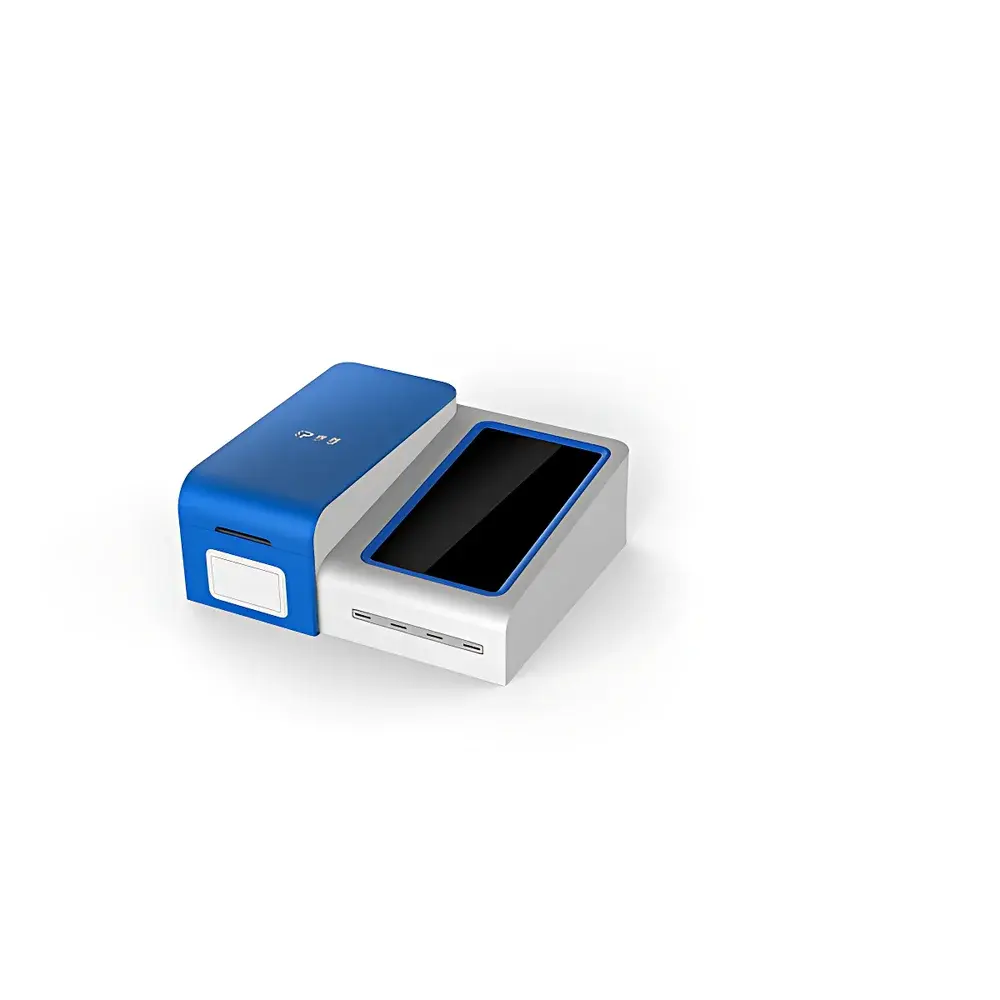
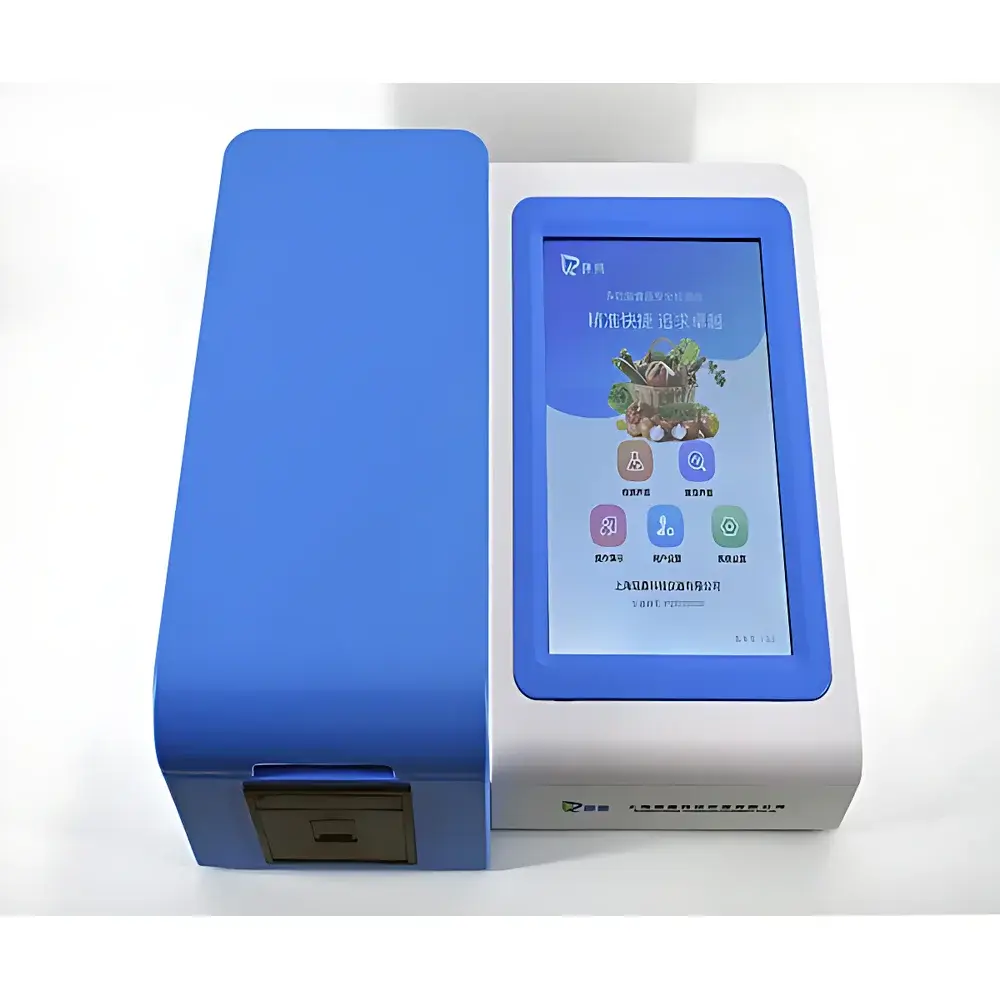
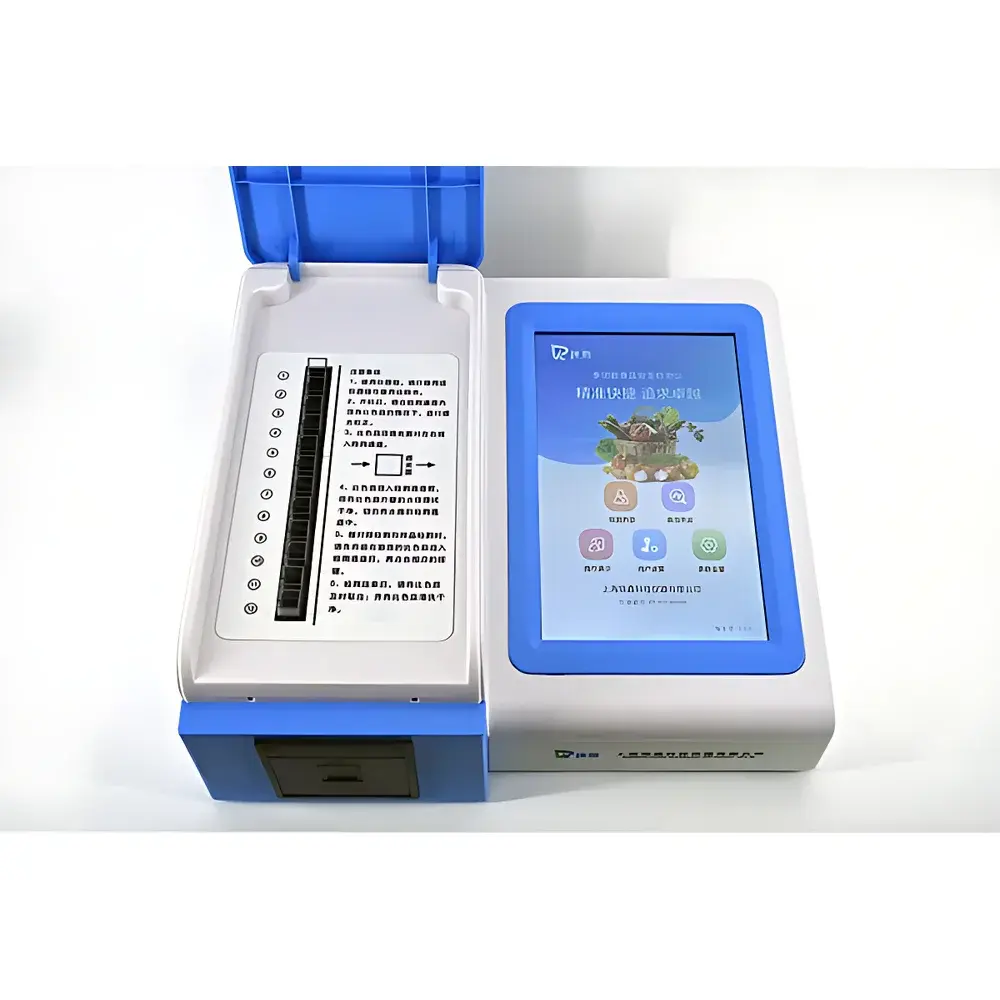
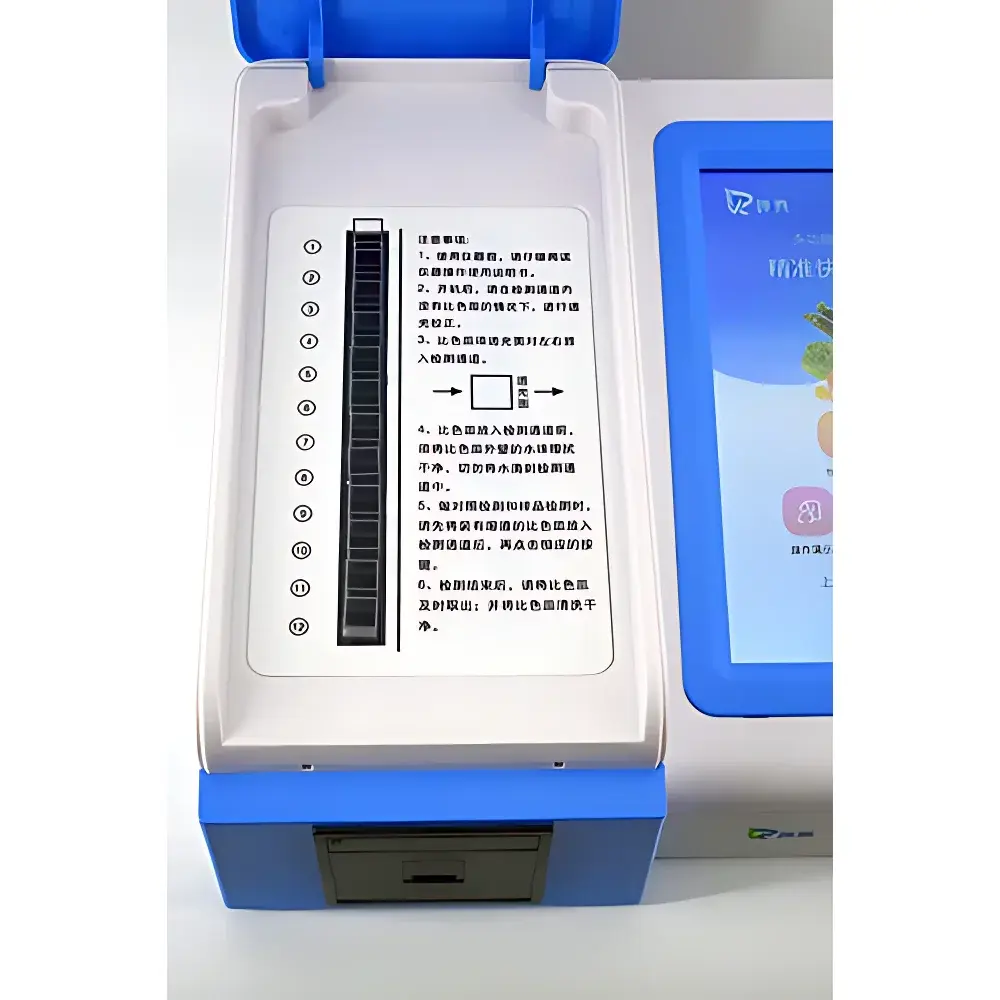
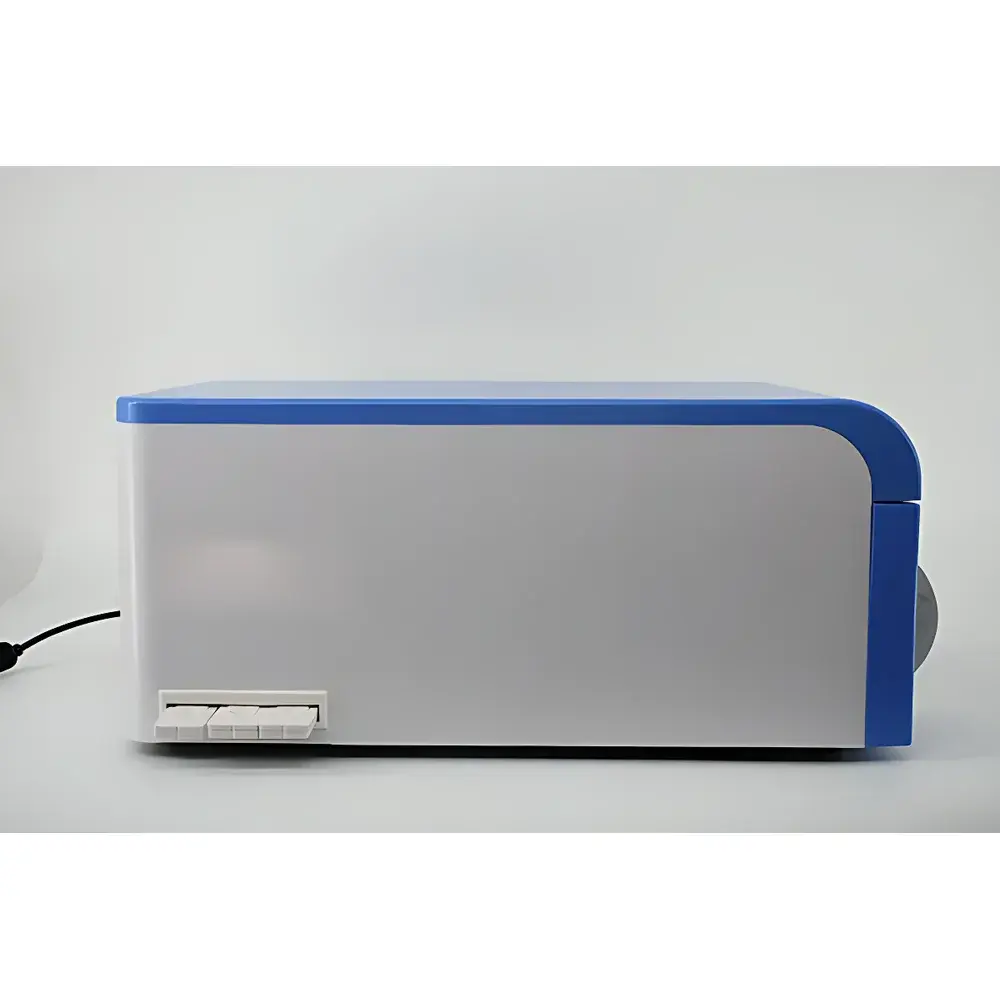
Ruixin CNY-2418D Multi-Mode Pesticide Residue Rapid Analyzer
| Brand | Ruixin |
|---|---|
| Origin | Shanghai, China |
| Manufacturer Type | Authorized Distributor |
| Product Category | Domestic |
| Model | CNY-2418D |
| Price | USD 5,300 (FOB Shanghai) |
| Detection Method | Spectrophotometric + Colloidal Gold Immunochromatographic Assay |
| Measurement Range | 0–100% inhibition rate |
| Number of Channels | 24 spectrophotometric + 3 colloidal gold (expandable to 10) |
| Measurement Error | <10% |
| Limit of Detection (LOD) | 0.2 ppm (for representative analytes e.g., chlorpyrifos, carbaryl, cypermethrin) |
| Display | 10.1-inch capacitive touchscreen (1024 × 600), IP65-rated front panel, 400 cd/m² brightness |
| OS | Android 7.0, Quad-core 1.8 GHz CPU, 2 GB RAM, 16 GB internal storage |
| Optical Performance | Absorbance range 0.000–4.000 A, resolution 0.001 A |
| Connectivity | Dual USB 2.0, Wi-Fi 802.11 b/g/n, RJ45 Ethernet, optional 4G LTE module |
| Power Supply | 220 V ±10%, 50/60 Hz |
| Built-in Thermal Printer | Adhesive-label compliance certificate printing + thermal report printing + A4 export capability |
| Database | Preloaded national standard sample library (>1,000 entries) |
| Data Management | Cloud synchronization, GLP-compliant audit trail, CSV/PDF export, remote firmware update |
Overview
The Ruixin CNY-2418D Multi-Mode Pesticide Residue Rapid Analyzer is an integrated, dual-principle analytical platform engineered for field-deployable and laboratory-grade screening of pesticide residues in agricultural commodities. It combines standardized spectrophotometric quantification—based on acetylcholinesterase (AChE) inhibition kinetics—with lateral-flow colloidal gold immunochromatography (LFIA), enabling simultaneous detection of organophosphates, carbamates, pyrethroids, herbicides, fungicides, and other agrochemical classes in a single instrument. Designed to meet the operational requirements of municipal food safety supervision centers, county-level agricultural inspection stations, wholesale market laboratories, and farm-to-market traceability systems, the CNY-2418D delivers quantitative and semi-quantitative results within 10–15 minutes per batch. Its architecture aligns with ISO/IEC 17025 pre-screening guidance and supports regulatory workflows compliant with China’s GB 2763–2021 maximum residue limits (MRLs), as well as harmonized principles referenced in Codex Alimentarius CXS 276–2019.
Key Features
- Dual-detection modality: 24-channel high-stability LED-based spectrophotometer (610 nm primary wavelength) + 3 independent colloidal gold strip readers (expandable to 10), each with calibrated optical sensors and auto-alignment mechanics.
- Industrial-grade human-machine interface: 10.1-inch capacitive touchscreen (1024 × 600 resolution), IP65-rated front bezel, 400 cd/m² luminance, and integrated stylus support—including cryptographic hand-signature capture for GLP documentation integrity.
- Embedded Android 7.0 operating system (Quad-core 1.8 GHz ARM Cortex-A53, 2 GB DDR3 RAM, 16 GB eMMC storage) ensures deterministic response latency and long-term firmware stability under continuous multi-user operation.
- Onboard thermal printer supports three output formats: self-adhesive “Qualified Certificate” labels (per MOA Notice No. 13 [2023]), thermal strip reports with QR-coded traceability links, and A4 PDF exports via USB or network.
- Preloaded reference database containing >1,000 agricultural samples mapped to Chinese national standards (GB/T 5009.x, NY/T 448, NY/T 761), enabling context-aware parameter auto-selection and intelligent interference flagging.
- Multi-protocol connectivity stack: IEEE 802.11n Wi-Fi, 10/100 Mbps Ethernet (RJ45), Bluetooth 4.2, plus optional LTE Cat-4 module (with GPS geotagging) for real-time cloud upload to Ruixin Cloud or third-party LIMS via HTTPS RESTful API.
Sample Compatibility & Compliance
The CNY-2418D is validated for homogenized extracts from fresh produce (leafy vegetables, fruits, tea leaves), cereal grains (rice, wheat, corn), and dried botanicals. Sample preparation follows AOAC Official Method 2007.01–derived protocols: acetone/water extraction, centrifugation (≥3,000 × g), and supernatant dilution per matrix-specific calibration curves. The instrument meets electromagnetic compatibility (EMC) requirements per GB/T 18268.1–2010 and electrical safety standards per GB 4793.1–2007. Its data handling architecture supports audit-trail generation per FDA 21 CFR Part 11 principles (user authentication, electronic signature, immutable log timestamps), and raw measurement logs are exportable in ISO/IEC 11172-3-compliant CSV format for external validation.
Software & Data Management
Firmware v3.2.1 includes embedded data governance tools: role-based user accounts (admin/operator/auditor), time-stamped test history with operator ID linkage, automatic cloud backup (encrypted AES-256), and configurable retention policies (default 18 months). Reports embed digital signatures verifiable against Ruixin’s public key infrastructure (PKI). Integration with national food safety monitoring platforms (e.g., China Food Safety Traceability System) is achieved via XML schema mapping and OAuth 2.0 token exchange. Statistical modules generate batch-wise inhibition rate distributions, MRL exceedance alerts, and temporal trend dashboards—exportable as PNG, Excel, or PDF.
Applications
- Routine surveillance at entry points of agricultural wholesale markets (e.g., Beijing Xinfadi, Guangzhou Jiangnan)
- On-farm verification prior to harvest certification and electronic合格证 (compliance certificate) issuance
- Mobile food safety patrols using vehicle-mounted power adapters and 4G-enabled real-time reporting
- Training and capacity building in rural extension centers—leveraging built-in video tutorials (MP4/H.264) and voice-guided workflows
- Reference screening in provincial CDC laboratories supporting GB 2763 compliance verification prior to GC-MS/MS confirmatory analysis
FAQ
What regulatory standards does the CNY-2418D support for method validation?
It adheres to GB/T 5009.199–2003 (spectrophotometric AChE inhibition) and GB/T 27404–2008 (validation of rapid screening methods), with documented recovery rates (70–110%) and intra-laboratory reproducibility (RSD ≤8%) across 22 representative pesticides.
Can the colloidal gold module quantify analyte concentration, or is it qualitative only?
The 3-channel LFIA reader provides semi-quantitative results via reflectance densitometry (630 nm), calibrated against WHO-recommended reference strips; quantitative confirmation requires GC-MS/MS or LC-MS/MS per GB 23200 series.
Is remote software update supported without physical access?
Yes—over-the-air (OTA) updates are delivered via HTTPS through Ruixin Cloud, requiring administrator approval and SHA-256 signature verification before installation.
How is data integrity ensured during cloud transmission?
All payloads are encrypted end-to-end using TLS 1.2+ with mutual certificate authentication; local storage employs full-disk encryption (FDE) compliant with GB/T 25069–2010.
Does the instrument require annual recalibration by authorized service personnel?
Optical channels are factory-calibrated with NIST-traceable neutral density filters; users perform daily blank verification—no scheduled recalibration is mandated unless mechanical impact or environmental exposure exceeds IP65 operational limits.