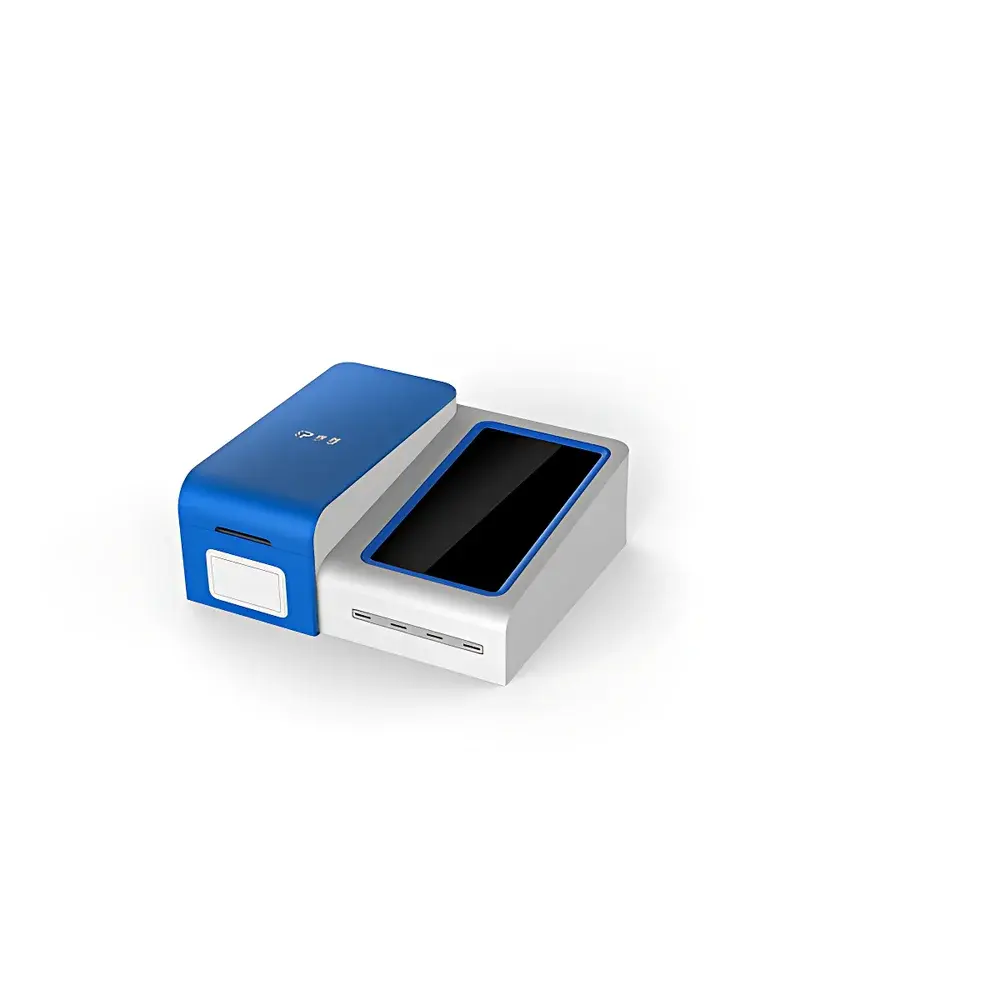
Ruixin CNY-1218CY Tea Safety Rapid Detection Analyzer
| Brand | Ruixin |
|---|---|
| Origin | Shanghai, China |
| Manufacturer Type | Authorized Distributor |
| Country of Origin | China |
| Model | CNY-1218CY |
| Function Type | Multi-analyte (Pesticide Residue Screening) |
| Sample Type | Single-sample dedicated platform |
| Wavelength Range | 380–680 nm |
| Detection Time | ≤3 min per sample |
| Photometric Repeatability | ≤0.2% (T) |
| Optical Channels | 12 colorimetric + 3 colloidal gold lateral flow channels |
| Absorbance Range | 0.000–4.000 A |
| Transmittance Range | 0.00–100.00% T |
| Transmittance Resolution | 0.01% T |
| Absorbance Resolution | 0.001 A |
| Photometric Accuracy | ±2.0% T |
| Dark Current Drift | ≤0.2% over 3 min |
| Measurement Accuracy | ±5% (vs. reference standards) |
| Display | 10.1″ capacitive touch LCD (1024×600), IP65-rated front panel, 400 cd/m² brightness |
| OS | Android 7.0, Quad-core 1.8 GHz CPU, 2 GB RAM, 16 GB internal storage |
| Connectivity | Dual-band Wi-Fi, RJ45 Ethernet, Bluetooth 4.2, optional 3G/4G/5G module |
| Integrated Thermal Printer | Label & A4 report output |
| Power Supply | AC 220 V ±10%, 50 Hz |
Overview
The Ruixin CNY-1218CY Tea Safety Rapid Detection Analyzer is a dual-mode, field-deployable instrument engineered for regulatory-compliant screening of pesticide residues in tea matrices. It integrates two orthogonal detection principles—visible-range spectrophotometry (380–680 nm) and immunochromatographic colloidal gold lateral flow assay—into a single compact platform. The spectrophotometric module operates on Beer–Lambert law-based quantification of enzymatic inhibition (e.g., acetylcholinesterase for organophosphates and carbamates) or chromogenic reactions (e.g., diazotization for nitroaromatics), while the colloidal gold module enables qualitative/semi-quantitative detection of target analytes via antigen–antibody binding on nitrocellulose membranes. Designed specifically for tea producers, quality control laboratories, and agricultural inspection agencies, the system delivers results within three minutes per sample without requiring solvent extraction, derivatization, or laboratory-grade infrastructure.
Key Features
- Dual-detection architecture: 12-channel visible-light photometer + 3-channel colloidal gold reader—enabling simultaneous screening of multiple pesticide classes in one run.
- 10.1-inch industrial-grade capacitive touchscreen (IP65 front panel) with glove-compatible operation, handwriting input support, and digital signature capture for audit-ready documentation.
- Embedded thermal printer compliant with Chinese Agricultural Standard NY/T 761–2008 for on-site generation of traceable “Qualified Compliance Labels” (adhesive stickers) and full-format A4 reports.
- Android 7.0 operating system (quad-core 1.8 GHz, 2 GB RAM, 16 GB eMMC) optimized for offline operation, local database queries, and firmware updates via USB or network.
- Built-in national reference database of >1,000 agricultural commodities—including varietal tea cultivars (e.g., Longjing, Tieguanyin, Pu’er)—with intelligent auto-matching of sample names and preloaded calibration curves.
- Comprehensive connectivity suite: dual-band Wi-Fi (802.11ac), Gigabit Ethernet (RJ45), Bluetooth 4.2, and modular expansion slots for 3G/4G/5G cellular modems and GNSS positioning modules.
- Real-time cloud synchronization (optional Ruixin Cloud Platform) supporting GLP-aligned data integrity: immutable timestamps, user authentication logs, and revision-controlled audit trails compliant with ISO/IEC 17025:2017 Annex A.2 requirements.
Sample Compatibility & Compliance
The CNY-1218CY is validated for homogenized dried tea leaf extracts prepared according to GB/T 5009.199–2003 (determination of organophosphorus and carbamate pesticides in vegetables and fruits) and modified for Camellia sinensis matrix interference mitigation. It supports detection of 42 priority pesticide residues including chlorpyrifos, carbofuran, imidacloprid, cypermethrin, bifenthrin, azoxystrobin, and DDT metabolites—covering all compound classes regulated under China’s GB 2763–2021 Maximum Residue Limits (MRLs) for tea. Instrument performance meets the repeatability (≤0.2% T), photometric accuracy (±2.0% T), and dark current stability (≤0.2% drift/3 min) criteria specified in JJG 178–2015 (Calibration Regulation for Visible Spectrophotometers). While not intended for definitive confirmation, results are suitable for rapid pass/fail triage aligned with FAO/WHO Codex Alimentarius risk-based screening protocols.
Software & Data Management
The embedded Ruixin SmartLab™ software provides role-based access control (administrator, technician, auditor), encrypted local storage of raw absorbance/transmittance values, and structured export of CSV/Excel files containing sample ID, test date/time, operator ID, channel-specific OD values, calculated inhibition rates, and pass/fail flags. All data entries include cryptographic hash signatures and are time-stamped using NTP-synchronized clocks. Optional cloud integration enables automated upload to centralized dashboards with configurable alert thresholds, statistical process control (SPC) charts, batch-level trend analysis, and interoperability with third-party LIMS via RESTful API (JSON format). Audit logs comply with FDA 21 CFR Part 11 electronic record requirements when deployed with digital certificate authentication.
Applications
- Routine incoming inspection of green tea, oolong, black tea, and pu’er raw materials at processing facilities.
- On-farm verification of pre-harvest pesticide withdrawal intervals prior to plucking.
- Regulatory field inspections by provincial agricultural bureaus during seasonal surveillance programs.
- Quality assurance testing in certified organic tea supply chains to detect unauthorized synthetic inputs.
- Training and capacity building in rural extension centers—leveraging built-in video tutorials and voice-guided workflows.
- Multi-residue screening in decentralized laboratories lacking GC-MS or LC-MS/MS infrastructure.
FAQ
Is the CNY-1218CY suitable for quantitative analysis or only qualitative screening?
It performs semi-quantitative analysis based on inhibition rate calculation and pre-calibrated dose–response curves; results are reported as % inhibition relative to negative controls and compared against established cutoff thresholds per analyte. Absolute concentration quantification requires confirmatory analysis by chromatographic methods.
Can the instrument be calibrated using internationally traceable standards?
Yes—calibration is performed using NIST-traceable neutral density filters (for photometric accuracy) and certified reference materials (CRMs) from CNAS-accredited providers (e.g., AccuStandard, ChemService) for pesticide-spiked tea matrixes.
Does the system support multi-language UI beyond Chinese?
The base firmware supports English and Simplified Chinese; additional language packs (Spanish, Vietnamese, Arabic) are available upon request for export markets.
What maintenance is required for long-term reliability?
Annual optical alignment verification and LED source intensity validation are recommended; no consumable optical components require replacement within the first 5 years under normal usage conditions.
How is data integrity ensured during power interruption or network failure?
All measurements are written to non-volatile flash memory before display; unsynchronized cloud uploads resume automatically upon network restoration without data loss or duplication.