
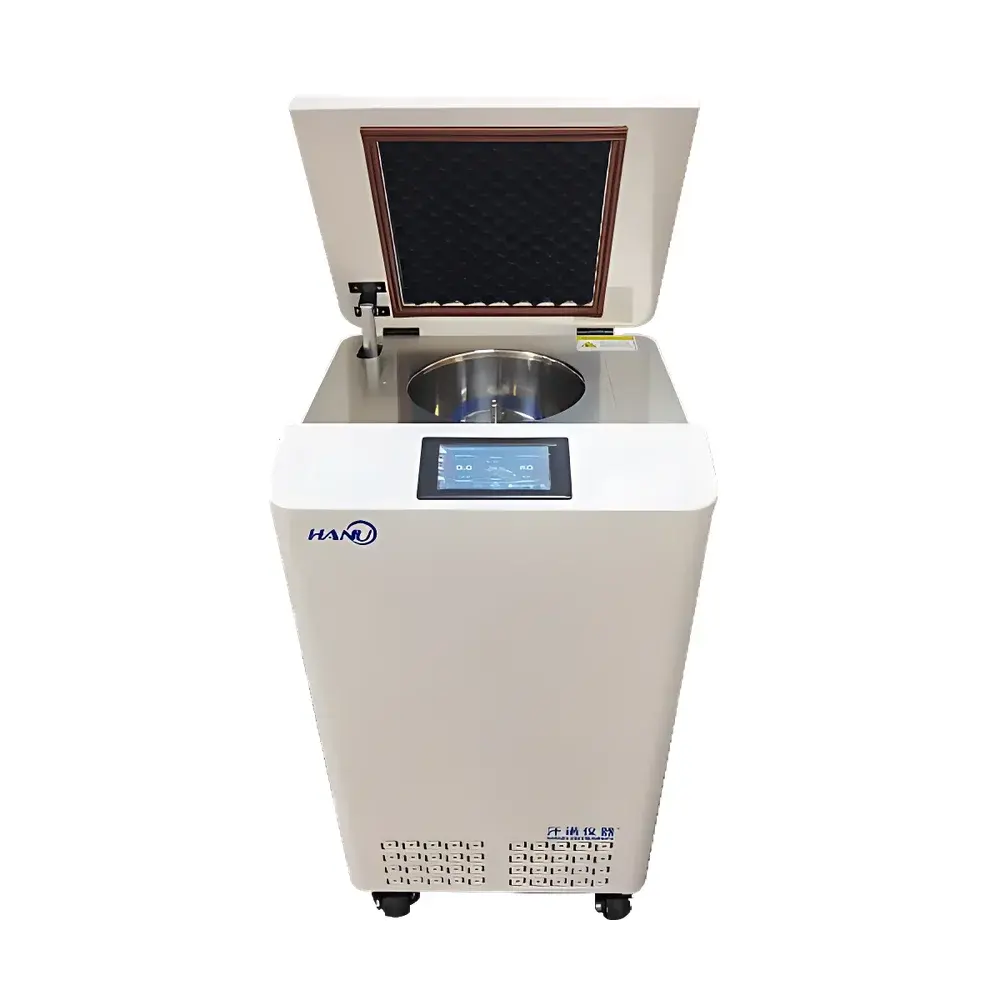
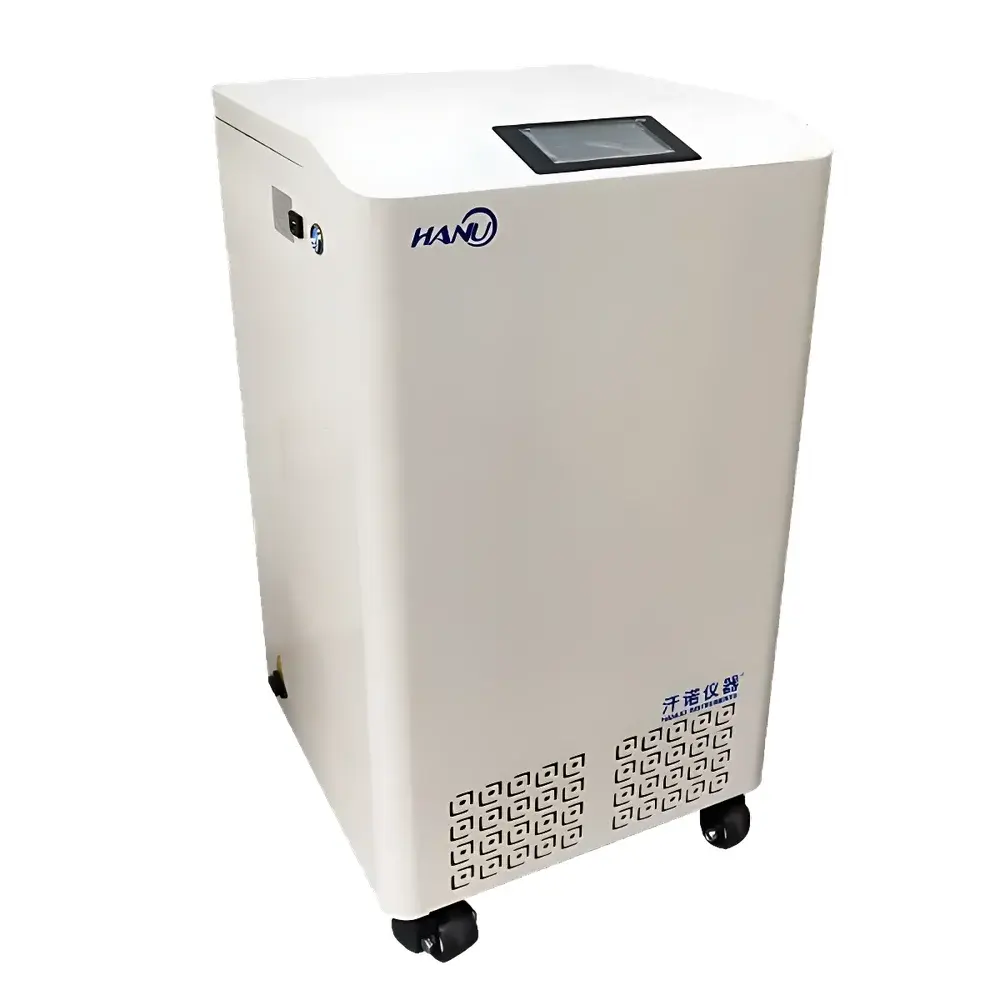
Hanuo Daxluot-48C Cryogenic High-Speed Benchtop Tissue Grinder
| Brand | Hanuo |
|---|---|
| Origin | Shanghai, China |
| Model | Daxluot-48C |
| Throughput | 48 × 2 mL tubes (simultaneous) |
| Temperature Range | –50 °C to +20 °C |
| Frequency Range | 0–70 Hz |
| Processing Time | 0–9999 s |
| Final Particle Size | ~5 µm |
| Compatible Vessel Formats | 48 × 2 mL, 12 × 5 mL, 4 × 10/15/25 mL, 2 × 50 mL |
| Drive Acceleration/Deceleration | ≤2 s |
| Noise Level | <55 dB(A) |
| Safety Features | Lid-interlock shutdown, emergency stop, auto-centering clamping system |
| Display | TFT touch screen with 30 pre-programmed tissue protocols |
| Grinding Modes | Dry, wet, cryogenic |
| Grinding Media | Stainless steel, chrome steel, zirconia, tungsten carbide, quartz sand (0.1–30 mm diameter) |
Overview
The Hanuo Daxluot-48C is a benchtop cryogenic high-speed tissue grinder engineered for reproducible, high-throughput mechanical homogenization of biological samples under precisely controlled low-temperature conditions. It operates on the principle of vertical reciprocating motion—distinct from orbital or horizontal shaking—ensuring uniform energy transfer across all sample positions and eliminating inter-row variability common in arc-motion grinders. This architecture enables simultaneous disruption of up to 48 samples in a single run, with programmable frequency (0–70 Hz), time (0–9999 s), and thermal control (–50 °C to +20 °C). The integrated closed-loop refrigeration system maintains sub-zero temperatures throughout grinding, suppressing enzymatic degradation, minimizing heat-induced nucleic acid fragmentation, and preserving labile metabolites and proteins. Designed for routine use in molecular biology, genomics, proteomics, and pharmacological research labs, the Daxluot-48C meets core operational requirements for GLP-compliant sample preparation workflows where traceability, repeatability, and thermal stability are critical.
Key Features
- Vertical vibration drive mechanism ensures consistent kinetic energy distribution across all 48 positions—no batch-to-batch positional bias.
- Integrated compressor-based cooling system delivers stable cryogenic operation down to –50 °C; temperature is continuously monitored and adjustable in 1 °C increments.
- TFT touchscreen interface with 30 pre-configured tissue-specific protocols (e.g., plant leaf, mammalian liver, yeast pellet) and user-definable parameter sets.
- Auto-centering clamping system with mechanical safety lock prevents tube displacement or lid ejection during high-frequency operation.
- Comprehensive safety architecture: lid-interlocked power cutoff, emergency stop button, real-time motor overload detection, and acoustic noise suppression (<55 dB(A)).
- Modular adapter compatibility supports multiple vessel formats—including 48 × 2 mL microtubes, 12 × 5 mL tubes, and larger 50 mL containers—enabling flexible throughput scaling without hardware modification.
Sample Compatibility & Compliance
The Daxluot-48C accommodates diverse biological matrices requiring mechanical lysis: plant tissues (seeds, stems, leaves), animal organs (liver, muscle, bone, lung), microbial cells (bacteria, yeast, spores), and fibrous or lipid-rich specimens resistant to sonication or enzymatic digestion. Its cryogenic capability is particularly effective for samples with high endogenous nuclease or protease activity, such as pancreatic tissue or root nodules. While not certified to ISO/IEC 17025 or FDA 21 CFR Part 11 out-of-the-box, the instrument’s programmable parameters, audit-ready protocol logging (via optional USB export), and deterministic mechanical action support alignment with internal SOPs for GMP-aligned nucleic acid extraction, biobanking, and QC release testing. All grinding media options—including zirconia and tungsten carbide—are chemically inert and compatible with downstream applications including qPCR, RNA-Seq, and LC-MS.
Software & Data Management
The embedded control firmware records timestamped operational metadata—including setpoint temperature, frequency, duration, and selected protocol ID—for each run. Parameters are stored locally on non-volatile memory and exportable via USB to CSV for integration into LIMS or ELN systems. No cloud connectivity or remote access is implemented, preserving data sovereignty per institutional IT policy. Protocol duplication, versioning, and operator ID tagging are supported through manual entry; while not compliant with 21 CFR Part 11 electronic signature requirements by default, the system permits integration with third-party validation packages for regulated environments requiring audit trails and role-based access control.
Applications
- Routine high-yield genomic DNA and total RNA isolation from field-collected plant tissues with minimal oxidation or degradation.
- Pre-analytical processing of clinical biospecimens (e.g., tumor biopsies, PBMC pellets) prior to NGS library preparation.
- Cell wall disruption of Gram-positive bacteria and fungal spores for intracellular metabolite profiling.
- Homogenization of frozen animal tissues for quantitative proteomics workflows requiring intact phosphopeptides.
- Preparation of uniformly micronized reference materials for method validation in food authenticity or environmental contaminant testing.
FAQ
What is the minimum and maximum sample volume per tube that the Daxluot-48C can process?
The system supports volumes ranging from 50 µL (in 2 mL tubes with spacer inserts) up to 50 mL (using dual-position large-tube adapters); optimal loading is 10–80% tube capacity to ensure efficient bead collision dynamics.
Can the instrument be validated for use in a regulated GMP laboratory?
Yes—though factory calibration certificates are not supplied, the device’s deterministic mechanical design, repeatable thermal control, and parameter logging enable IQ/OQ/PQ execution using internally developed or third-party qualification protocols.
Is liquid nitrogen required for cryogenic operation?
No—this is a compressor-cooled system; LN₂ is not used, eliminating handling hazards, supply dependency, and thermal shock variability associated with cryo-adapters.
How is cross-contamination prevented between runs?
Rigorous cleaning protocols (e.g., 70% ethanol wipe-down, UV irradiation of chamber interior, and autoclaving of adapters) are recommended; the absence of internal fluid pathways eliminates carryover risk inherent in rotor-stator homogenizers.
Does the Daxluot-48C support remote monitoring or network integration?
No—this is a standalone instrument with local HMI control only; no Ethernet, Wi-Fi, or API interfaces are provided to maintain electromagnetic compatibility and cybersecurity compliance in shared lab infrastructure.



