
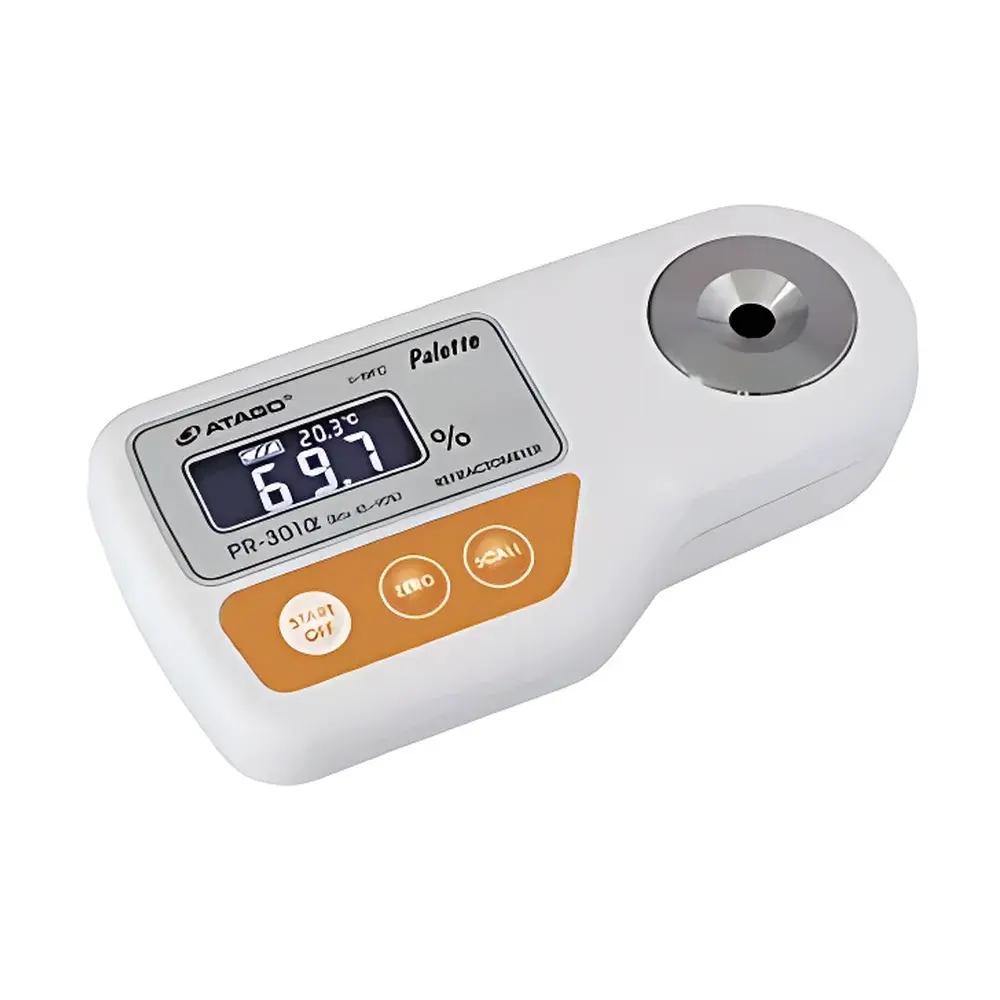
ATAGO PR-301α Portable Digital High-Concentration Refractometer
| Brand | ATAGO |
|---|---|
| Origin | Japan |
| Model | PR-301α (High-Concentration) |
| Measurement Range | Brix 45.0–90.0% |
| Accuracy | ±0.1% Brix |
| Resolution | 0.1% Brix |
| Temperature Compensation | Automatic (ATC), 10–30°C |
| Operating Ambient Temperature | 10–30°C |
| Power Supply | 9V Alkaline Battery (006P) |
| Dimensions (L×W×H) | 170 × 90 × 40 mm |
| Weight | 300 g (instrument only) |
| IP Rating | IP64 |
| Sample Volume | 2–3 drops |
| Measurement Time | <3 seconds |
Overview
The ATAGO PR-301α is a precision-engineered portable digital refractometer designed specifically for high-concentration aqueous solutions in food and beverage manufacturing environments. It operates on the principle of critical-angle refractometry: light passing through a sample-prism interface undergoes total internal reflection at an angle inversely proportional to the solution’s refractive index, which correlates directly with solute concentration—primarily expressed as % Brix (sucrose-equivalent mass fraction). Unlike generic benchtop units, the PR-301α features an optimized optical path and high-stability Abbe prism calibrated for the elevated refractive indices typical of dense syrups, pastes, and confectionery intermediates (e.g., bean paste, fruit jellies, concentrated glucose-fructose syrup, and caramelized sugar bases). Its automatic temperature compensation (ATC) system maintains measurement integrity across ambient conditions from 10°C to 30°C, eliminating manual correction tables and ensuring traceable consistency in QC labs, pilot-scale production lines, and R&D kitchens.
Key Features
- Extended high-range Brix measurement capability: 45.0–90.0%, engineered for viscous, non-dilutable samples where conventional refractometers saturate or yield unreliable readings.
- User-definable scale conversion: Supports up to three custom concentration scales (Scale 2, 3, 4) via programmable linear coefficients—enabling direct readout of process-specific units (e.g., % dry solids in jam base, % invert sugar in fondant, or % total soluble solids in concentrated fruit puree).
- ELI (Enhanced Light Immunity) optical design: Integrates spectral filtering and adaptive signal processing to suppress interference from ambient daylight, fluorescent lighting, or LED sources—ensuring stable operation during outdoor field checks or unshielded production-floor use.
- IP64-rated enclosure: Dust-tight and protected against water splashing from any direction—suitable for humid processing environments including steam-intensive confectionery kitchens and wet-cleaning zones.
- Rapid, single-drop measurement protocol: Requires only 2–3 µL sample volume; full stabilization and display within <3 seconds post-initiation—minimizing operator fatigue and cross-contamination risk.
- On-device zero calibration: Performed using distilled water at instrument temperature; supports daily verification per GLP-aligned lab routines and facilitates battery replacement or thermal drift correction without external standards.
Sample Compatibility & Compliance
The PR-301α is validated for homogeneous, non-particulate, low-turbidity liquids and semi-fluids with viscosity ≤5,000 mPa·s (measured at 25°C). Compatible matrices include sucrose/glucose/fructose syrups, malt extracts, molasses, honey concentrates, fruit pulp concentrates, and cooked bean pastes. It is not intended for emulsions, suspensions, or samples containing undissolved solids >5 µm. While not certified to ISO/IEC 17025, its performance aligns with ASTM D1074 (Standard Test Method for Refractive Index of Bituminous Materials) and AOAC Official Method 932.12 (for Brix determination in fruit products). The device meets IEC 60529 (IP64), RoHS Directive 2011/65/EU, and conforms to JIS Z 8806:2011 for refractometric accuracy reporting.
Software & Data Management
The PR-301α operates as a standalone, firmware-controlled instrument with no embedded Bluetooth, USB, or cloud connectivity. All configuration—including scale selection, coefficient assignment, and zero calibration—is performed via tactile keypad navigation. Calibration and measurement history are not stored; however, the unit supports audit-ready procedural compliance: each zeroing event records the ambient temperature (accessible via diagnostic key combination), enabling correlation with environmental logs. For regulated environments operating under FDA 21 CFR Part 11 or EU Annex 11 requirements, users may integrate the PR-301α into paper-based or LIMS-linked workflows by documenting instrument ID, operator, date/time, calibration status, and raw Brix values manually or via connected barcode scanners.
Applications
- Confectionery QA: Real-time monitoring of caramelization endpoints, fondant crystallization control, and marshmallow syrup density before whipping.
- Fruit Processing: Verification of concentrate Brix prior to canning, freeze-drying, or enzymatic hydrolysis—critical for microbial stability and shelf-life modeling.
- Asian Dessert Manufacturing: Quantitative assessment of azuki bean paste, mochi dough, and yam-based fillings where traditional hydrometers fail due to high viscosity.
- Beverage Concentrate Blending: Batch verification of high-Brix base syrups used in RTD tea, flavored water, and functional drink premixes.
- R&D Formulation: Rapid iteration of sugar-acid balance in prototype jams and jellies without dilution-induced error propagation.
FAQ
What does “ELI” stand for, and how does it improve measurement reliability?
ELI stands for Enhanced Light Immunity—a proprietary optical and firmware architecture that filters out extraneous broadband illumination, reducing photodiode saturation and baseline drift under variable lighting conditions.
Can the PR-301α measure alcohol content directly?
No. It measures refractive index correlated to dissolved solids (Brix). Alcohol quantification requires complementary tools such as densitometry or near-infrared spectroscopy, as ethanol lowers refractive index nonlinearly relative to sugar.
Is temperature calibration required before every measurement?
Zero calibration is recommended before first use each day, after significant ambient temperature shifts (>5°C), or following battery replacement—but ATC ensures reading accuracy across 10–30°C without recalibration between measurements.
How do I verify the instrument’s long-term accuracy?
Use certified NIST-traceable Brix reference standards (e.g., 50.0% and 80.0% sucrose solutions at 20°C); deviation beyond ±0.1% warrants service or revalidation.
Why is the PR-301α unsuitable for dairy-based concentrates?
Milk proteins and fat micelles scatter light and disrupt refractive index linearity; for dairy applications, consider dedicated lactose-corrected refractometers or HPLC-based dry matter analysis.





