
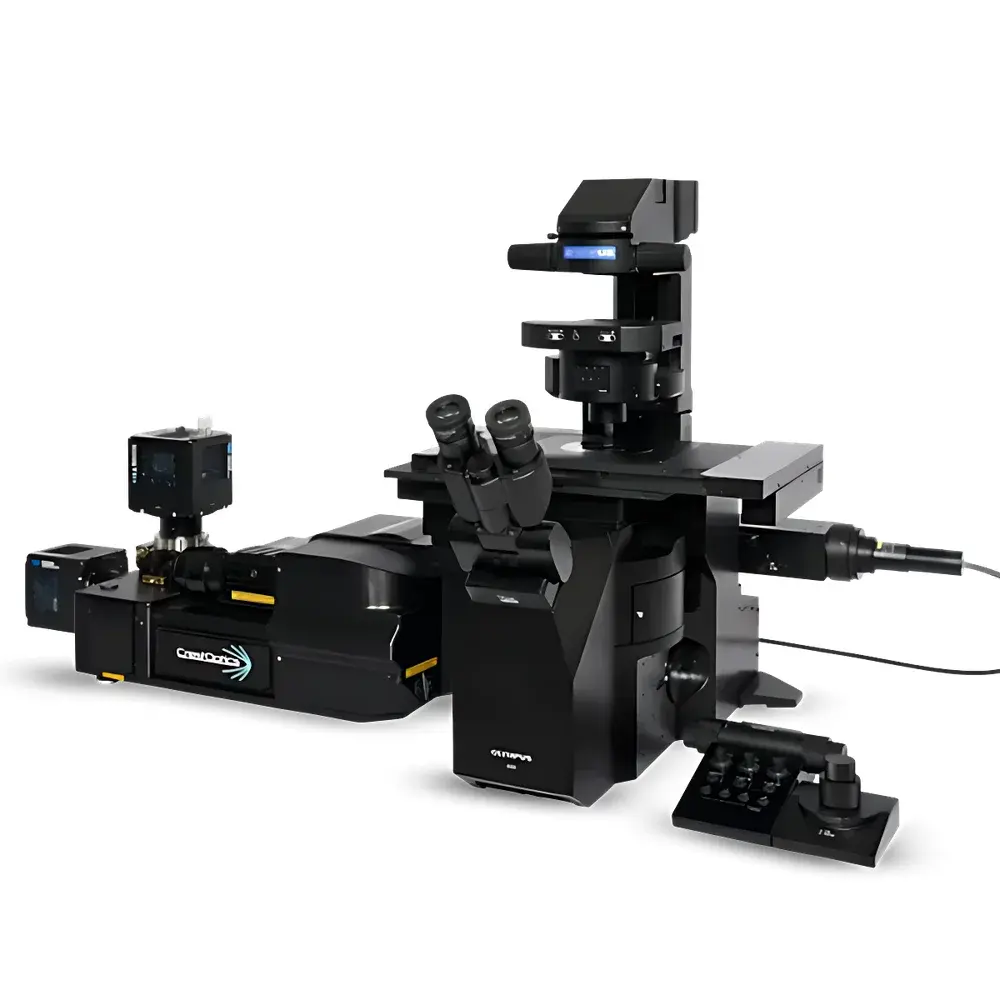
Olympus IXplore SpinXL Spinning Disk Confocal Microscope
| Brand | Olympus |
|---|---|
| Origin | Japan |
| Manufacturer Type | Original Equipment Manufacturer (OEM) |
| Import Status | Imported |
| Model | IXplore IX85 SpinXL |
| Resolution (Lateral) | ~230 nm (with 1.4 NA objective) |
| Resolution (Axial) | ~600 nm (with 1.4 NA objective) |
| Lasers | 405 nm, 445 nm, 470 nm, 488 nm, 520 nm, 530 nm, 555 nm, 577 nm, 640 nm, 730 nm |
| Detectors | Up to 7 simultaneous channels |
| Scan Module | Integrated spinning-disk unit |
| Scanning Modes | Multi-mode acquisition (e.g., frame scan, line scan, ROI scan, time-lapse, Z-stack) |
| Objective Compatibility | Wide range of high-NA and correction-collared objectives (including silicone/oil/water immersion) |
| Microscope Host | Research-grade fully motorized inverted fluorescence microscope (IX85 platform) |
| Illumination Source | 89 North Laser Diode Illuminator (LDI) with independent intensity control per wavelength |
| Software & Workstation | Intelligent acquisition software with guided setup, hardware synchronization, and real-time feedback |
| Vibration Isolation | Dedicated active or passive anti-vibration optical table included |
| XY Stage Control | Motorized high-precision piezo-enhanced stage with closed-loop feedback |
Overview
The Olympus IXplore SpinXL Spinning Disk Confocal Microscope is a high-throughput, wide-field confocal imaging platform engineered for quantitative live-cell and thick-tissue fluorescence microscopy. Built upon the IX85 inverted microscope chassis, it integrates a proprietary high-speed spinning-disk scan module with synchronized laser illumination and multi-channel detection to deliver optical sectioning without compromising temporal resolution or phototoxicity. Unlike point-scanning systems, the SpinXL employs parallelized excitation and emission collection across thousands of microlenses—enabling true confocal contrast at video-rate speeds (up to 100 fps full-frame). Its design prioritizes reproducibility in long-term time-lapse experiments, compatibility with sensitive biosensors (e.g., GCaMP, FRET reporters), and seamless integration into core imaging facilities serving multiple users and assay types.
Key Features
- Ultra-Wide Field-of-View Confocal Imaging: Supports up to 22 mm field diameter with minimal vignetting, enabling rapid survey imaging of organoids, tissue slices, and micro-patterned cell cultures while maintaining confocal rejection of out-of-focus light.
- Multi-Laser Excitation Architecture: Ten discrete laser lines (405–730 nm) are coupled via the 89 North LDI system, each independently modulated for precise spectral separation and optimal signal-to-noise ratio across fluorophore families (e.g., DAPI, FITC, TRITC, Cy5, far-red dyes).
- 7-Channel Simultaneous Detection: Configurable through dichroic selection and spectral unmixing—ideal for multiplexed immunofluorescence, spectral phasor analysis, and lifetime-compatible acquisitions when paired with TCSPC modules.
- Fully Motorized Platform: Includes encoded objectives, filter turrets, focus drive, XY stage, and Z-stage—all controllable via software with hardware-triggered synchronization for repeatable experiment replication.
- Integrated Environmental Control Support: Designed for compatibility with stage-top incubators (temperature, CO₂, humidity) and perfusion systems, ensuring physiological relevance during extended dynamic imaging sessions.
- Robust Mechanical Architecture: Precision-machined aluminum frame, low-drift thermal design, and factory-aligned optical path ensure alignment stability over multi-day acquisitions and multi-user facility deployment.
Sample Compatibility & Compliance
The IXplore SpinXL accommodates diverse biological specimens—from single adherent cells in glass-bottom dishes to 300 µm-thick cleared tissues and live zebrafish embryos. Its high numerical aperture (up to 1.4 NA) and correction-collared objective support ensures minimal spherical aberration across varied mounting media (PBS, glycerol, RIMS, FRUIT, CUBIC). The system complies with ISO 10993-5 for biocompatibility of contact materials and meets IEC 61000-6-3/6-4 electromagnetic compatibility standards. When operated under documented SOPs, it supports GLP-compliant data acquisition workflows, including audit-trail-enabled software logging and metadata-rich TIFF export compliant with OME-TIFF v0.4 specifications.
Software & Data Management
Olympus cellSens Dimension software provides an intuitive, workflow-driven interface with intelligent acquisition presets—including auto-exposure optimization, Z-stack spacing calculation based on Nyquist sampling, and ROI-based multi-position time-lapse scheduling. All hardware parameters (laser power, exposure time, gain, pinhole size, stage coordinates) are embedded as structured metadata within exported images. The platform supports DICOM-SR export for clinical research applications and integrates with third-party analysis environments (Fiji/ImageJ, Python via Bio-Formats, MATLAB) through open API protocols. For regulated environments, optional FDA 21 CFR Part 11-compliant modules provide electronic signatures, role-based access control, and immutable acquisition logs.
Applications
- High-content screening of 3D spheroids and organoids under physiological conditions
- Long-term calcium dynamics imaging in neuronal networks with subcellular resolution
- Real-time tracking of intracellular vesicle trafficking using dual-color ratiometric probes
- Multi-parameter immunofluorescence quantification in tumor microenvironment sections
- Co-culture interaction studies involving immune cells and epithelial monolayers
- Developmental biology imaging of live avian or amphibian embryos with minimal photodamage
FAQ
What is the maximum frame rate achievable with full-frame confocal imaging?
Up to 100 fps at 2048 × 2048 pixels using binning and optimized laser/detector settings; typical high-resolution acquisition operates between 10–30 fps depending on signal intensity and channel count.
Can the SpinXL be upgraded to include FLIM or super-resolution capabilities?
Yes—the platform supports modular integration of time-correlated single-photon counting (TCSPC) units and structured illumination modules (e.g., Olympus SIM) via standardized optical ports and software APIs.
Is remote operation supported for shared-core facility use?
Fully supported via secure RDP or web-based thin-client interfaces; includes user session isolation, instrument reservation calendars, and automated calibration report generation.
How does the system handle chromatic aberration across its broad laser spectrum?
Through hardware-integrated achromatic correction in the scan lens and tube lens assemblies, plus software-based lateral shift compensation calibrated per objective and wavelength.
What file formats are natively supported for raw data export?
OME-TIFF (primary), ND2, and HDF5; all retain full metadata including hardware configuration, timestamps, and environmental sensor logs.




