
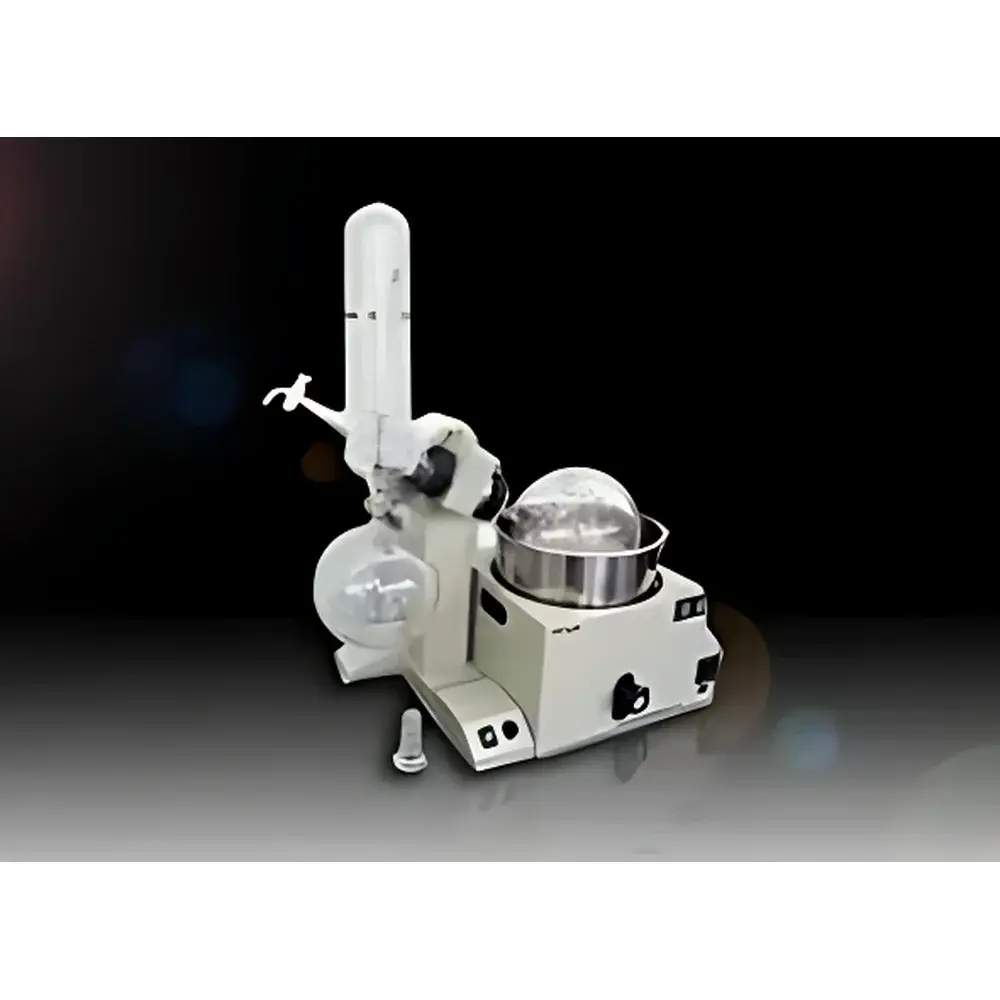
Hanuo RE-5203A Rotary Evaporator
| Brand | Hanuo |
|---|---|
| Origin | Shanghai, China |
| Model | RE-5203A |
| Rotational Speed Range | 0–150 rpm |
| Heating Temperature Range | RT to 100 °C |
| Ultimate Vacuum | 0.098 MPa (≈740 mmHg) |
| Evaporation Flask Capacity | 3 L |
| Collection Flask Capacity | 2 L |
| Cooling System | Vertical high-density dual-coil condenser |
| Lifting Mechanism | Motorized tilting-type lift |
| Total Power Consumption | 1630 W |
| Heating Control Accuracy | ±0 °C (indicative of basic on/off or proportional control without digital PID specification) |
Overview
The Hanuo RE-5203A Rotary Evaporator is a benchtop vacuum distillation system engineered for reliable solvent removal, concentration, and purification under reduced pressure. It operates on the principle of thin-film evaporation: a motor-driven rotating flask spreads sample solution across its inner surface, increasing the effective evaporation area while minimizing thermal exposure. Simultaneously, precise temperature control of the heating bath—ranging from ambient to 100 °C—and vacuum regulation down to 0.098 MPa collectively lower the boiling point of solvents, enabling gentle and efficient phase separation. This operational paradigm is particularly suited for thermolabile compounds encountered in pharmaceutical synthesis, natural product isolation, and analytical sample preparation—where preserving molecular integrity during concentration is critical.
Key Features
- Motorized tilting lift mechanism with intuitive push-button operation ensures reproducible, hands-free flask positioning for safe solvent transfer and system venting.
- 3 L evaporation flask with standard 29/32 ball joint interface, paired with a 2 L collection flask, supports medium-scale batch processing typical in QC labs and pilot-scale R&D workflows.
- Vertical dual-coil condenser with high surface-area density enhances condensation efficiency across a broad range of volatile solvents—including acetone, ethanol, ethyl acetate, and dichloromethane—without requiring external chiller integration for moderate throughput.
- Heating bath with stainless steel housing and embedded temperature sensor provides stable thermal delivery up to 100 °C; control architecture implements basic proportional or on/off regulation (±0 °C nominal accuracy reflects system calibration tolerance, not real-time precision).
- Robust aluminum alloy frame and tempered glass components meet standard laboratory durability requirements; all wetted parts are borosilicate glass (3.3), compliant with ISO 3585 and resistant to common organic solvents and mild aqueous reagents.
Sample Compatibility & Compliance
The RE-5203A accommodates homogeneous liquid solutions, suspensions, and low-viscosity extracts compatible with rotary evaporation—excluding highly viscous, foaming, or corrosive media (e.g., concentrated mineral acids, halogenated solvents above 60 °C). Its design aligns with general laboratory safety practices outlined in ANSI Z9.5 and IEC 61010-1 for electrical equipment. While not certified to specific GMP or GLP validation protocols out-of-the-box, the unit’s mechanical repeatability, sealed vacuum path, and traceable temperature/vacuum endpoints support documentation required for internal SOP adherence in regulated environments (e.g., ISO/IEC 17025-accredited testing labs).
Software & Data Management
This model operates via analog/digital hybrid controls without integrated data logging or PC connectivity. All operational parameters—including rotation speed (0–150 rpm), bath temperature setpoint, and manual vacuum valve adjustment—are monitored and adjusted locally using front-panel dials and LED indicators. For laboratories requiring audit trails or electronic records, third-party vacuum gauges with RS-485 output and standalone temperature loggers may be externally interfaced. The absence of embedded software eliminates concerns related to FDA 21 CFR Part 11 compliance complexity—making it suitable for non-GxP research settings where procedural consistency is maintained through operator training and written protocols.
Applications
- Solvent recovery and concentration of reaction mixtures in synthetic organic chemistry.
- Removal of low-boiling solvents (e.g., hexane, diethyl ether) following column chromatography fraction collection.
- Pre-concentration of aqueous extracts prior to lyophilization or HPLC analysis.
- Batch-wise purification of heat-sensitive biomolecules—including peptides, glycosides, and labile alkaloids—by minimizing residence time at elevated temperatures.
- Standardized evaporation steps in method development per USP , EP 2.9.30, and ASTM D1296 for volatile content determination.
FAQ
What vacuum level is required for optimal performance with ethanol?
Ethanol boils at ~35 °C under 0.098 MPa vacuum; the RE-5203A’s ultimate vacuum supports this condition, though actual performance depends on pump capacity, trap efficiency, and ambient humidity.
Is the heating bath filled with oil or water by default?
The bath is dry-heated via immersed resistive elements; users must add compatible heat-transfer fluid (e.g., silicone oil or water) based on desired temperature range and viscosity requirements.
Can the RE-5203A be used with aggressive solvents like chloroform?
Yes—provided cold traps and appropriate PTFE seals are installed; however, prolonged exposure to chlorinated solvents may degrade standard rubber gaskets and requires post-run ventilation.
Does the unit include a vacuum controller or pressure sensor?
No; vacuum is manually regulated via a stopcock or external vacuum regulator—no built-in feedback loop or digital readout is provided.
What maintenance intervals are recommended for long-term reliability?
Inspect glass joints and seals monthly; lubricate lifting mechanism annually; verify bath temperature calibration semiannually using a NIST-traceable thermometer.



