
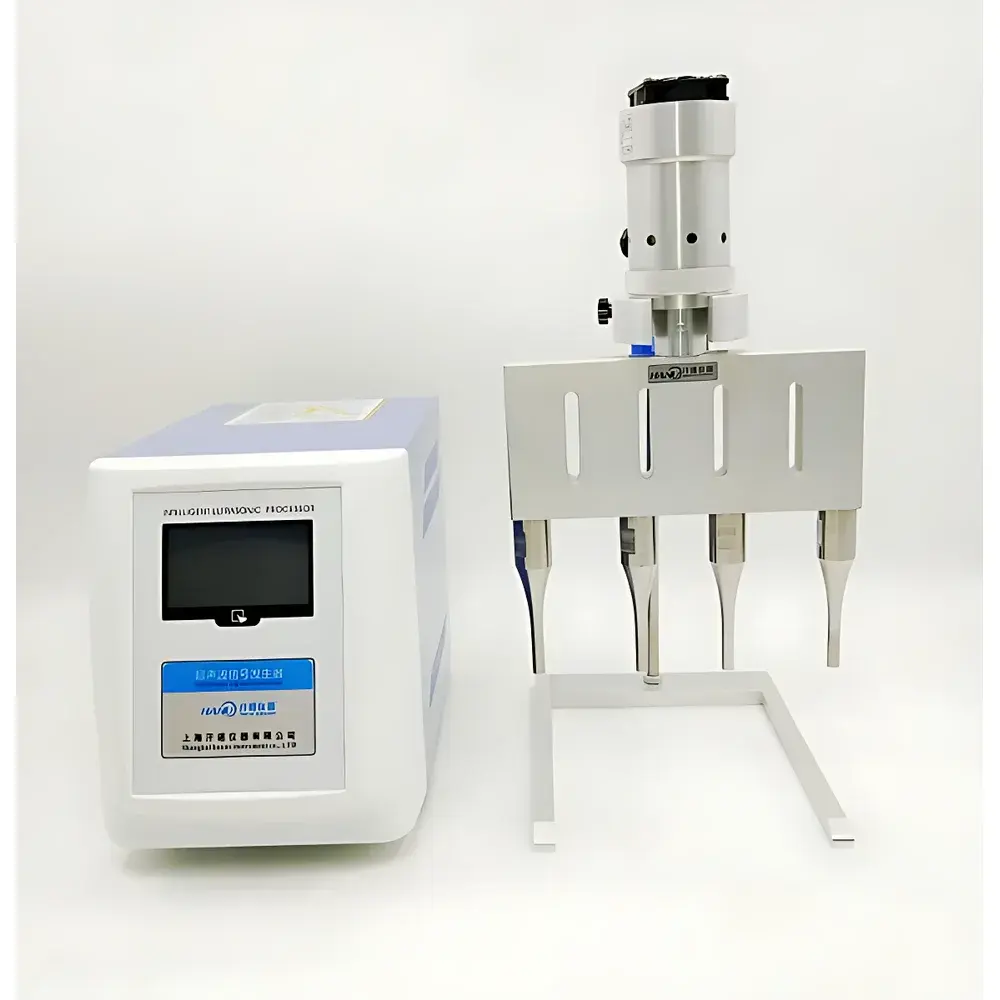
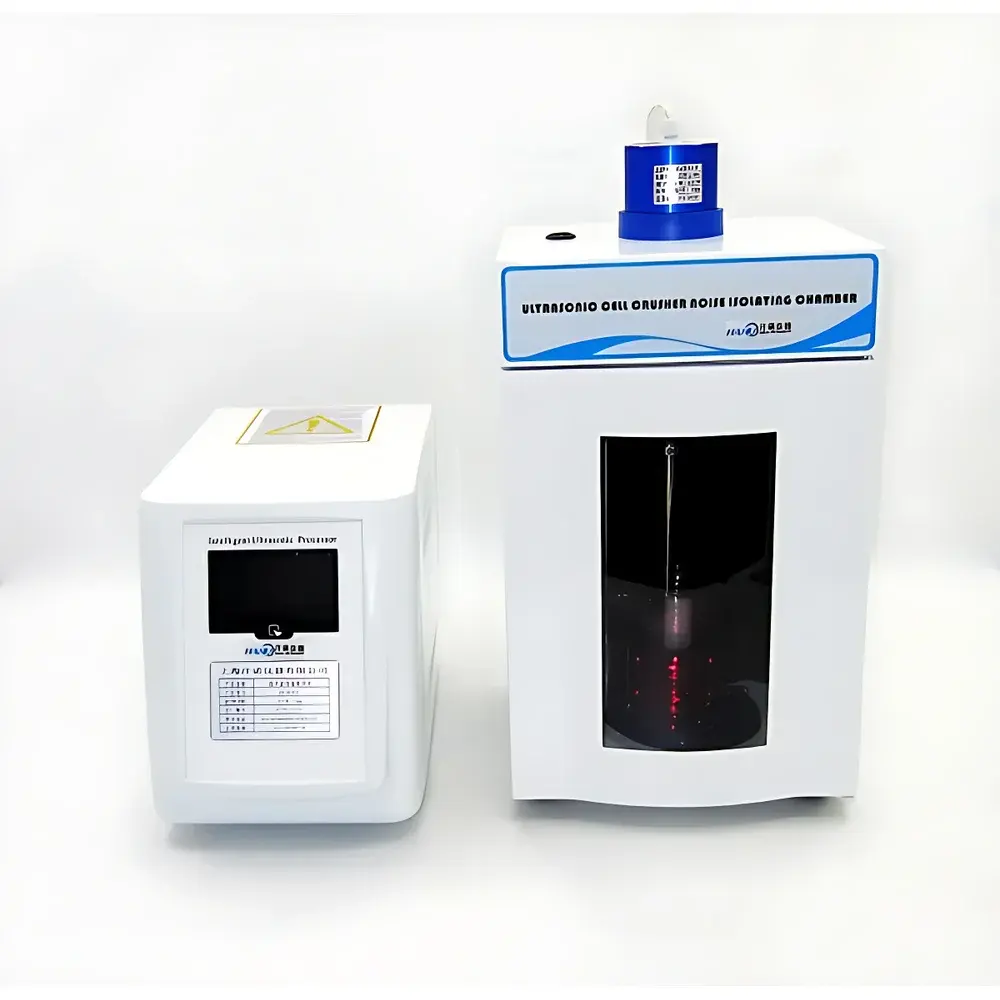
Daxluot-4S Multi-Channel Ultrasonic Cell Disruptor
| Origin | Shanghai, China |
|---|---|
| Manufacturer Type | Authorized Distributor |
| Model | Daxluot-4S |
| Price | USD 6,500 (FOB Shanghai) |
| Ultrasonic Output Power | 2000 W (adjustable) |
| Operating Frequency | 20 kHz |
| Sample Capacity | 4 × 300 mL vessels |
| Pulse Mode | 0.1–99.9 s on/off adjustable |
| Timer Range | 0–99 h 59 min 59 s |
| Temperature Monitoring & Overheat Protection | Ambient to 90 °C |
| Control Interface | 4.3-inch TFT capacitive touchscreen |
| Data Storage | 20 programmable protocols with user password protection |
| Power Supply | AC 220 V ±5%, 50 Hz (110 V option available) |
| Communication Interface | Optional RS-232 or USB-to-PC connectivity |
| Probe Material | Grade 5 titanium alloy (Ti-6Al-4V), corrosion-resistant, USP Class VI compliant |
| Amplitude Stability | Closed-loop amplitude regulation under variable load conditions |
Overview
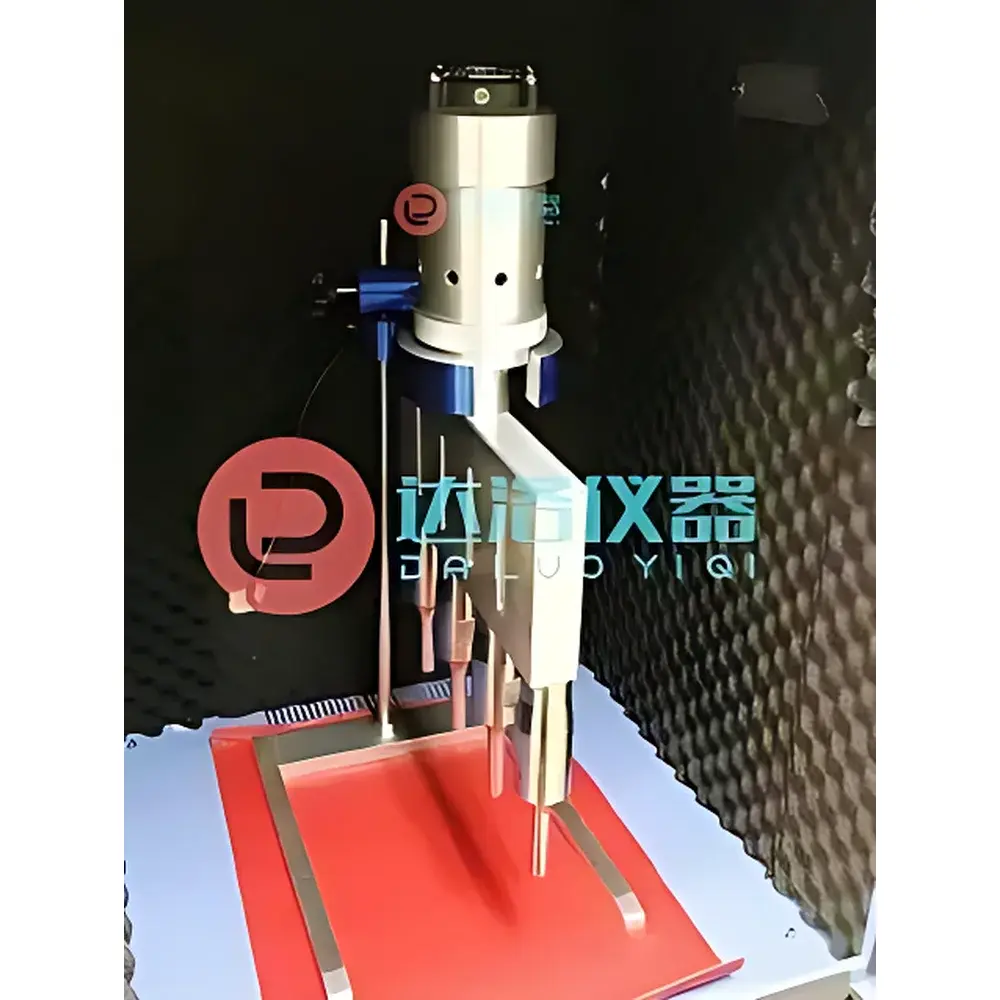
The Daxluot-4S Multi-Channel Ultrasonic Cell Disruptor is an engineered platform for scalable, reproducible ultrasonic lysis and processing of biological samples based on controlled acoustic cavitation. Operating at a fundamental frequency of 20 kHz, the system generates high-intensity longitudinal pressure waves in liquid media, inducing transient microcavitation—formation, growth, and violent collapse of vacuum bubbles—which delivers localized shear forces, microstreaming, and thermal transients sufficient to disrupt cell membranes, solubilize inclusion bodies, fragment chromatin, and accelerate mass transfer in extraction processes. Unlike single-probe sonicators, the Daxluot-4S integrates four independent, synchronized ultrasonic transducer assemblies housed in a rigid stainless-steel chassis, enabling parallel processing of up to four 300 mL samples under identical acoustic field parameters. This architecture eliminates inter-sample variability inherent in sequential processing and supports statistically robust experimental design—critical for comparative proteomics, nucleic acid isolation validation, or formulation development under GLP-aligned workflows.
Key Features
- Four-channel parallel ultrasonic processing with individual transducer calibration and real-time power balancing to ensure ≤±3% inter-channel output deviation.
- 4.3-inch capacitive TFT touchscreen interface with intuitive icon-driven navigation, supporting multilingual UI (English, German, French, Japanese) and audit-ready parameter logging.
- Active frequency auto-tracking circuitry maintains resonance stability across probe wear, temperature drift, and viscosity changes—ensuring consistent cavitation intensity throughout operation.
- Integrated thermistor-based sample temperature monitoring with configurable upper-limit threshold (ambient to 90 °C); automatic duty-cycle reduction initiates when preset temperature is approached, minimizing thermal denaturation of labile biomolecules.
- Titanium alloy (Ti-6Al-4V) probes manufactured to ASTM F136 standards, passivated per ISO 10993-17, resistant to hydrochloric, nitric, and phosphoric acids at concentrations ≤10% v/v—validated for repeated sterilization via autoclaving (121 °C, 20 min).
- Microprocessor-controlled pulse modulation with independently adjustable on/off durations (0.1–99.9 s resolution), enabling optimization of energy delivery for heat-sensitive targets such as membrane proteins or extracellular vesicles.
- Closed-loop amplitude regulation compensates for load impedance shifts—maintaining constant tip displacement amplitude (±1 µm repeatability) whether processing low-viscosity buffers or high-density bacterial lysates.
- Non-volatile memory stores 20 user-defined protocols with encrypted password protection (AES-128), supporting multi-user laboratory environments compliant with FDA 21 CFR Part 11 requirements for electronic records.
Sample Compatibility & Compliance
The Daxluot-4S accommodates standard cylindrical glass or polypropylene vessels (Ø 50–75 mm, height ≤150 mm) and is validated for use with aqueous, buffered, and mildly organic solvent systems (≤20% ethanol, ≤10% isopropanol). It meets IEC 61000-6-3 (EMC emission) and IEC 61000-6-2 (immunity) standards. All electrical components conform to UL/CSA 61010-1 safety requirements for laboratory equipment. The system supports ISO/IEC 17025-compliant method validation through traceable power calibration (NIST-traceable hydrophone measurements available upon request) and is routinely employed in laboratories adhering to USP , ISO 13485, and GMP Annex 11 documentation practices.
Software & Data Management
Optional PC software (DaxControl Suite v3.2) provides remote operation, real-time power/temperature/time trending, CSV export of full session logs (including timestamped fault events), and automated report generation compliant with ALCOA+ principles. Audit trail functionality records all parameter modifications, user logins, and protocol executions with immutable timestamps—fully compatible with electronic signature workflows required under 21 CFR Part 11 Subpart B.
Applications
- High-yield lysis of Gram-negative and Gram-positive bacteria, yeast, and mammalian cells for recombinant protein purification.
- Chromatin shearing in ChIP-seq and ATAC-seq library preparation protocols.
- Ultrasound-assisted extraction of polyphenols, alkaloids, and terpenoids from botanical matrices.
- Preparation of nanoemulsions and liposomal drug carriers via cavitation-mediated homogenization.
- Disaggregation of amyloid fibrils and protein aggregates in neurodegenerative disease research.
- Routine cleaning and decontamination of reusable labware using cavitation-enhanced detergent activation.
FAQ
Is the Daxluot-4S suitable for CLIA-certified clinical laboratories?
Yes—when operated with validated protocols and integrated into a documented quality management system, it complies with CLIA requirements for instrument qualification and ongoing performance verification.
Can the system be integrated into a LIMS environment?
Yes—via optional RS-232 or TCP/IP communication modules, enabling bidirectional data exchange with major LIMS platforms including LabWare, STARLIMS, and Thermo Fisher SampleManager.
What maintenance is required for long-term amplitude stability?
Annual transducer impedance calibration and probe tip inspection (for pitting or erosion) are recommended; no routine oiling or mechanical alignment is necessary due to solid-state piezoelectric stack design.
Does the unit support IQ/OQ/PQ documentation packages?
Comprehensive vendor-supplied qualification templates—including installation checklist, operational test scripts, and performance verification protocols—are provided with each shipment.



