
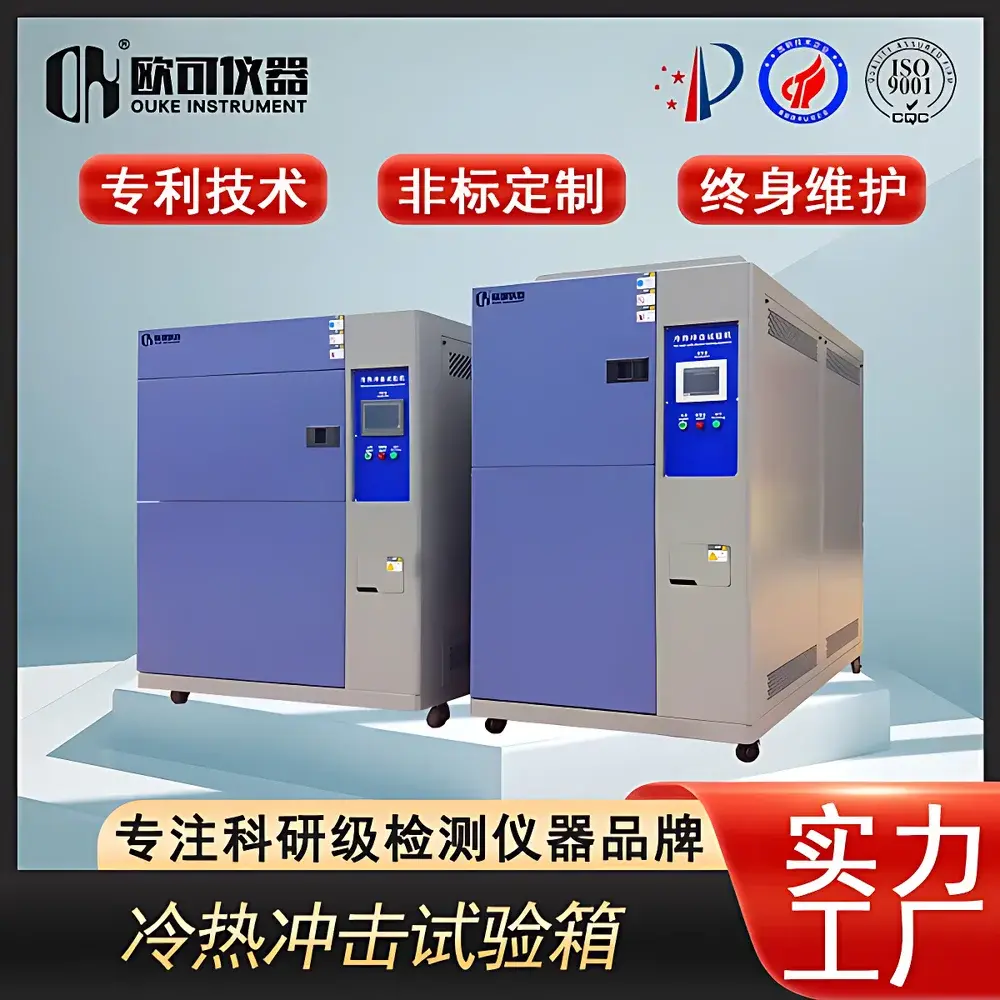
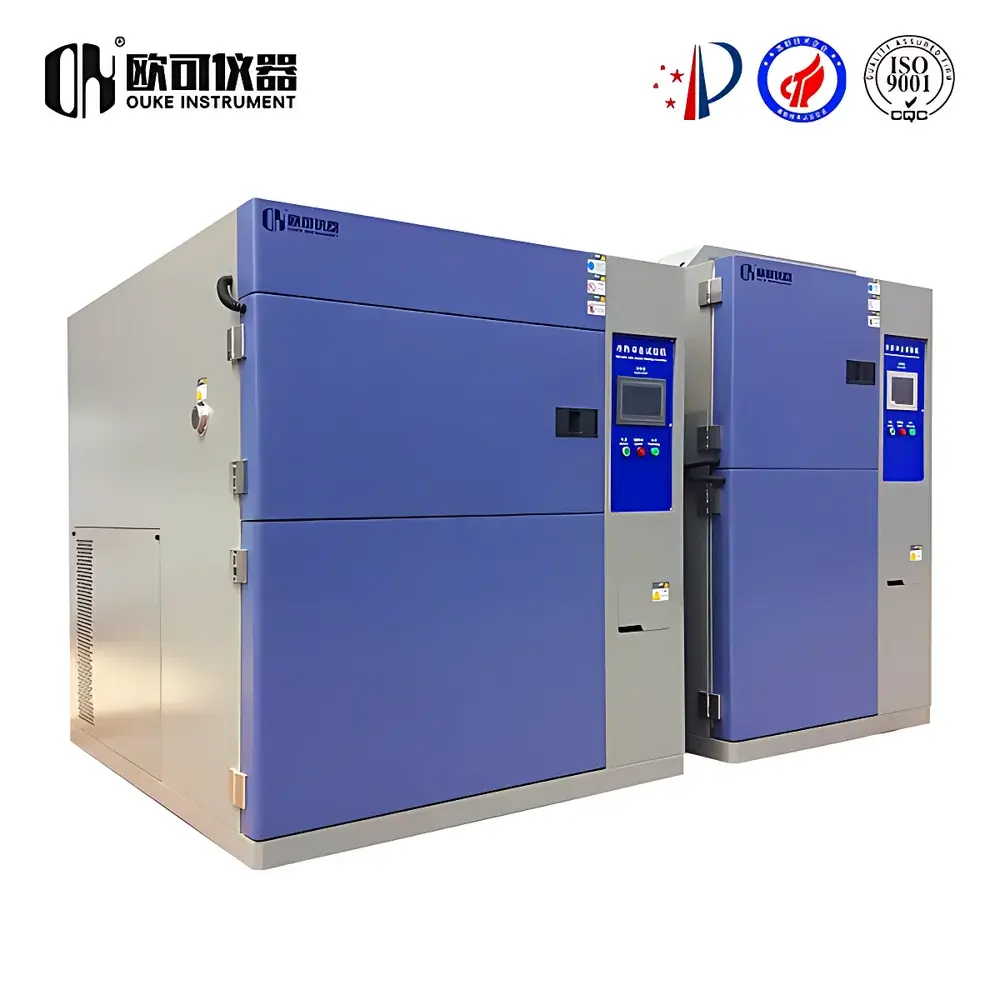
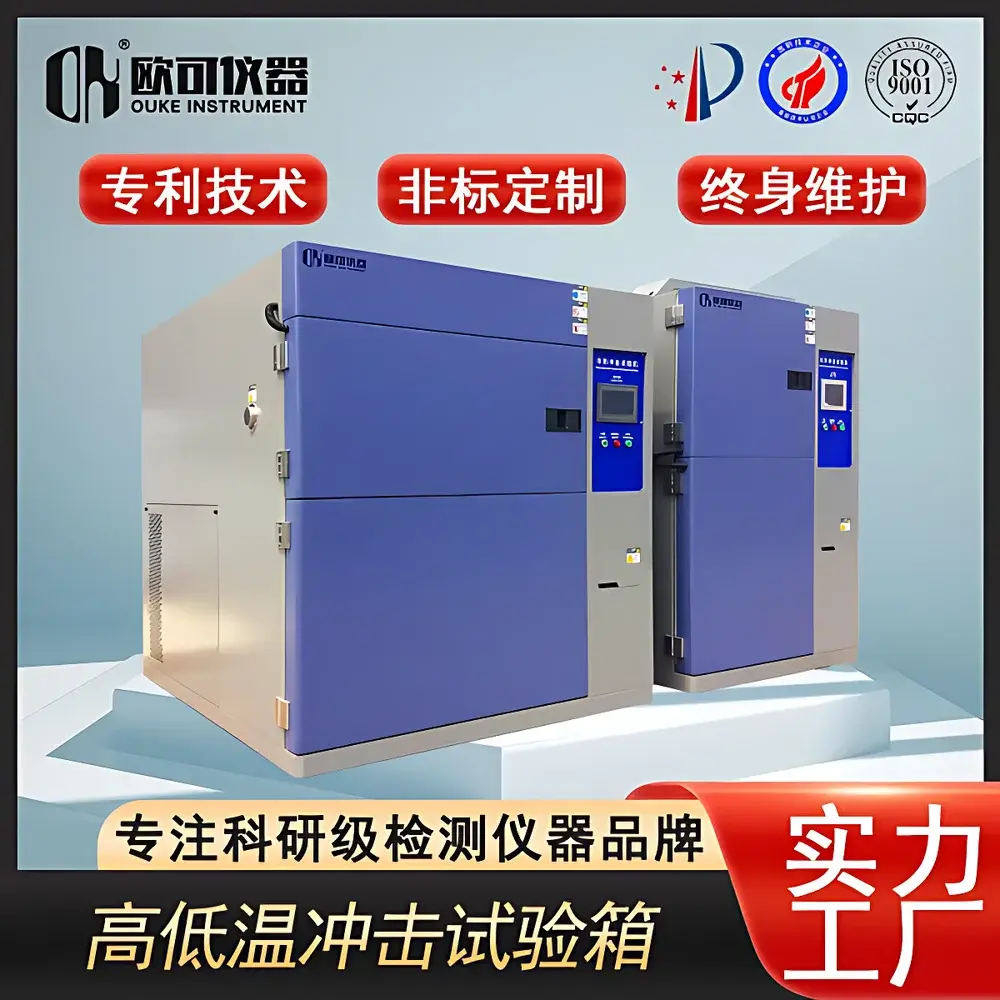
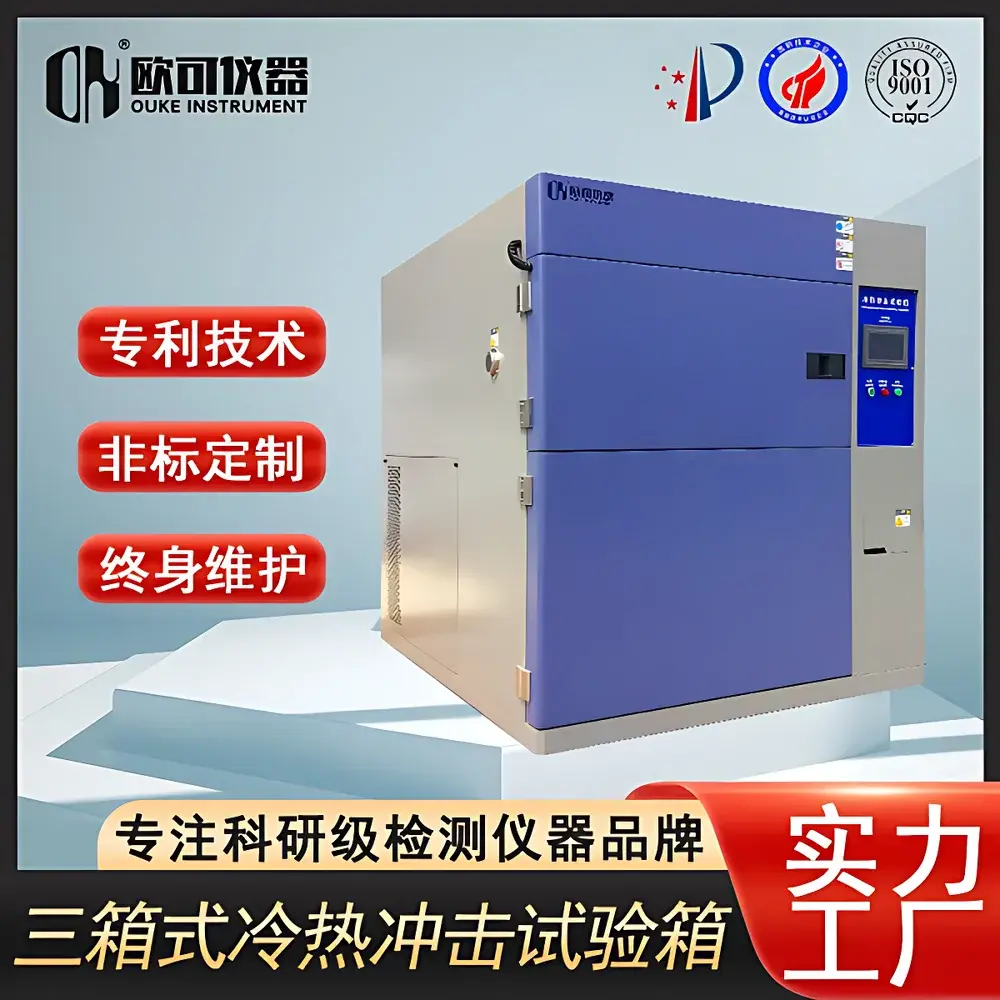
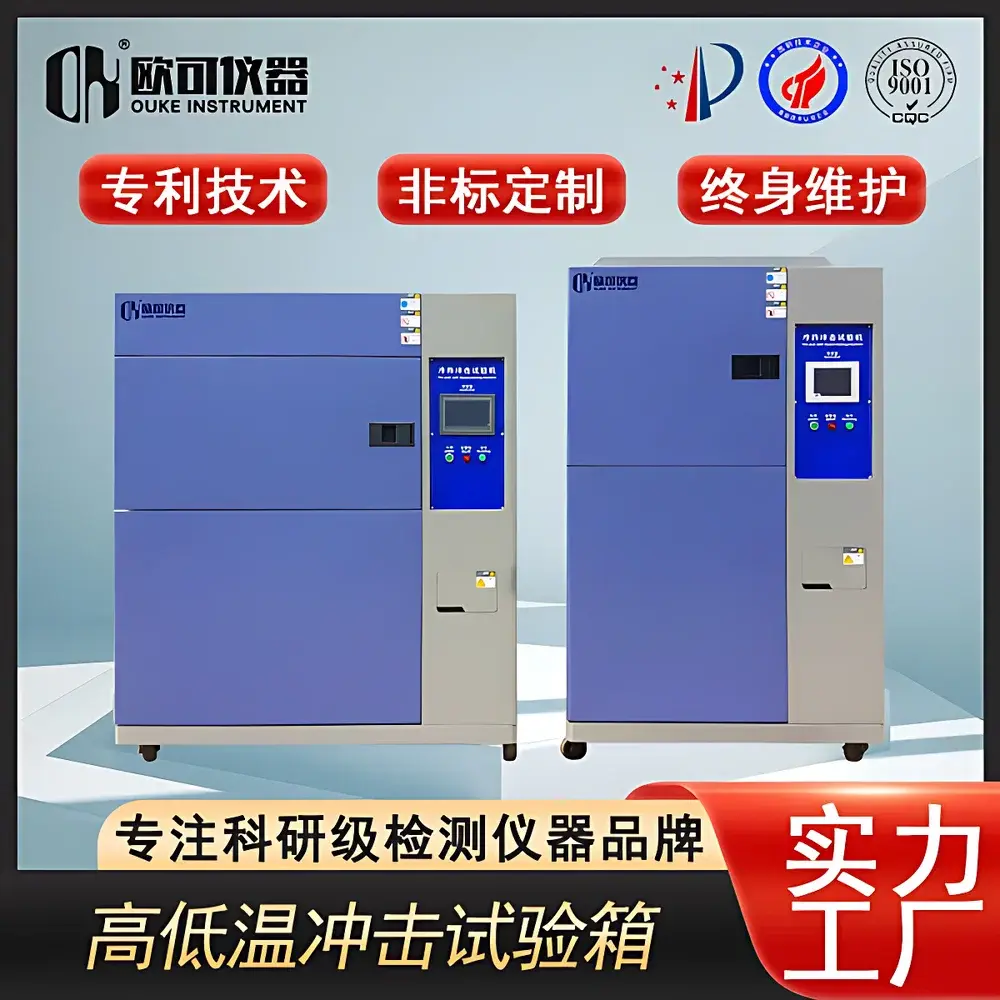
OK-TS-11 Three-Zone Thermal Shock Test Chamber
| Brand | OK Instruments |
|---|---|
| Origin | Guangdong, China |
| Manufacturer Type | Direct Manufacturer |
| Model | OK-TS-11 |
| Price | USD 11,200 (FOB Guangdong) |
| High-Temperature Range | +150 °C |
| Low-Temperature Range | −50 °C |
| Thermal Shock Range | −50 °C to +150 °C |
| Temperature Stability | ±2 °C |
| Heating Rate | 10 °C/min |
| Cooling Rate | 10 °C/min |
Overview
The OK-TS-11 Three-Zone Thermal Shock Test Chamber is an engineered solution for high-acceleration thermal stress testing in reliability engineering and qualification validation. Unlike two-chamber (elevator-type) systems, it employs a stationary-sample architecture with three thermally isolated zones—high-temperature chamber, low-temperature chamber, and central test chamber—enabling rapid air-mass transfer via pneumatically actuated isolation dampers. This design eliminates mechanical sample movement, thereby eliminating vibration, positional misalignment, and cable/tubing strain during transitions. The chamber operates on the principle of convective thermal shock: conditioned air from either extreme zone is introduced directly into the test chamber, achieving rapid temperature transients without thermal inertia associated with chamber-wall heating or cooling. It complies with the fundamental physical requirements of IEC 60068-2-14 (Test N: Change of Temperature), MIL-STD-202G Method 107, and JESD22-A104, making it suitable for HALT (Highly Accelerated Life Testing), HASS (Highly Accelerated Stress Screening), and qualification-level environmental stress screening (ESS).
Key Features
- Three independent, hermetically sealed chambers: high-temp zone (up to +150 °C), low-temp zone (down to −50 °C), and static test chamber—ensuring zero sample displacement during thermal transitions.
- High-speed pneumatic damper system enables air-source switching in ≤30 seconds, supporting typical thermal transition times from −50 °C to +150 °C within 60 seconds (measured at 50 mm from sample surface per IEC 60068-2-14 Annex B).
- Stable thermal control architecture: ±2 °C uniformity across test chamber volume (at steady state), maintained by dual PID-controlled refrigeration/heating loops with redundant safety cutoffs.
- Robust refrigeration system using cascade two-stage compressors with R404A/R23 refrigerant blend, optimized for sustained operation at sub-zero temperatures without frost accumulation.
- Integrated 10.1-inch industrial-grade touchscreen controller with real-time logging, multi-segment programmability, and alarm-triggered event capture—including over-temperature, compressor high-pressure, fan failure, and damper position fault detection.
- Structural frame constructed from powder-coated cold-rolled steel; inner chamber lined with 304 stainless steel; insulation comprising 150 mm thick polyurethane foam (thermal conductivity <0.022 W/m·K).
Sample Compatibility & Compliance
The OK-TS-11 accommodates electrically active, wired, or hydraulically connected units—including ECUs, battery modules, power converters, and RF front-end assemblies—without requiring disconnection or repositioning. Its static-test configuration supports continuous power cycling and real-time signal monitoring during thermal transients. All operational modes adhere to traceable calibration protocols aligned with ISO/IEC 17025–accredited practices. The system meets essential safety and electromagnetic compatibility requirements per IEC 61000-6-2 (immunity) and IEC 61000-6-4 (emission), and supports audit-ready documentation for GLP/GMP environments when paired with optional 21 CFR Part 11–compliant software modules.
Software & Data Management
The embedded controller supports up to 100 stored test profiles, each with ≥999 cycles, variable dwell times, ramp rates, and user-defined pass/fail thresholds. Real-time data—including chamber air temperature, damper status, compressor discharge pressure, and heater current—is logged at 1 Hz resolution and exportable via USB or Ethernet (TCP/IP) in CSV format. Optional PC-based OK-DataLink software provides graphical trend analysis, statistical process control (SPC) charts, deviation heatmaps, and automated report generation compliant with internal QA templates or external regulatory submissions.
Applications
- Automotive electronics: ECU thermal cycling validation per GMW3172, Ford CETP 00.00-L-467, and VW 80101.
- Power electronics: Reliability assessment of SiC MOSFET modules, photovoltaic inverters, and EV onboard chargers under repeated thermal gradients.
- Aerospace & defense: Screening of avionics LRUs per MIL-STD-810H Method 503.6 (Temperature Shock) and DO-160G Section 4.12.
- Semiconductor packaging: Interconnect fatigue evaluation of QFN, BGA, and wafer-level CSP devices per JEDEC JESD22-A104.
- Medical device components: Verification of sterilization-resistant housing integrity and sensor drift behavior under accelerated thermal stress.
FAQ
How does the three-zone architecture improve test fidelity compared to two-chamber systems?
It eliminates mechanical motion-induced artifacts—such as inertial loading, connector fretting, or micro-vibration—that can mask or mimic failure modes. Stationary placement ensures consistent thermal boundary conditions and enables synchronized electrical characterization throughout the cycle.
Can the OK-TS-11 perform standard temperature cycling (not just shock)?
Yes—it supports programmable dwell-and-ramp sequences with adjustable dwell times (1 min to 999 h), enabling full compliance with IEC 60068-2-2 (heat) and IEC 60068-2-1 (cold) sequential tests.
What is the maximum allowable sample power dissipation during active testing?
The test chamber supports up to 500 W continuous internal heat load without compromising temperature stability or transition performance—verified per internal thermal load calibration protocol.
Is third-party calibration certification available?
Yes—NIST-traceable calibration certificates (including temperature uniformity mapping and transition time verification) are available upon request, with annual recalibration services offered under service contract.
Does the system support remote monitoring and alarm notification?
Via optional Ethernet interface and OK-RemoteConnect module, users can monitor live parameters, receive SMS/email alerts on critical faults, and initiate emergency shutdown from offsite locations.



