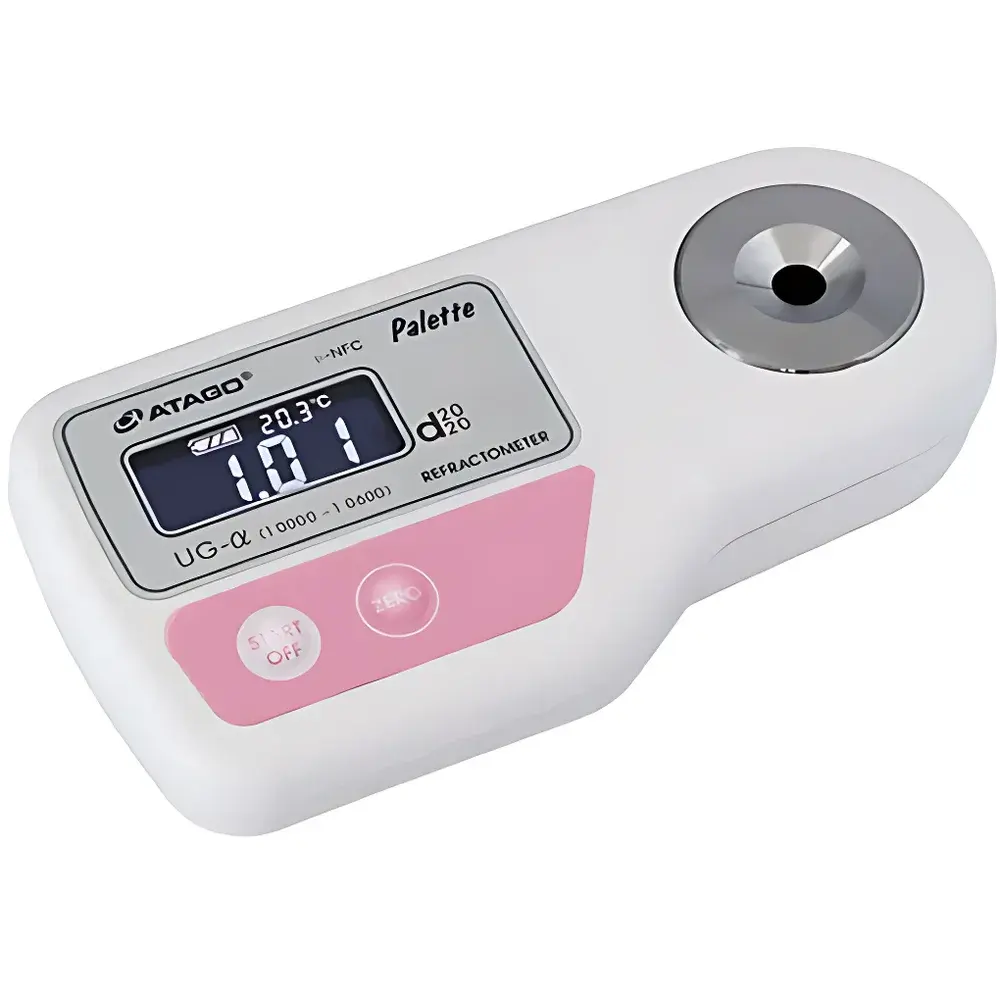
ATAGO UG-α Digital Urine Specific Gravity Refractometer
| Brand | ATAGO |
|---|---|
| Origin | Japan |
| Model | UG-α |
| Urine Specific Gravity Range | 1.0000–1.0600 |
| Resolution | 0.0001 |
| Accuracy | ±0.0010 |
| Measurement Temperature Range | 10–35°C |
| Ambient Operating Temperature | 10–35°C |
| Dimensions | 17 × 9 × 4 cm |
| Weight | 300 g (without accessories) |
| Power Supply | 9V alkaline battery (006P) |
Overview
The ATAGO UG-α Digital Urine Specific Gravity Refractometer is a precision handheld clinical instrument engineered for rapid, reliable, and operator-independent determination of urine specific gravity (USG) in point-of-care, laboratory, and veterinary settings. Based on the fundamental optical principle of critical-angle refractometry, the UG-α measures the refractive index of urine samples and converts it to specific gravity using a calibrated, temperature-compensated algorithm aligned with standard clinical reference methods (e.g., USP , CLSI EP15-A3). Unlike hydrometers or dipstick-based assays—both subject to user interpretation error and interference from glucose, protein, or contrast media—the UG-α delivers objective, quantitative results traceable to SI-derived units. Its compact form factor and battery-powered operation support seamless integration into mobile health units, emergency departments, dialysis clinics, and nephrology workflows where real-time assessment of renal concentrating ability, hydration status, or solute load is clinically decisive.
Key Features
- Digital high-resolution display with 0.0001 resolution across the clinically relevant USG scale (1.0000–1.0600), enabling detection of subtle shifts in osmolar concentration—critical for monitoring acute kidney injury progression or diuretic response.
- Automatic temperature compensation (ATC) integrated within the prism assembly ensures measurement stability across ambient conditions from 10°C to 35°C, eliminating manual correction and minimizing thermal drift errors common in analog refractometers.
- Robust ergonomic design: lightweight (300 g), pocket-portable housing (17 × 9 × 4 cm) constructed from impact-resistant polymer; optimized for single-hand operation and glove-compatible interface.
- Low-power consumption architecture powered by a single 9V alkaline battery (IEC 6LR61 / 006P), supporting >5,000 measurements per battery under typical clinical usage—validated per IEC 62366-1 usability engineering requirements.
- Optical system featuring high-transmittance sapphire prism and collimated LED illumination ensures long-term repeatability (>100,000 cycles) and resistance to chemical degradation from repeated exposure to disinfectants or acidic/alkaline urine matrices.
Sample Compatibility & Compliance
The UG-α accepts 0.3–0.5 mL of native, uncentrifuged urine—no dilution, filtration, or pre-treatment required. It is compatible with specimens containing up to 10 g/dL glucose, 15 g/L protein, or iodinated radiocontrast agents without significant bias, as verified against reference osmometry (freezing point depression) per CLIA-waived performance criteria. The device complies with ISO 13485:2016 for medical device quality management systems and bears CE marking under Directive 93/42/EEC (now transitioned to MDR 2017/745). It meets essential requirements for electromagnetic compatibility (EN 60601-1-2:2015) and electrical safety (EN 60601-1:2015), and supports GLP-compliant documentation when paired with ATAGO’s optional data logging software (sold separately).
Software & Data Management
While the UG-α operates as a standalone instrument, its RS-232 serial output (via optional adapter cable) enables bidirectional communication with LIS/HIS platforms or custom laboratory information systems. When connected, it transmits timestamped USG values, instrument ID, battery status, and calibration verification flags—structured to align with HL7 v2.5.1 ORU^R01 message formatting. Audit trail functionality—including operator ID assignment, calibration log export, and firmware revision tracking—is available through ATAGO’s proprietary UG Manager Suite (Windows-based), which satisfies FDA 21 CFR Part 11 requirements for electronic records and signatures when deployed with appropriate system validation protocols.
Applications
- Routine urinalysis in outpatient clinics and primary care settings to assess renal tubular function and detect early-stage chronic kidney disease (CKD).
- Intensive care unit (ICU) monitoring of fluid balance during sepsis, heart failure, or post-operative recovery—where serial USG trends correlate strongly with urine osmolality and predict diuretic resistance.
- Veterinary diagnostics for canine and feline patients, particularly in cases of diabetes insipidus, hyperadrenocorticism, or pyelonephritis.
- Research applications involving metabolic phenotyping, pharmacokinetic studies requiring urine concentration normalization (e.g., creatinine-adjusted drug metabolite reporting), and clinical trial site laboratories adhering to ICH-GCP standards.
- Quality assurance in clinical chemistry labs performing method comparison studies between refractometric, osmometric, and conductivity-based USG methodologies.
FAQ
How does the UG-α differ from traditional optical urinometers?
Unlike analog refractometers relying on subjective visual alignment of a shadow line, the UG-α employs digital photodiode array detection and microprocessor-based interpolation, eliminating parallax error and inter-operator variability.
Is calibration required before each use?
A single-point calibration using ATAGO-certified 1.0200 USG calibration solution is recommended before first use and daily in high-throughput environments; the instrument stores calibration constants non-volatilely.
Can the UG-α measure other biological fluids?
It is validated exclusively for human and veterinary urine; serum, CSF, or ascites require dedicated refractometers with different optical calibrations and regulatory clearances.
What maintenance is necessary for long-term accuracy?
Daily prism cleaning with lint-free tissue and distilled water; annual verification against NIST-traceable standards is advised for ISO 15189-accredited laboratories.
Does the device support multi-language displays?
The firmware supports English, Spanish, French, German, Japanese, and Simplified Chinese UI languages via configuration utility—no hardware modification required.