
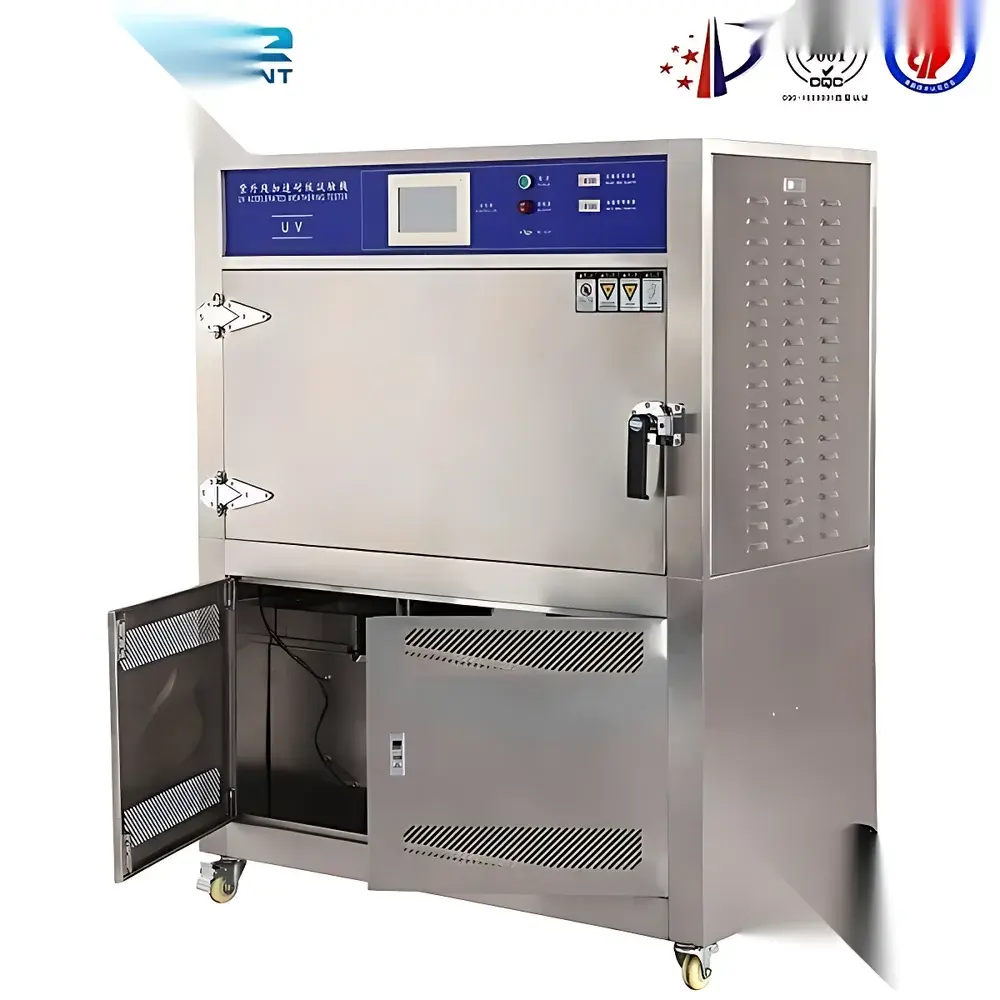
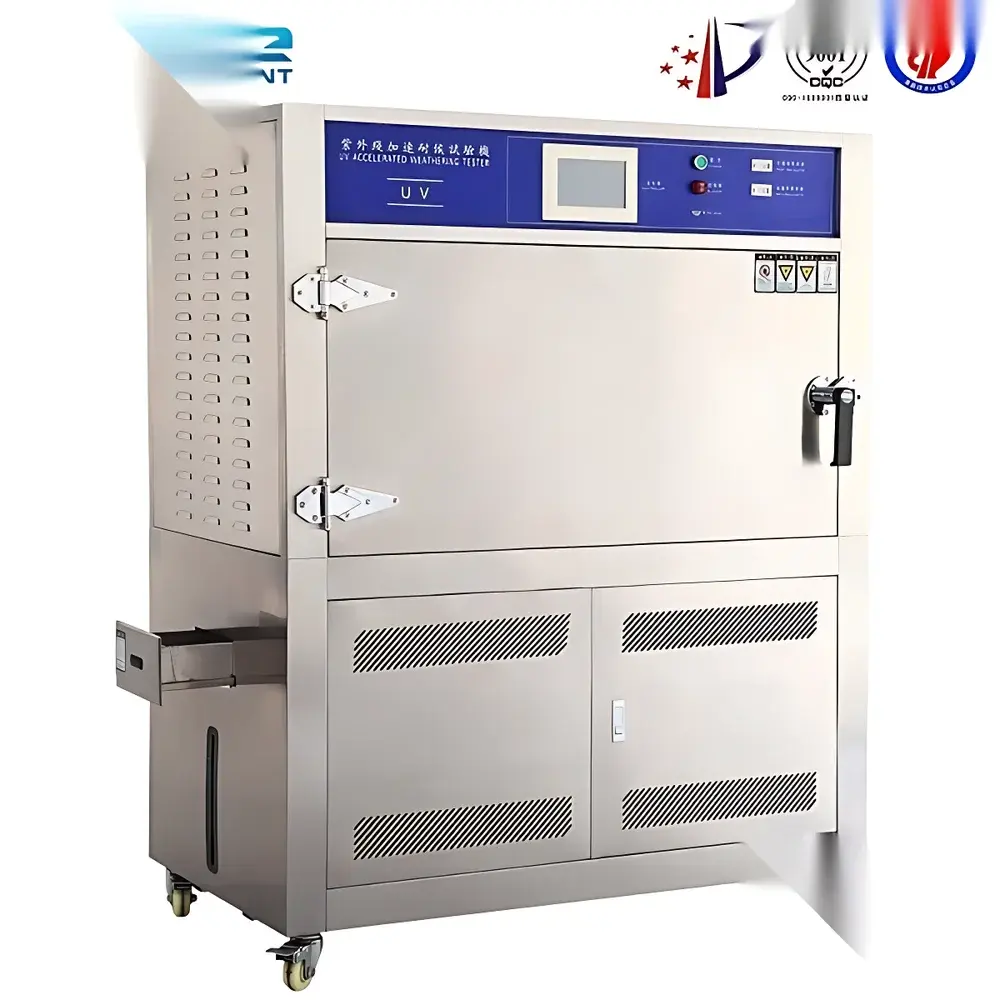
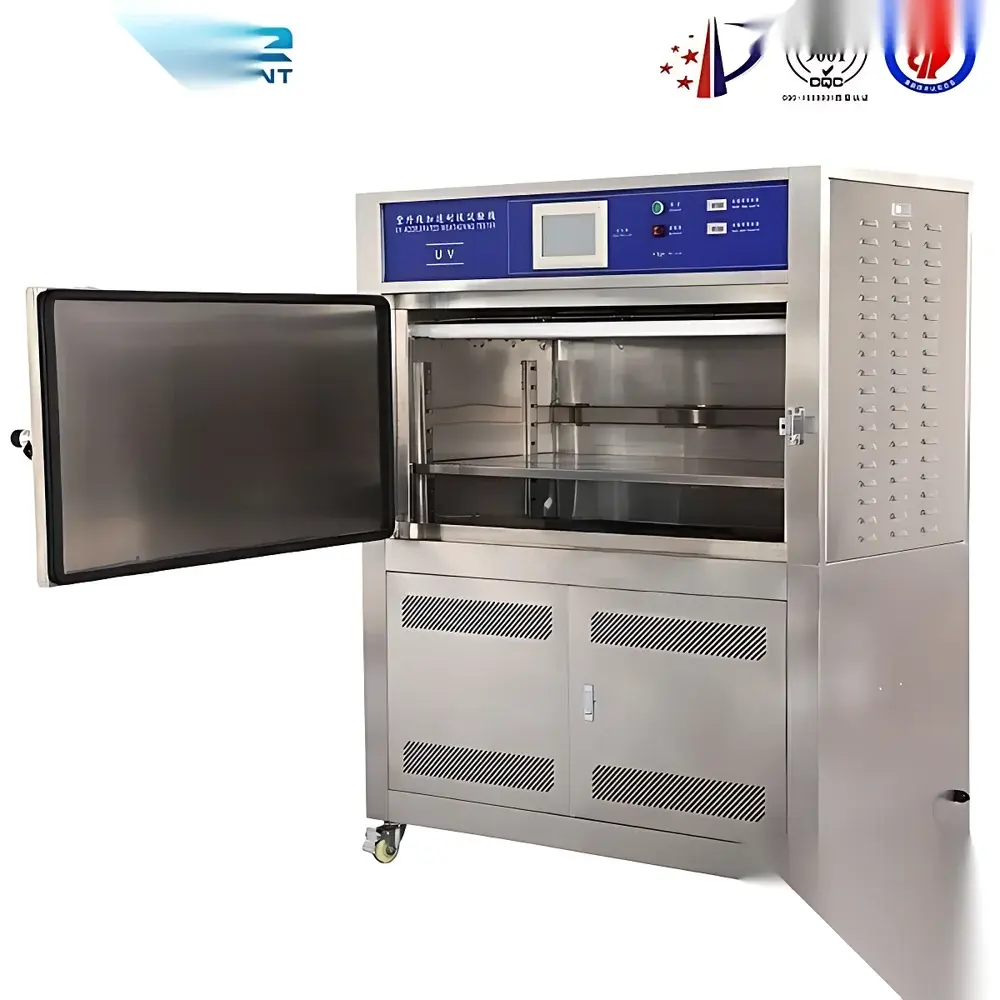
UV Aging Test Chamber – OK-UV-290 Benchtop Fluorescent UV Accelerated Weathering Tester
| Brand | OK Instruments |
|---|---|
| Origin | Imported |
| Manufacturer Type | Authorized Distributor |
| Price | USD 3,150 (FOB) |
| Internal Chamber Dimensions (W×H×D) | 114 × 40 × 40 cm |
| External Dimensions (W×H×D) | 135 × 140 × 65 cm |
| Temperature Range | Ambient to 70 °C |
| Humidity Control | ≥95% RH during condensation cycle |
| Temperature Uniformity | ≤±2 °C (at setpoint) |
| Temperature Accuracy | ≤±0.5 °C |
| UV Lamp Type | Fluorescent UVA-340 or UVB-313 lamps (standard configuration) |
| Spectral Range | 280–400 nm |
| Lamp Lifetime | Approx. 2,000 hours |
| Exposure Time Setting | 0–999 hours (digital timer with auto-cycling) |
| Construction | Interior & exterior chamber walls — AISI 304 stainless steel |
| Heating System | U-shaped titanium alloy high-speed heating elements |
| Safety Features | Interlocked door cut-off for UV lamp power, over-temperature protection, low-water level cutoff, automatic thermal equilibrium recovery |
Overview
The OK-UV-290 UV Aging Test Chamber is an engineered solution for accelerated weathering evaluation of polymeric, coated, and organic materials under controlled ultraviolet radiation, thermal cycling, and moisture condensation. Based on the fundamental principles of photochemical degradation—where UV photons induce bond scission, oxidation, and free-radical chain reactions—the chamber replicates key outdoor stressors using fluorescent UV lamps (UVA-340 or UVB-313) calibrated to match solar spectral irradiance below 400 nm. Unlike xenon arc or carbon arc systems, this instrument emphasizes reproducible, high-intensity UV exposure in conjunction with precisely regulated condensation cycles—mimicking dew formation at night—thereby accelerating failure modes such as chalking, gloss loss, cracking, yellowing, embrittlement, and tensile strength reduction. Designed for laboratory-based durability qualification, it delivers statistically meaningful correlation with real-world field exposure data when operated per internationally recognized test protocols.
Key Features
- Fluorescent UV lamp array (UVA-340 standard; optional UVB-313) with spectral output traceable to NIST-calibrated reference spectroradiometers
- Programmable multi-step test cycles combining UV irradiation (60–80 °C), dark condensation (≥95% RH, 50–60 °C), and optional water spray (per ASTM D4329)
- Digital microprocessor controller with real-time monitoring of chamber temperature, UV irradiance (optional sensor integration), and elapsed exposure time
- AISI 304 stainless steel construction throughout—interior chamber, door gasket, and drip trays—ensuring corrosion resistance and long-term dimensional stability
- U-shaped titanium alloy heating elements enabling rapid thermal response and uniform temperature distribution (≤±2 °C deviation across working volume)
- Interlocked safety system: automatic UV lamp shutdown upon door opening, plus independent over-temperature and low-water-level cutoffs
- Modular lamp tray design facilitating quick replacement without tools; average lamp service life: 2,000 hours at nominal irradiance
Sample Compatibility & Compliance
The OK-UV-290 accommodates flat-panel specimens up to 110 × 35 cm (standard rack capacity: 48 samples at 7.5 × 15 cm each), with optional custom sample holders for irregular geometries. It complies with core international standards governing UV-accelerated exposure testing—including ASTM G154 (fluorescent UV-condensation apparatus), ASTM D4329 (plastics), ASTM D4587 (coatings), ASTM G153 (non-metallic materials), ISO 4892-3 (method A & B), SAE J2020 (automotive exterior materials), and GB/T 14522 (Chinese national standard). Its operational parameters meet GLP-relevant requirements for instrument qualification (IQ/OQ), including documented temperature mapping, UV irradiance uniformity verification, and calibration traceability to accredited laboratories. While not inherently 21 CFR Part 11 compliant, audit-ready electronic logs can be generated via optional RS-485/USB data export modules.
Software & Data Management
The embedded controller supports password-protected user profiles, up to 16 stored test programs, and event-triggered logging (temperature deviation >0.5 °C, lamp fault, door open). Optional PC-based software (OK-UVLink v3.2) enables remote parameter adjustment, real-time graphing of chamber conditions, automated report generation (PDF/CSV), and alignment with LIMS workflows. All test records include timestamped metadata: operator ID, chamber serial number, lamp batch code, calibration certificate expiry, and environmental ambient conditions at startup. Data integrity safeguards include write-protected archive mode and configurable backup intervals to external USB storage.
Applications
This chamber serves as a primary qualification tool across R&D, QC, and regulatory submission phases. In automotive OEM supply chains, it validates UV resistance of interior trim, exterior paint clearcoats, and headlamp polycarbonate lenses. Coating manufacturers use it for QAD (quality assurance documentation) supporting ISO 9001 and IATF 16949 audits. Plastics compounders rely on its repeatability for comparative ranking of HALS (hindered amine light stabilizers) and UV absorbers. Additional validated use cases include: adhesion testing of pressure-sensitive tapes after UV/humidity aging; shelf-life estimation of cosmetic packaging polymers; corrosion resistance assessment of pre-treated aluminum extrusions; and photostability screening of pharmaceutical packaging films per ICH Q1B guidance.
FAQ
What UV lamp types are supported, and how do they differ?
The standard configuration uses UVA-340 lamps, which closely replicate terrestrial sunlight from 295–365 nm—ideal for general polymer and coating testing. UVB-313 lamps emit shorter wavelengths (280–360 nm) and induce more aggressive degradation; they are selected for highly accelerated screening or thin-film applications where rapid failure onset is required.
Can the OK-UV-290 perform cyclic tests with water spray?
Yes—when equipped with the optional water spray module, it executes ASTM D4329-compliant cycles integrating intermittent deionized water application during dark phases to simulate rain erosion effects.
Is temperature uniformity validated across the full working volume?
Yes—per ASTM E2298, temperature mapping is performed at nine spatial points during OQ; reports confirm ≤±2 °C deviation at any setpoint between 40–70 °C.
How often must UV lamps be recalibrated or replaced?
Lamp irradiance decay is monitored via optional radiometer integration; replacement is recommended at 2,000 hours or when output falls below 85% of initial value—whichever occurs first.
Does the system support IQ/OQ documentation packages?
Yes—factory-provided qualification kits include installation checklists, operational test scripts, calibration certificates for temperature sensors and (if installed) UV radiometers, and blank template forms aligned with ISO/IEC 17025 requirements.



