
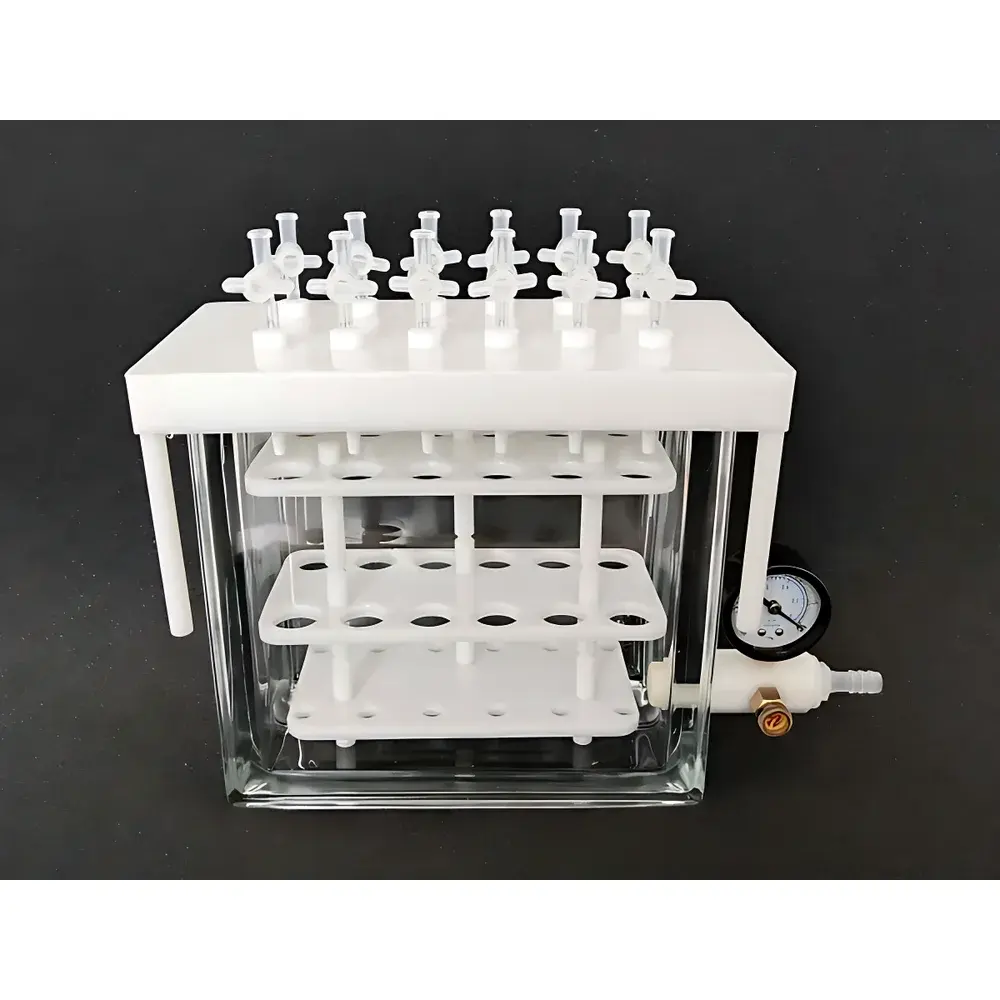
Hanuo SPE-12 Manual Solid Phase Extraction Manifold
| Brand | Hanuo |
|---|---|
| Origin | Shanghai, China |
| Model | SPE-12 |
| Automation Level | Manual |
| Number of Channels | 12 |
| Extraction Format | Cartridge-Based (Column) |
| Vacuum Control | Independent Per-Channel Regulating Valves |
| Vacuum Capacity | Up to –0.08 MPa (–80 kPa) |
| Sample Capacity | 12 Samples |
| Support Plate Material | High-Molecular-Weight Polymer |
| Vacuum Chamber Material | Borosilicate Glass (Square Chamber, One-Piece Molded) |
| Weight | 3.4 kg |
| Compliance | Designed for ASTM D7292, ISO 16775, and USP <621> sample preparation workflows |
Overview
The Hanuo SPE-12 Manual Solid Phase Extraction Manifold is an engineered platform for reproducible, low-risk solid-phase extraction (SPE) of liquid samples in regulated and research laboratory environments. Based on vacuum-assisted, cartridge-based separation principles, the system leverages controlled negative pressure to drive sample loading, washing, and elution steps across twelve independent SPE columns. Unlike automated systems, the SPE-12 provides full operator control over flow dynamics via individual stainless-steel needle valves—enabling precise method optimization for diverse sorbent chemistries (e.g., C18, silica, SCX, NH₂, mixed-mode) and matrix types (aqueous, biological fluids, environmental extracts). Its modular architecture supports both standard 1 mL–6 mL cartridges and stacked disk formats, making it suitable for routine QC, environmental monitoring, clinical toxicology screening, and pharmaceutical impurity isolation where method flexibility and audit-ready consistency are required.
Key Features
- Twelve independently adjustable stainless-steel regulating valves—each with tactile feedback and fine-thread precision—allow real-time flow rate modulation during all SPE stages (loading, rinsing, drying, elution).
- Modular support plate system with interchangeable high-molecular-weight polymer trays; compatible with 12 mm, 16 mm, and 25 mm diameter SPE cartridges and stacked disk assemblies.
- Vacuum chamber constructed from one-piece, thick-walled borosilicate glass (square configuration), offering superior chemical resistance to organic solvents (e.g., acetonitrile, methanol, dichloromethane) and strong acids/bases used in method development.
- Integrated anti-cross-contamination design: sealed valve manifolds prevent vapor migration between channels; vacuum chamber features a non-fogging, low-volatility seal interface to minimize solvent condensation and column bypass.
- Integrated analog vacuum gauge (0 to –0.1 MPa range) enables continuous pressure monitoring without external instrumentation—critical for GLP-compliant documentation and method transfer validation.
- Optional accessories include high-capacity solvent collection reservoirs (500 mL/1 L), nitrogen-assisted dry-down modules, and calibrated glass fraction collectors—all designed to integrate seamlessly with the SPE-12’s mounting geometry and vacuum port layout.
Sample Compatibility & Compliance
The SPE-12 accommodates a broad spectrum of sample matrices—including wastewater, plasma, urine, food homogenates, plant extracts, and pharmaceutical formulations—without modification to core hardware. All wetted components comply with USP Class VI biocompatibility standards and exhibit no detectable leachables under ICH Q5A stress conditions. The system is routinely deployed in laboratories adhering to ISO/IEC 17025, FDA 21 CFR Part 11 (when paired with validated electronic lab notebook logging), and EU GMP Annex 11 requirements. Its manual operation mode inherently supports full traceability: each valve position, vacuum reading, and timing step can be recorded manually or via synchronized stopwatch logging per SOP. It meets the mechanical and material specifications referenced in ASTM D7292 (determination of PAHs in water) and ISO 16775 (extraction of pesticides from soil and sediment).
Software & Data Management
As a fully manual manifold, the SPE-12 does not incorporate embedded firmware or proprietary software. This design eliminates cybersecurity risks associated with networked instruments and ensures long-term operational continuity without vendor lock-in or license renewal dependencies. All procedural parameters—including vacuum setpoint, dwell time per step, eluent volume, and valve calibration settings—are documented externally using standardized laboratory notebooks or validated LIMS templates. For laboratories requiring digital workflow integration, the SPE-12 is compatible with third-party time-stamped video recording systems and barcode-scanned sample tracking protocols aligned with ALCOA+ data integrity principles.
Applications
- Environmental analysis: Isolation of PFAS, PCBs, organochlorine pesticides, and heavy metal chelates from surface water, groundwater, and sludge extracts.
- Clinical and forensic toxicology: Cleanup and concentration of opioids, benzodiazepines, amphetamines, and synthetic cannabinoids from serum and urine prior to LC-MS/MS analysis.
- Food safety testing: Removal of phospholipids, pigments, and fatty acids from meat, dairy, and cereal extracts before GC-ECD or HPLC-UV quantification of mycotoxins and veterinary drug residues.
- Pharmaceutical R&D: Desalting and buffer exchange of peptide digests; removal of unreacted reagents following solid-phase synthesis.
- Biochemical research: Fractionation of glycoproteins and nucleic acid contaminants from cell lysates using immobilized metal affinity (IMAC) and anion-exchange cartridges.
FAQ
Is the SPE-12 compatible with 3 mL and 6 mL SPE cartridges?
Yes—the support plate accepts standard 12 mm, 16 mm, and 25 mm outer diameter cartridges, including 1 mL, 3 mL, and 6 mL formats, as well as stacked disk configurations.
Can the vacuum chamber be autoclaved?
No—the borosilicate glass chamber is not designed for autoclaving; cleaning is performed using solvent rinses followed by air-drying under laminar flow.
What vacuum pump specifications are recommended?
A two-stage oil-sealed rotary vane pump capable of sustaining ≤ –0.085 MPa at the chamber inlet is recommended; diaphragm pumps may be used for lower-throughput applications but require verification of ultimate vacuum stability.
Does the system include tubing and fittings?
Standard delivery includes 12 pieces of PTFE-coated stainless-steel needles, 12 silicone vacuum tubing segments (4 mm ID), and one 8 mm ID main vacuum hose with barbed connectors.
How is method reproducibility ensured without electronic flow control?
Reproducibility is achieved through operator training, standardized valve-turn counts per method, use of calibrated vacuum gauges, and adherence to documented SOPs that specify dwell times, solvent volumes, and visual endpoint criteria (e.g., dry bed appearance).



