
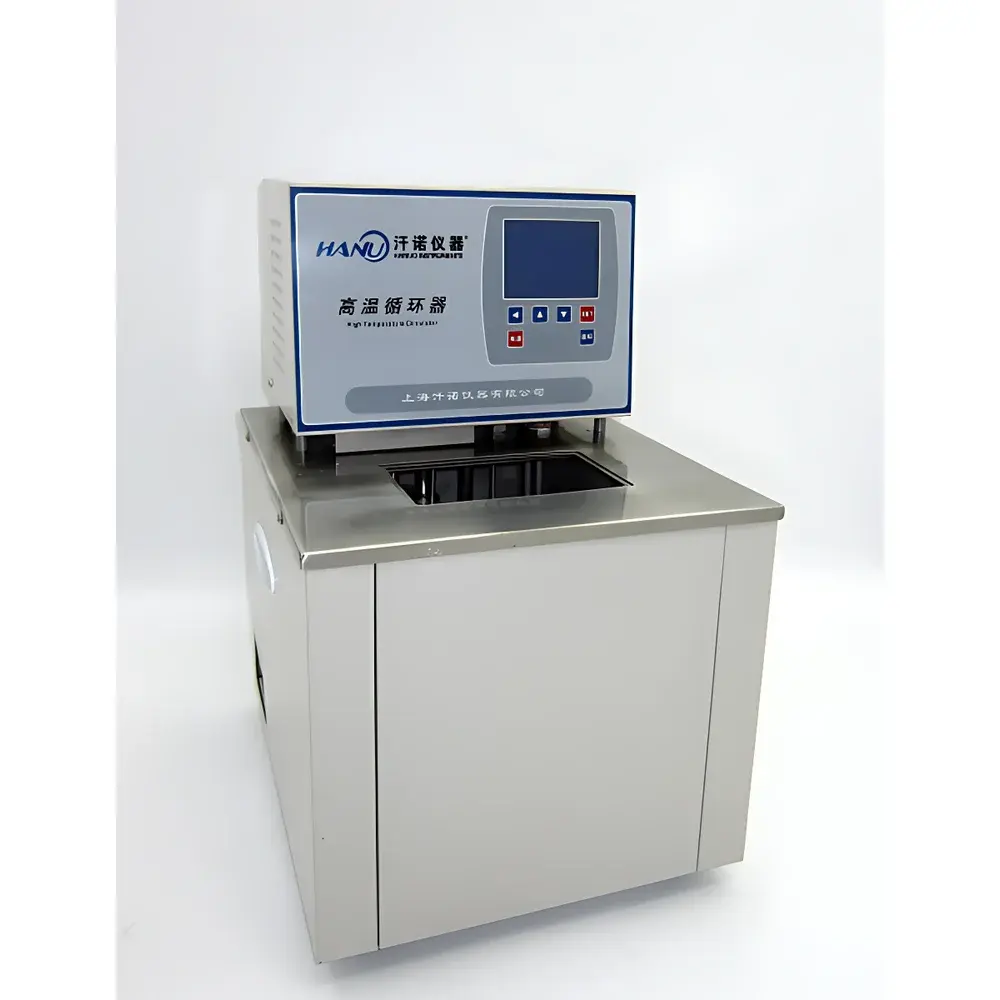
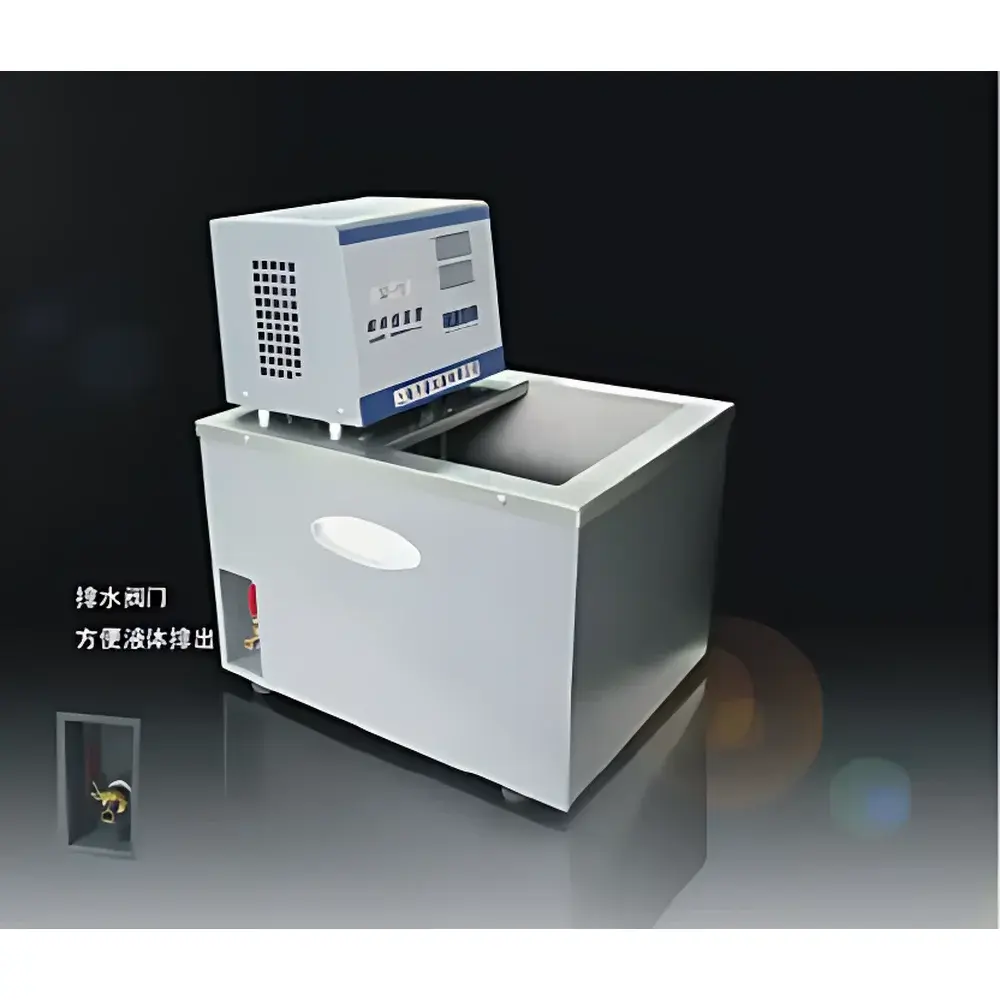
Hanuo GX-2050 High-Temperature Circulating Oil Bath
| Brand | Hanuo |
|---|---|
| Origin | Shanghai, China |
| Model | GX-2050 |
| Temperature Range | RT to 300 °C |
| Stability | ±0.2 °C |
| Bath Volume | 50 L |
| External Circulation Flow Rate | 15 L/min |
| Tank Dimensions (W×D×H) | 500 × 330 × 300 mm |
| Depth | 300 mm |
| Display | Dual LED (Setpoint & Actual Temperature) |
| Control Interface | Touch Keypad |
Overview
The Hanuo GX-2050 High-Temperature Circulating Oil Bath is a precision-engineered thermal management system designed for demanding laboratory and pilot-scale applications requiring stable, uniform heating up to 300 °C. Unlike water baths limited by boiling point, this unit utilizes thermally stable silicone or mineral oils as the heat transfer medium—enabling reliable operation across extended high-temperature ranges without evaporation, oxidation, or pressure buildup. Its core function relies on forced convection via an integrated high-flow external circulation pump, delivering consistent thermal energy to jacketed reactors, distillation columns, calorimeters, and semiconductor processing fixtures. The system operates exclusively in heating mode with no built-in refrigeration; however, it supports seamless integration with external chillers or tap-water cooling loops for controlled exothermic reaction quenching—a critical capability in synthetic chemistry, polymerization, and materials annealing workflows.
Key Features
- Microprocessor-based PID temperature controller with dual LED display showing both setpoint and real-time bath temperature—ensuring intuitive monitoring and rapid parameter adjustment.
- Robust external circulation system delivering up to 15 L/min flow rate, optimized for low-backpressure delivery to auxiliary equipment such as reactor jackets or condenser coils.
- Stainless steel working tank (500 × 330 × 300 mm, 300 mm depth) with 50 L usable volume, engineered for mechanical durability and chemical resistance against common heat-transfer oils.
- Thermal stability of ±0.2 °C at setpoints across the full 25–300 °C operating range—validated under steady-state conditions per ISO 17025-aligned calibration protocols.
- Touch-key interface with password-protected parameter locking, supporting repeatable method recall and operator-level access control suitable for GLP-compliant environments.
- Modular design allows optional integration with external refrigerated circulators or tap-water heat exchangers for active cooling down to ambient—enabling bidirectional temperature trajectory control in multi-step reaction protocols.
Sample Compatibility & Compliance
The GX-2050 accommodates a broad spectrum of heat-transfer media including polydimethylsiloxane (PDMS) oils, aromatic hydrocarbons, and high-flash-point mineral oils—compatible with ASTM D445 (kinematic viscosity), ASTM D92 (Cleveland Open Cup flash point), and IEC 61000-6-3 (EMC emissions). Its construction meets IP20 ingress protection standards and complies with CE marking requirements for electrical safety (EN 61010-1). While not intrinsically rated for hazardous locations, the unit is routinely deployed in Class 1000 cleanrooms and ISO 14644-1 certified facilities when paired with closed-loop oil circulation and vapor containment accessories. No internal plumbing or wetted parts contact process samples directly; all thermal exchange occurs through indirect jacketed interfaces—supporting compliance with USP analytical instrument qualification frameworks.
Software & Data Management
The GX-2050 operates autonomously via its embedded firmware and does not include proprietary PC software or USB/Ethernet connectivity. However, analog 0–10 V or 4–20 mA output signals (optional) enable integration into centralized SCADA or LIMS platforms for remote setpoint modulation and temperature logging. All operational events—including power-on cycles, over-temperature alarms, and pump fault states—are timestamped and retained in non-volatile memory for audit trail generation. For laboratories subject to FDA 21 CFR Part 11 requirements, third-party data acquisition systems may be interfaced using standard Modbus RTU protocol (RS-485 port available upon request) to support electronic signature, audit trail, and role-based access configurations.
Applications
- Temperature control of glass-lined or stainless-steel jacketed reactors during catalytic hydrogenation, Grignard synthesis, and Friedel-Crafts acylation.
- Heating feed streams in pilot-scale fractional distillation and wiped-film evaporation systems operating above 200 °C.
- Thermal conditioning of wafer chucks and probe stations in semiconductor R&D labs requiring sub-degree stability at elevated temperatures.
- Accelerated aging studies of elastomers, adhesives, and encapsulants per ASTM D573 and ISO 188 protocols.
- Calibration of high-temperature RTDs, thermocouples (Types K, S, R), and infrared pyrometers using traceable NIST-traceable reference standards.
FAQ
What types of heat-transfer fluids are compatible with the GX-2050?
Silicone oils (e.g., Dow Corning 200 Fluid series), polyalphaolefins (PAOs), and high-stability mineral oils meeting ASTM D1120 specifications are recommended. Avoid glycols, water, or low-flash-point solvents.
Can the unit maintain temperature during extended unattended operation?
Yes—equipped with over-temperature cutoff, dry-run protection, and auto-restart after power interruption (configurable), enabling 72+ hour continuous operation under monitored conditions.
Is the external circulation port compatible with standard tubing fittings?
The unit features dual 1/2″ BSP male threaded ports (inlet/outlet) compatible with reinforced silicone or PTFE-lined hoses rated for >300 °C service.
Does the GX-2050 meet international calibration traceability requirements?
The factory calibration certificate includes uncertainty values referenced to NPL or NIM standards; users may perform in-house verification using accredited PT100 probes per ISO/IEC 17025.
What maintenance intervals are recommended for optimal performance?
Oil level and clarity inspection every 200 operating hours; full oil replacement every 1,500 hours or annually—whichever occurs first—using manufacturer-specified thermal fluid.



