
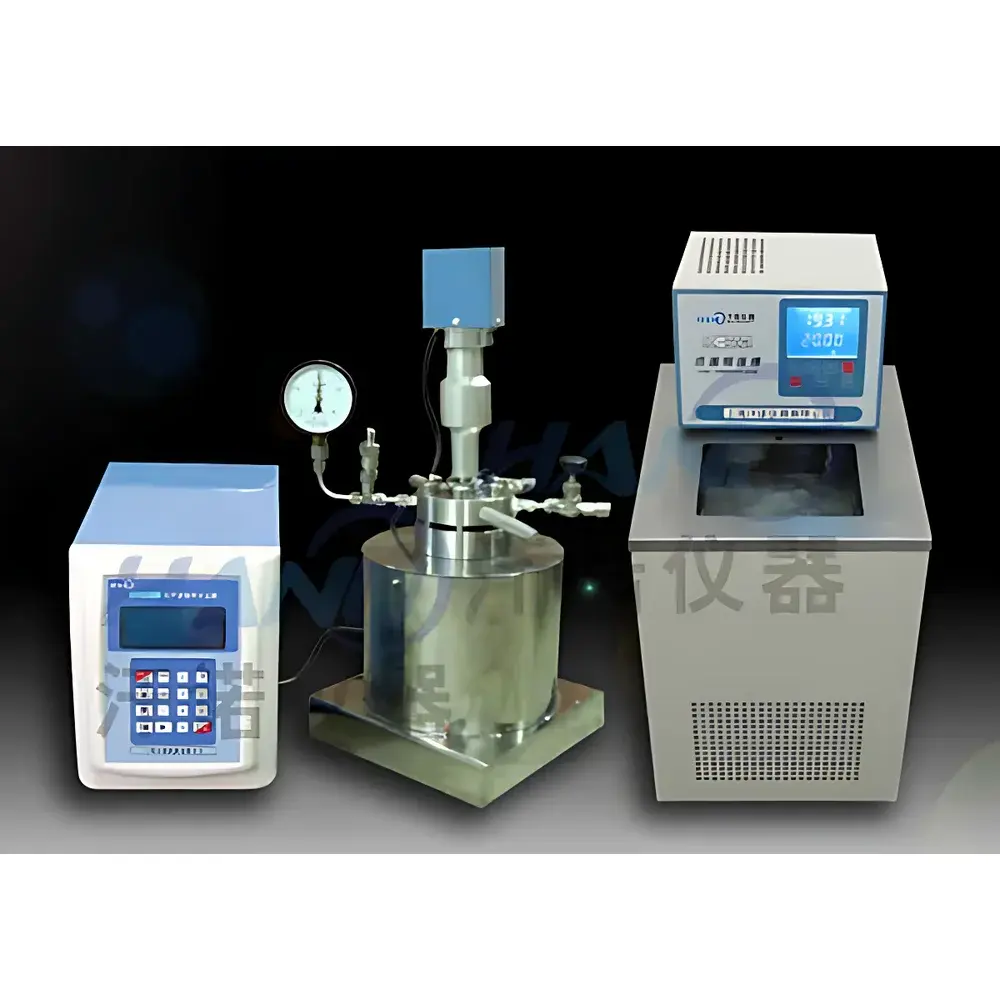
Hanuo HNGYF-250D Low-Temperature High-Pressure Ultrasonic Reactor
| Brand | Hanuo |
|---|---|
| Origin | Shanghai, China |
| Model | HNGYF-250D |
| Working Volume | 250 mL |
| Operating Pressure | Up to 12.5 MPa |
| Temperature Range | −10 °C to 100 °C |
| Ultrasonic Power Output | 20–1000 W (continuously adjustable) |
| Vacuum Capability | 0.1 MPa |
| Construction Material | Stainless Steel (316L grade typical) |
| Transducer Type | Titanium alloy sonotrode with focused ultrasonic energy delivery |
| Cooling/Heating Configuration | Double- or triple-jacketed vessel for precise thermal control |
| Sealing Method | Flanged ultrasonic transducer interface with metal gasket sealing |
Overview
The Hanuo HNGYF-250D Low-Temperature High-Pressure Ultrasonic Reactor is an engineered platform for intensifying chemical synthesis, catalytic reactions, and material dispersion under precisely controlled thermobaric conditions. It integrates high-intensity focused ultrasound—delivered via a titanium alloy sonotrode immersed directly into the reaction medium—with simultaneous pressure containment up to 12.5 MPa and temperature regulation from −10 °C to 100 °C. Unlike bath-type or indirect ultrasonic systems, this reactor employs a direct-coupled, high-amplitude piezoelectric transducer mounted through a pressure-rated flange, ensuring zero acoustic energy loss at the interface and maintaining hermetic integrity during operation. The reactor core operates on the principle of acoustic cavitation: ultrasonic waves generate transient microbubbles in the liquid phase that collapse violently, producing localized hotspots (>5000 K), extreme pressures (>1000 atm), and intense shear forces—conditions known to accelerate reaction kinetics, enhance mass transfer, and promote nanoparticle nucleation or emulsification. Its dual capability for cryogenic operation and high-pressure confinement makes it especially suitable for hydrogenation, CO₂ utilization, hydrothermal synthesis, and low-temperature polymerization where conventional reactors face kinetic or solubility limitations.
Key Features
- Stainless steel (316L-equivalent) pressure vessel rated to 12.5 MPa, with optional double- or triple-jacket configuration for independent heating/cooling circuits
- Integrated titanium alloy sonotrode with replaceable tip geometry, delivering 20–1000 W of controllable ultrasonic power at 20 kHz ± 0.5 kHz
- Hermetically sealed ultrasonic feedthrough using metal C-ring or silver-gasket flange assembly compliant with ASME B16.5 Class 600 requirements
- Programmable digital ultrasonic generator with real-time amplitude modulation, duty cycle control, and overload protection
- Top-mounted magnetic coupling drive (optional) enabling simultaneous mechanical agitation and ultrasonic irradiation without compromising seal integrity
- Modular reactor head accommodating standard ports for gas inlet/outlet, sampling valve, pressure transducer, PT100 sensor, reflux condenser, and liquid addition funnel
- Motorized mechanical lifting system (optional) for safe, repeatable lid actuation during high-pressure operation
Sample Compatibility & Compliance
The HNGYF-250D supports heterogeneous, homogeneous, and multiphase reaction systems—including aqueous, organic, supercritical CO₂, and ionic liquid media. Its inert stainless-steel wetted surfaces ensure compatibility with corrosive reagents (e.g., halogenated solvents, strong acids/bases) and catalysts (Pd/C, Raney Ni, MOFs). All pressure-containing components conform to GB/T 150.1–2011 (Chinese equivalent of ASME VIII Div. 1) and are subject to hydrostatic testing at 1.5× design pressure prior to shipment. The system supports GLP-compliant documentation packages, including calibration certificates for pressure and temperature sensors traceable to NIM (National Institute of Metrology, China). While not inherently FDA 21 CFR Part 11–compliant, data logging outputs (via RS485/Modbus or analog 4–20 mA signals) can be integrated into validated LIMS or SCADA environments meeting GMP audit requirements.
Software & Data Management
The reactor is operated via a dedicated industrial touchscreen HMI (Human-Machine Interface) with embedded PLC logic. Control parameters—including ultrasonic amplitude (%), setpoint temperature, ramp rate, target pressure, stirring speed (if equipped), and run duration—are programmable in multi-step sequences. Real-time trend logging records all process variables at configurable intervals (1 s to 60 s), stored internally (SD card) and exportable as CSV or Excel-compatible files. Optional Ethernet/IP or OPC UA connectivity enables remote monitoring and integration with LabVIEW, MATLAB, or DeltaV DCS platforms. Audit trail functionality includes user login timestamps, parameter change logs, and alarm history—supporting basic ALCOA+ principles (Attributable, Legible, Contemporaneous, Original, Accurate, Complete, Consistent, Enduring, Available) for regulated research workflows.
Applications
- Catalytic hydrogenation under sub-ambient temperatures and elevated H₂ pressure, minimizing thermal decomposition of sensitive substrates
- Ultrasound-assisted synthesis of metal–organic frameworks (MOFs) and perovskite nanocrystals with narrow size distribution
- High-pressure hydrolysis or esterification reactions requiring precise water activity control and rapid mixing
- Supercritical fluid processing (e.g., scCO₂ + ultrasound) for extraction, impregnation, or particle formation
- Low-temperature cross-coupling reactions (Suzuki, Heck) enabled by enhanced reagent activation via cavitation-induced radical generation
- In situ monitoring of crystallization kinetics using integrated optical port (optional quartz viewport)
FAQ
What is the maximum allowable operating pressure and temperature range?
The HNGYF-250D is rated for continuous operation up to 12.5 MPa and −10 °C to 100 °C; short-term excursions beyond these limits require prior engineering review.
Can mechanical stirring and ultrasonic irradiation operate simultaneously?
Yes—via optional top-entry magnetic coupling agitator combined with bottom-immersed sonotrode; shaftless design eliminates dynamic seal failure modes.
Is the ultrasonic frequency fixed or tunable?
The system operates at a nominal 20 kHz with ±0.5 kHz stability; frequency sweeping or harmonic mode operation is not supported.
How is temperature controlled during ultrasonic operation?
Circulating chiller/heater fluid passes through the jacket; PID-controlled external unit maintains setpoint within ±0.3 °C under steady-state cavitation load.
What safety certifications does the reactor carry?
It complies with GB/T 150.1–2011 for pressure equipment and meets CE machinery directive (2006/42/EC) when supplied with full enclosure and interlocked access doors.



