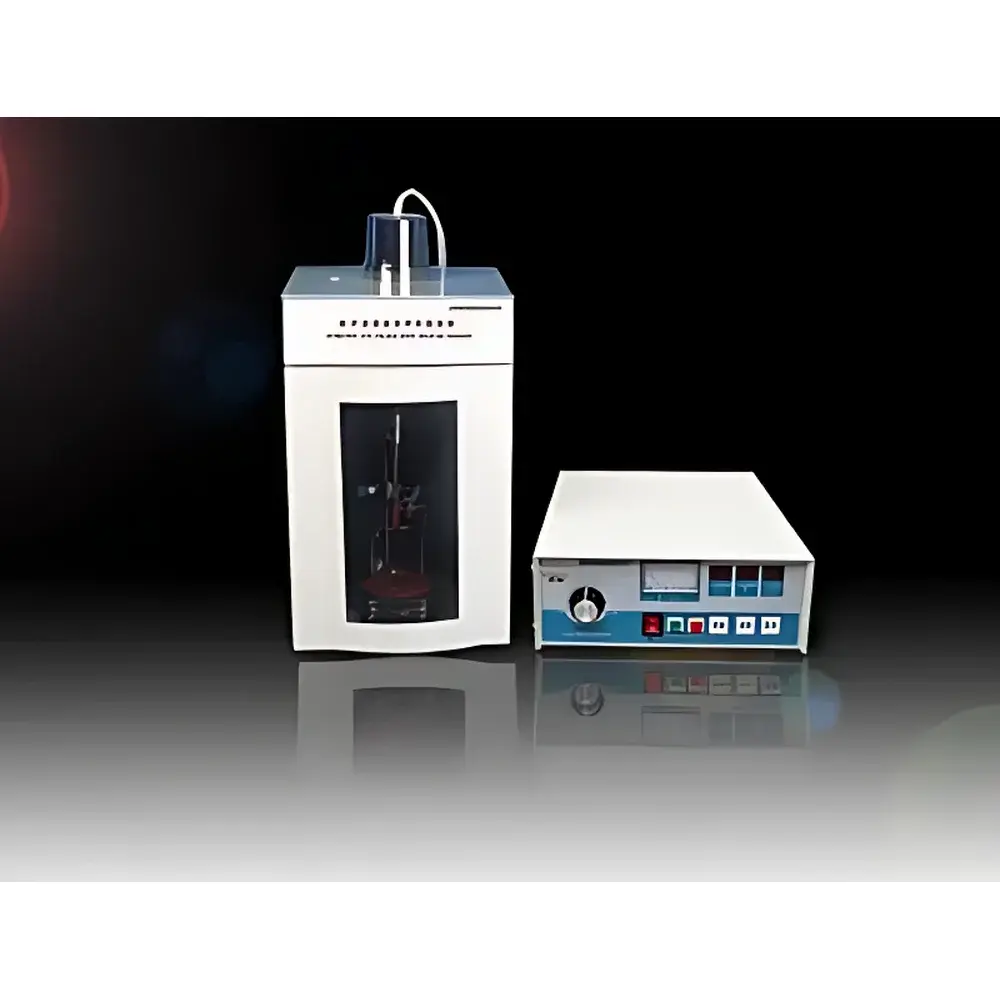
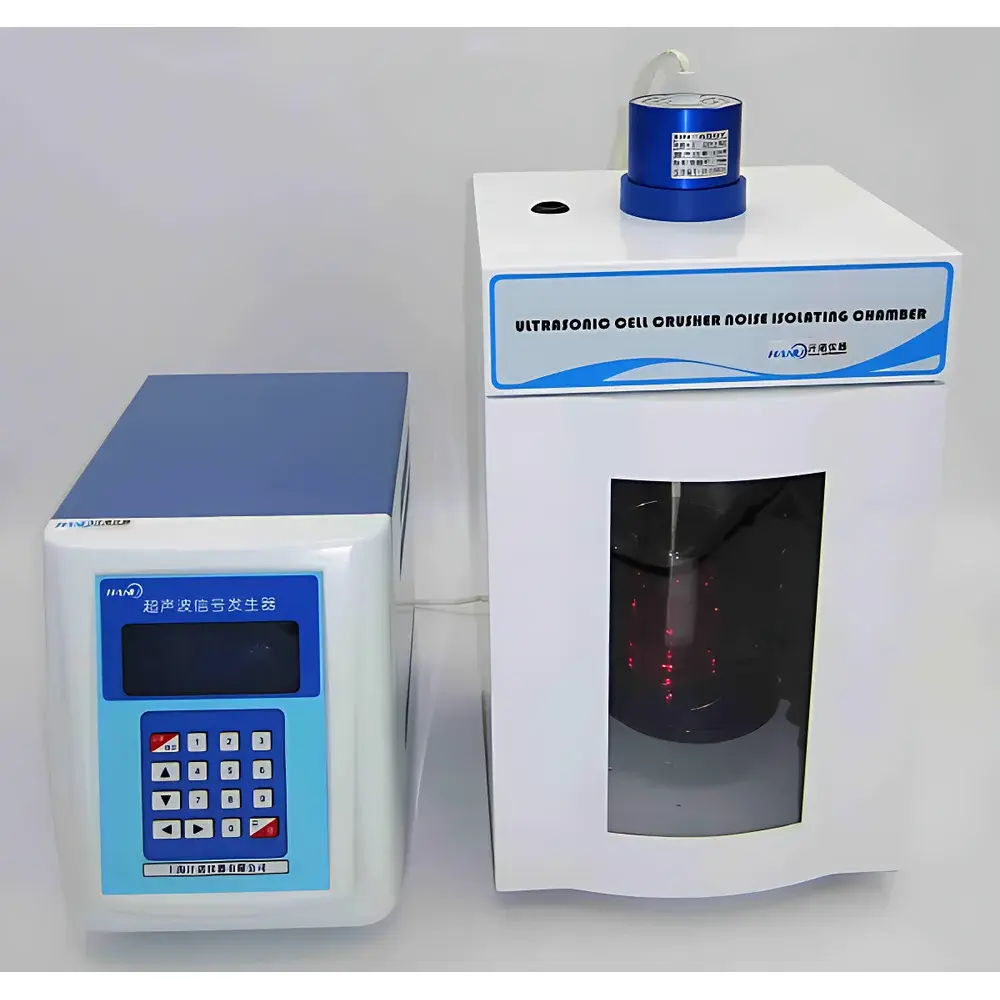
Hanuo HN92-IID Temperature-Controlled Ultrasonic Cell Disruptor & Homogenizer
| Brand | Hanuo |
|---|---|
| Model | HN92-IID |
| Instrument Type | Ultrasonic Cell Disruptor |
| Ultrasonic Power | 20–900 W (adjustable) |
| Operating Frequency | 20–25 kHz |
| Temperature Control Range | Ambient to 90 °C |
| Maximum Sample Volume | 1000 mL |
| Probe Diameter | Φ6 mm or Φ10 mm (included) |
| Duty Cycle | 1–99.9% |
| Sample Capacity Range | 0.2–600 mL |
| Temperature Protection Threshold | ≤90 °C |
| Probe Material | Titanium Alloy (Ti-6Al-4V) |
| Control System | Microprocessor-Based with Digital Interface |
Overview
The Hanuo HN92-IID is a benchtop, temperature-controlled ultrasonic cell disruptor engineered for reproducible lysis of biological samples under thermally regulated conditions. It operates on the principle of high-intensity focused ultrasound (HIU), generating acoustic cavitation in liquid media—where rapid formation and collapse of microbubbles produce localized shear forces, shockwaves, and transient hotspots (>5000 K, >1000 atm). This physical mechanism enables efficient disruption of membranes, organelles, and extracellular matrices without chemical additives or enzymatic digestion. Designed for life science laboratories requiring strict thermal management during sample preparation, the HN92-IID integrates real-time temperature monitoring and active cooling compensation to mitigate heat-induced denaturation of proteins, nucleic acids, and labile biomolecules. Its architecture conforms to standard biosafety Level 2 (BSL-2) workflow requirements and supports routine use in downstream applications including protein extraction, chromatin shearing (ChIP-seq prep), plasmid isolation, and nanoparticle dispersion.
Key Features
- Titanium alloy probe (Ti-6Al-4V) with optimized horn geometry for uniform energy transfer and resistance to acoustic erosion and corrosion.
- Microprocessor-controlled power delivery with continuous 20–900 W adjustment and automatic amplitude stabilization across variable load impedances (e.g., viscosity, volume, vessel geometry).
- Digital temperature feedback loop with Pt100 sensor embedded in the sample cup or jacketed vessel interface; user-defined upper limit (up to 90 °C) triggers automatic ultrasonic pause or duty-cycle reduction.
- Programmable operating parameters: total sonication time (1 s–99 h 59 min), pulse-on/pulse-off intervals (10 ms–999 s), and duty cycle (1–99.9%) for precise control of thermal and mechanical stress exposure.
- Integrated acoustic isolation chamber lined with multi-layer viscoelastic damping material, achieving ≥45 dB(A) noise attenuation at 25 kHz—compliant with ISO 11201 for laboratory equipment sound emission.
- Front-panel LCD with real-time display of power output (%), actual amplitude (µm), elapsed time, and measured sample temperature (°C).
Sample Compatibility & Compliance
The HN92-IID accommodates a broad range of sample types—including mammalian and insect cell suspensions, bacterial cultures (E. coli, Bacillus spp.), yeast, plant tissues (leaf homogenates, root extracts), viral lysates, and synthetic colloids—within volumes from 0.2 mL (microcentrifuge tube mode) up to 1000 mL (jacketed beaker configuration). Probe selection (Φ6 mm for low-volume/high-intensity work; Φ10 mm for larger volumes and viscous samples) ensures optimal energy coupling. The system complies with IEC 61000-6-3 (EMC emission limits) and IEC 61010-1 (safety requirements for electrical equipment for measurement, control, and laboratory use). Temperature logging functionality supports GLP/GMP documentation when paired with external data acquisition systems meeting FDA 21 CFR Part 11 audit trail requirements.
Software & Data Management
While the HN92-IID operates autonomously via its embedded microcontroller, optional RS-232 or USB-to-serial interface enables integration with third-party laboratory information management systems (LIMS) or custom Python/Matlab scripts for protocol automation and metadata capture. Timestamped operational logs—including setpoints, actual power, temperature history, and cycle completion status—can be exported as CSV files. No proprietary software installation is required; all parameter configurations are retained in non-volatile memory after power-down. For regulated environments, the instrument supports manual entry of operator ID and batch/sample ID directly on the front panel to facilitate traceability.
Applications
- Cell lysis for proteomics and metabolomics workflows requiring native-state protein preservation.
- Preparation of soluble antigen extracts for ELISA and immunoblotting.
- Mechanical shearing of genomic DNA for library construction in next-generation sequencing (NGS).
- Dispersion of carbon nanotubes, graphene oxide, and metal oxide nanoparticles in aqueous or organic solvents.
- Enhancement of solvent-based extraction efficiency for alkaloids, flavonoids, and terpenoids in phytochemical analysis.
- Routine homogenization of tissue biopsies prior to RNA isolation under RNase-inhibiting conditions.
FAQ
What is the maximum recommended continuous operation time per cycle?
For thermal stability and probe longevity, continuous sonication should not exceed 5 minutes without an intervening cooling interval. Pulse-mode operation (e.g., 5 s on / 5 s off) is recommended for extended protocols.
Can the HN92-IID be used with corrosive solvents such as chloroform or strong acids?
Titanium alloy probes resist most aqueous buffers and mild organic solvents; however, prolonged exposure to halogenated hydrocarbons, concentrated mineral acids, or fluorinated compounds may compromise surface integrity and is not advised without prior compatibility testing.
Is calibration traceable to national standards?
Ultrasonic power output is factory-calibrated using a NIST-traceable calorimetric method (ASTM E2884-13); certificate of conformance is provided with each unit.
Does the system support external temperature probes for jacketed vessels?
Yes—the rear-panel analog input accepts 0–5 V signals from external Pt100 or thermistor probes, enabling closed-loop control of circulating water baths or Peltier-cooled reactors.
How is acoustic energy output verified during routine maintenance?
Users may perform periodic verification using a calibrated hydrophone (e.g., Onda HGL-0085) and oscilloscope per IEC 62127-1, or employ the aluminum foil erosion test (ISO 20487) for relative consistency checks.
Related Products