
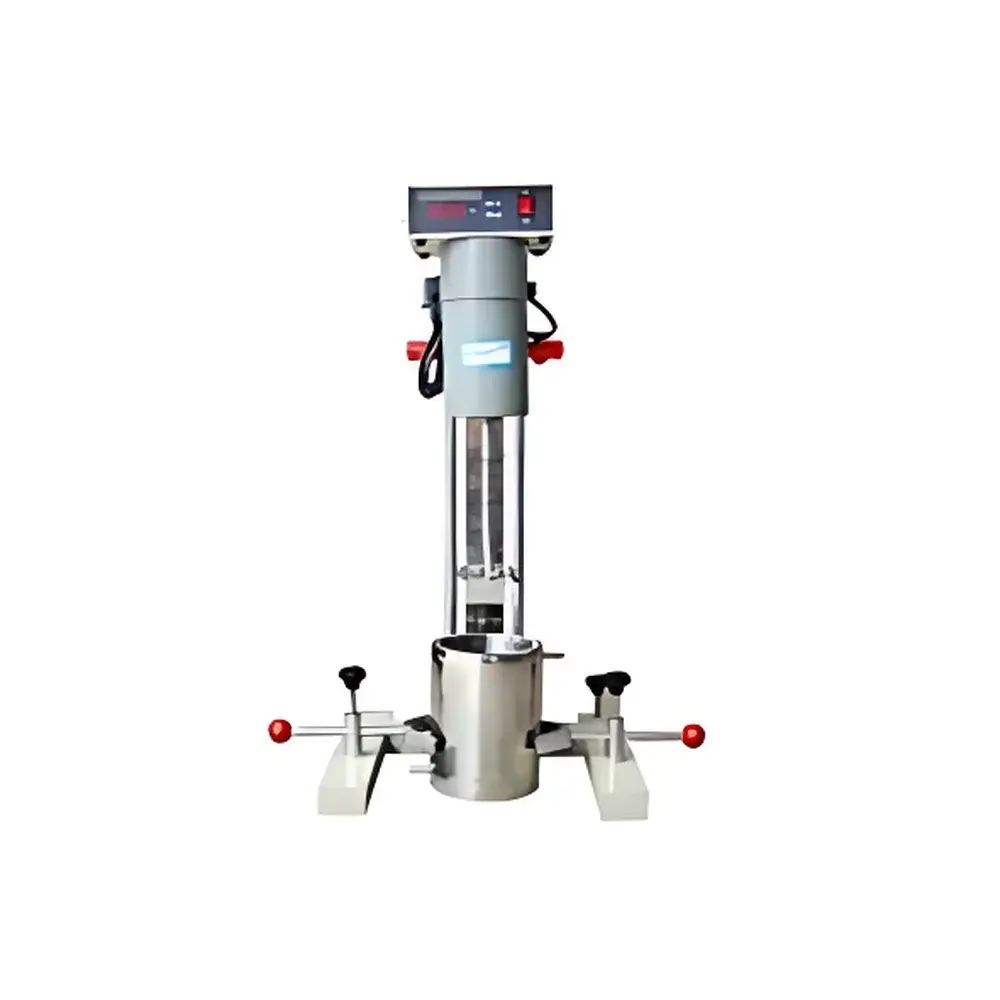
Hanuo SFS-400 High-Speed Disperser
| Brand | Hanuo |
|---|---|
| Origin | Shanghai, China |
| Manufacturer Type | Authorized Distributor |
| Country of Origin | China |
| Model | SFS-400 |
| Motor Power | 400 W |
| Motor Type | Precision Micro-Motor |
| Voltage/Frequency | 220 V / 50 Hz |
| Speed Range | 0–8000 rpm |
| Speed Display | Digital, Stepless Adjustment |
| Processing Volume | 0.2–5 L (in water) |
| Contact Material | SS304 Stainless Steel |
| Working Head Configurations | Φ50 mm & Φ80 mm dispersing discs |
| Height Adjustment | Manual with counterbalance mechanism |
| Net Weight | 20 kg |
| Dimensions (W×D×H) | 450 × 420 × 860 mm |
| Packaging | Standard Wooden Crate |
Overview
The Hanuo SFS-400 High-Speed Disperser is an engineered laboratory instrument designed for efficient dispersion, homogenization, and rapid dissolution of viscous and heterogeneous materials in liquid media. It operates on the principle of high-shear hydrodynamic cavitation and turbulent vortex generation: rotation of the dispersing disc at controlled speeds induces intense radial flow, axial recirculation, and localized shear gradients—enabling effective particle deagglomeration, wetting, and uniform phase distribution. Unlike low-shear mixers, this unit delivers reproducible mechanical energy input across scalable volumes (0.2–5 L), making it suitable for formulation development, pigment dispersion, nanoparticle suspension stabilization, and emulsion preparation in R&D laboratories. Its compact footprint, rigid column assembly, and balanced manual lift system ensure operational stability during extended runs—even at maximum rotational speeds.
Key Features
- 400 W precision micro-motor with thermal overload protection and electromagnetic braking for safe, repeatable start/stop cycles
- Digital RPM display with stepless speed control (0–8000 rpm), enabling precise process parameter documentation and method transfer
- Interchangeable SS304 working heads: two dispersing discs (Φ50 mm and Φ80 mm) optimized for macro-mixing and vortex induction; two sand-milling discs (Φ45 mm and Φ60 mm) for enhanced surface-area contact and fine-particle attrition
- Manual height adjustment with counterbalanced lift mechanism—ensures consistent immersion depth and eliminates operator-induced torque variation
- Full SS304 wetted parts compliant with general laboratory corrosion resistance requirements and compatible with aqueous, polar organic, and mild solvent systems
- Low-noise operation (<65 dB(A) at 1 m) and vibration-damped base design support continuous duty cycles up to 8 hours without thermal derating
Sample Compatibility & Compliance
The SFS-400 accommodates a broad range of sample viscosities (up to 10,000 mPa·s) and densities (0.8–2.2 g/cm³), including suspensions, pastes, latexes, and non-Newtonian fluids. Its modular head configuration allows method optimization per material rheology—e.g., larger discs for low-viscosity bulk mixing; smaller milling discs for high-viscosity shear-sensitive formulations. While not certified to ISO 17025 or GLP as a standalone analytical instrument, the device supports compliance-driven workflows when integrated into validated SOPs. All mechanical adjustments are lockable; speed settings are manually recorded—facilitating traceability in quality-controlled environments adhering to internal lab standards or preliminary FDA 21 CFR Part 11-aligned documentation practices.
Software & Data Management
This model operates as a stand-alone benchtop unit without embedded firmware or digital connectivity. Speed values are displayed locally via LED readout; no data logging, USB export, or PC interface is provided. Users must manually record operational parameters (RPM, time, head type, volume, temperature) in laboratory notebooks or LIMS-compatible spreadsheets. For regulated applications requiring audit trails, integration with external timers, thermal probes, or video-based process monitoring is recommended. The absence of proprietary software reduces cybersecurity exposure and simplifies qualification (IQ/OQ) under GxP frameworks where minimal electronic records are preferred.
Applications
- Preparation of stable pigment and dye dispersions for coating and ink R&D
- Homogenization of ceramic slurries and battery electrode pastes prior to rheological or electrochemical testing
- Emulsification of oil-in-water and water-in-oil systems for food science and pharmaceutical prototype development
- Deagglomeration of nanomaterials (e.g., TiO₂, SiO₂, carbon black) in aqueous or ethanolic carriers
- Accelerated dissolution testing of poorly soluble APIs in biorelevant media
- Blending of polymer solutions and crosslinker precursors for hydrogel synthesis
FAQ
What is the maximum viscosity this disperser can handle effectively?
For optimal dispersion efficiency and motor longevity, the unit is rated for continuous operation with Newtonian fluids up to ~10,000 mPa·s (e.g., 30% w/w xanthan gum solution). Higher viscosities may be processed intermittently using lower RPM and shorter duty cycles.
Is the SFS-400 suitable for use with flammable solvents?
The motor lacks ATEX or UL Class I Div 1 certification. It is intended for use only with non-flammable or low-flashpoint solvents (e.g., ethanol, acetone) under well-ventilated fume hood conditions—and never with chlorinated or peroxide-forming solvents.
Can I retrofit this unit with a digital timer or foot switch?
No factory-supported accessories are available. Third-party timers or switches may be connected externally, but doing so voids the manufacturer’s warranty and introduces unvalidated electrical interfaces.
How often should the dispersing discs be replaced?
SS304 discs show measurable wear after ~500–800 hours of cumulative operation with abrasive media (e.g., silica, alumina). Visual inspection for pitting or edge deformation is recommended before each high-value batch.
Does the unit include calibration documentation?
No NIST-traceable calibration certificate is supplied. Users must perform in-house speed verification using an optical tachometer prior to critical experiments.



