
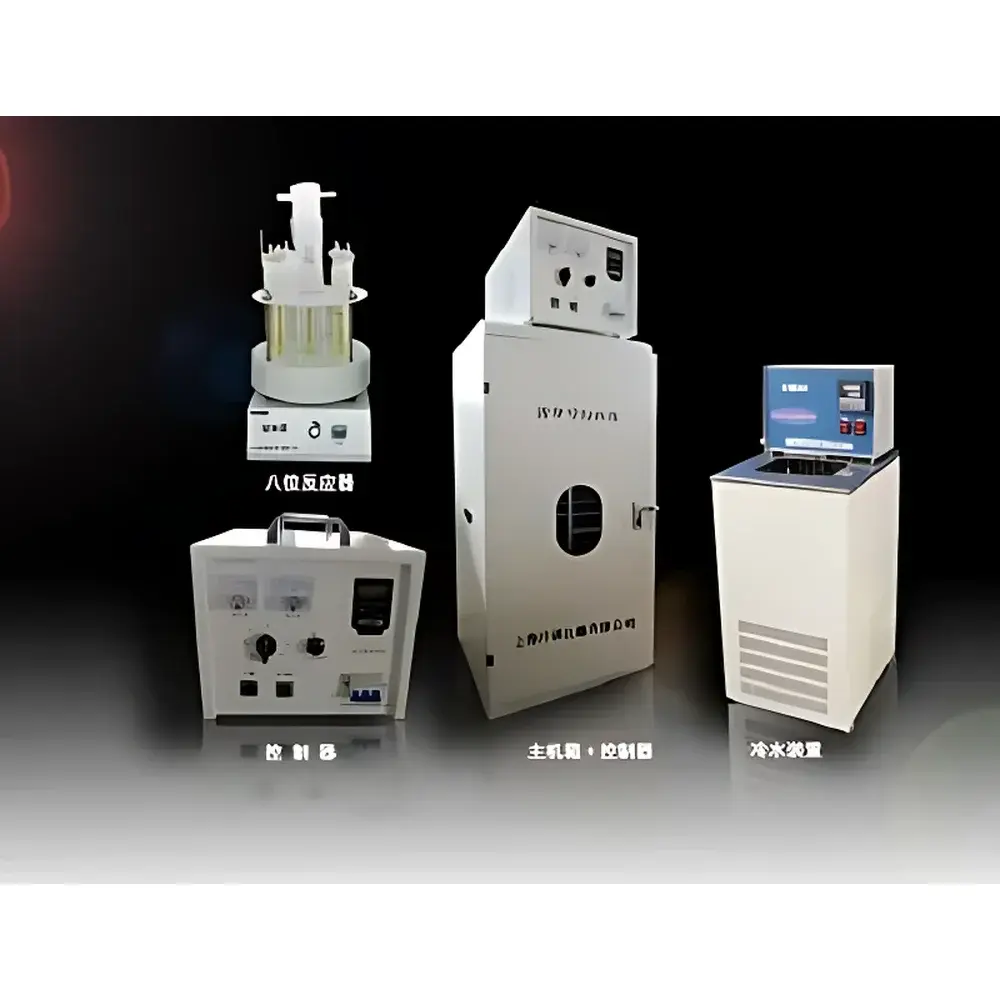
Hanuo HANUO-I Photochemical Reactor
| Brand | Hanuo |
|---|---|
| Model | HANUO-I |
| Type | Benchtop Photochemical Reaction System |
| Light Source Compatibility | Mercury Lamp (100–1000 W), Xenon Lamp (100–1000 W), Metal Halide Lamp (100–450 W) |
| Reaction Vessel Options | 250 mL, 500 mL, 1000 mL (borosilicate glass or optional quartz) |
| Integrated Light Controller | Yes |
| Cooling | Quartz Cold Finger (water-cooled) |
| Stirring | Motorized magnetic stirrer with speed control |
| Enclosure | Light-tight reaction chamber (dark box) |
| Power Regulation | Continuous analog dimming for all lamp types |
| Compliance | Designed for laboratory-scale photochemistry under ISO/IEC 17025-aligned experimental conditions |
Overview
The Hanuo HANUO-I Photochemical Reactor is a modular, benchtop photochemical reaction system engineered for controlled irradiation studies in homogeneous and heterogeneous photocatalytic processes. It operates on the principle of controlled photon delivery to reaction media—enabling precise investigation of light-driven chemical transformations under reproducible radiometric conditions. The system supports both gas-phase and liquid-phase reactions, static or flow-through configurations, and accommodates common photocatalysts such as TiO₂, g-C₃N₄, or plasmonic nanoparticles immobilized on reactor walls or suspended in solution. Its core architecture integrates spectral flexibility (via interchangeable broadband lamps), thermal management (quartz cold finger with recirculating coolant interface), and mechanical agitation—ensuring uniform photon flux distribution and minimized localized heating. This design conforms to fundamental requirements for quantitative photochemistry, including actinometric traceability, irradiance homogeneity assessment, and dark-reaction baseline isolation.
Key Features
- Multi-lamp compatibility with independent, continuous power regulation: mercury vapor (100–1000 W), xenon arc (100–1000 W), and metal halide (100–450 W) lamps—all supported via a single integrated controller with analog dimming circuitry.
- Light-tight reaction chamber (dark box) constructed from powder-coated steel with interlocked access door and viewing window equipped with UV-blocking acrylic shielding.
- Water-cooled quartz cold finger assembly positioned coaxially above the reaction vessel to maintain stable bulk temperature (< ±2 °C drift over 4 h at 800 W lamp load).
- Modular glass reactor options: standard borosilicate vessels (250 mL, 500 mL, 1000 mL) with PTFE-sealed ports for gas inlet/outlet, sampling septa, and thermocouple insertion; custom quartz reactors available upon request for enhanced UV transmission (λ ≥ 185 nm).
- Integrated magnetic stirrer with variable speed control (0–1200 rpm), coupled to a corrosion-resistant stir bar and compatible with sealed or reflux-capable vessel caps.
- Mobility-enabled platform: stainless-steel mobile cart with locking casters, cable management tray, and dedicated mounting points for lamp housing, controller, and cooling unit.
Sample Compatibility & Compliance
The HANUO-I supports a broad range of sample matrices—including aqueous suspensions, organic solvent mixtures, gas-saturated liquids, and thin-film catalyst coatings—without requiring modification to core hardware. Reaction vessels are designed to ASTM D4329-compliant UV exposure geometry (cylindrical symmetry, defined path length). All optical components meet ISO 9001 manufacturing tolerances; lamp spectral output profiles are documented per IEC 62471 (Photobiological Safety of Lamps). The system facilitates GLP-compliant operation through consistent lamp aging tracking (hours-of-use logging), standardized irradiance calibration protocols (using NIST-traceable silicon photodiode sensors), and full documentation of irradiation parameters (wavelength range, effective irradiance [W/m²], cumulative fluence [J/m²]) in experimental records.
Software & Data Management
While the HANUO-I operates via hardware-based analog control (no embedded firmware or proprietary software), it is fully compatible with third-party data acquisition systems. Analog voltage outputs (0–10 V) from the lamp controller enable real-time power monitoring and synchronization with external DAQ units (e.g., National Instruments USB-6009). Temperature, stirring speed, and gas flow rates can be logged independently using calibrated transducers. For regulatory environments, users may implement 21 CFR Part 11-compliant electronic lab notebooks (ELNs) to record lamp type, power setpoint, exposure duration, vessel volume, catalyst loading, and post-reaction analytical metadata (e.g., GC-MS peak areas, HPLC retention times, EPR spin-trap integrals). Audit trails for parameter changes are maintained externally per institutional SOPs.
Applications
- Quantitative photocatalytic degradation kinetics of organic pollutants (e.g., methylene blue, phenol, pharmaceutical residues) under simulated solar or UVC illumination.
- Determination of apparent quantum yield (AQY) for redox reactions using actinometric ferrioxalate or potassium iodide methods.
- Photoelectrochemical precursor synthesis, including metal–organic framework (MOF) crystallization and semiconductor nanocrystal nucleation.
- Photobiological studies involving ROS generation (•OH, O₂•⁻, ¹O₂) quantified via fluorescence probes (e.g., terephthalic acid, nitroblue tetrazolium) or spin trapping coupled with EPR spectroscopy.
- Gas-phase photooxidation of VOCs (e.g., formaldehyde, toluene) over immobilized TiO₂ coatings under controlled humidity and residence time.
- Method development for ASTM E2535 (Standard Practice for Determining Photocatalytic Activity of Materials) and ISO 22197-1 (Photocatalytic Air Purification Performance Testing).
FAQ
What lamp types are supported, and can they be interchanged during operation?
Yes—the controller accepts mercury, xenon, and metal halide lamps. Lamps must be cooled and powered down before physical replacement. No electrical reconfiguration is required.
Is the quartz cold finger compatible with all standard reaction volumes?
The standard cold finger is optimized for 500 mL vessels. Adapters are available for 250 mL and 1000 mL configurations to maintain consistent cooling surface area-to-volume ratio.
Can the system be used for vacuum or pressurized reactions?
The base configuration supports ambient pressure only. Optional high-pressure quartz reactors (up to 10 bar) and vacuum-rated seals are available as custom-engineered add-ons.
Does the system include radiometric calibration documentation?
Each unit ships with a lamp-specific irradiance map (measured at vessel center using a calibrated spectroradiometer), referenced to ISO/IEC 17025-accredited calibration services.
How is temperature stability verified during long-duration experiments?
Users may insert a PT100 sensor into the vessel’s side port; temperature deviation is logged externally. Stability is validated per ASTM E2934 guidelines for photochemical thermal control.




