
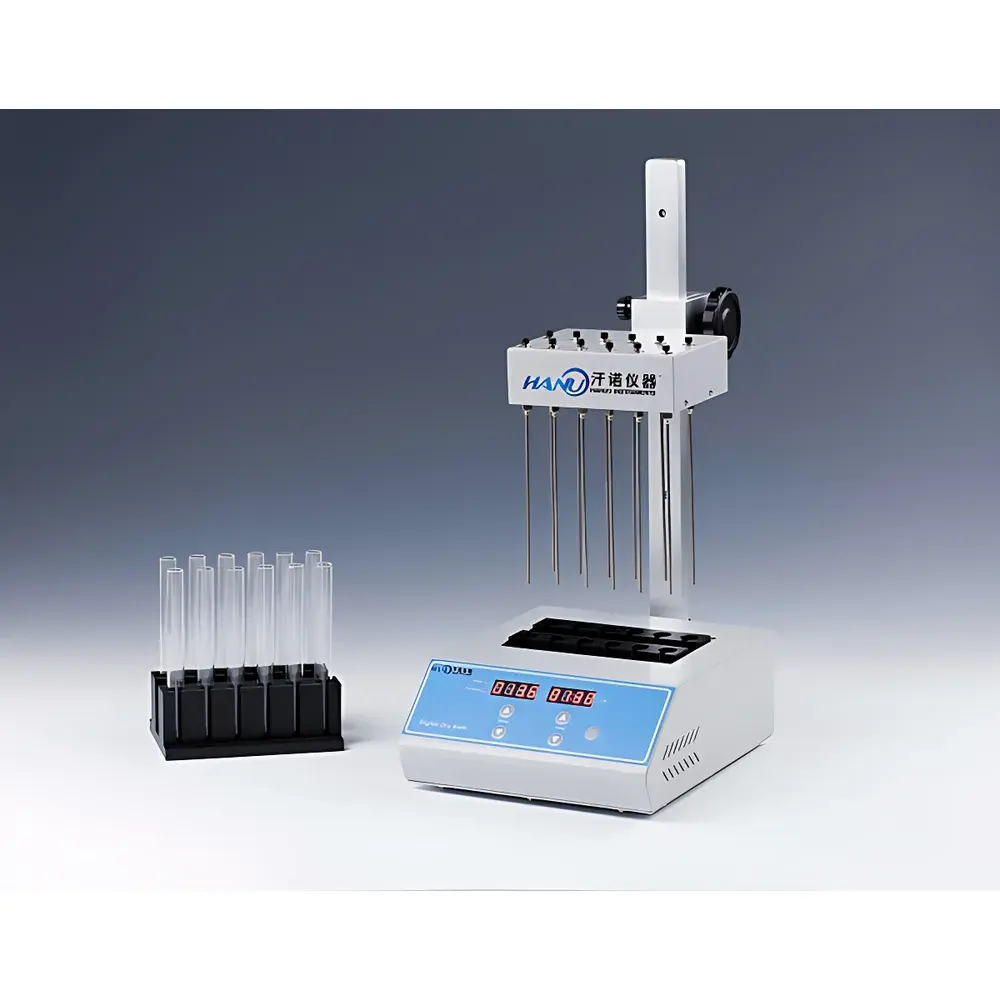
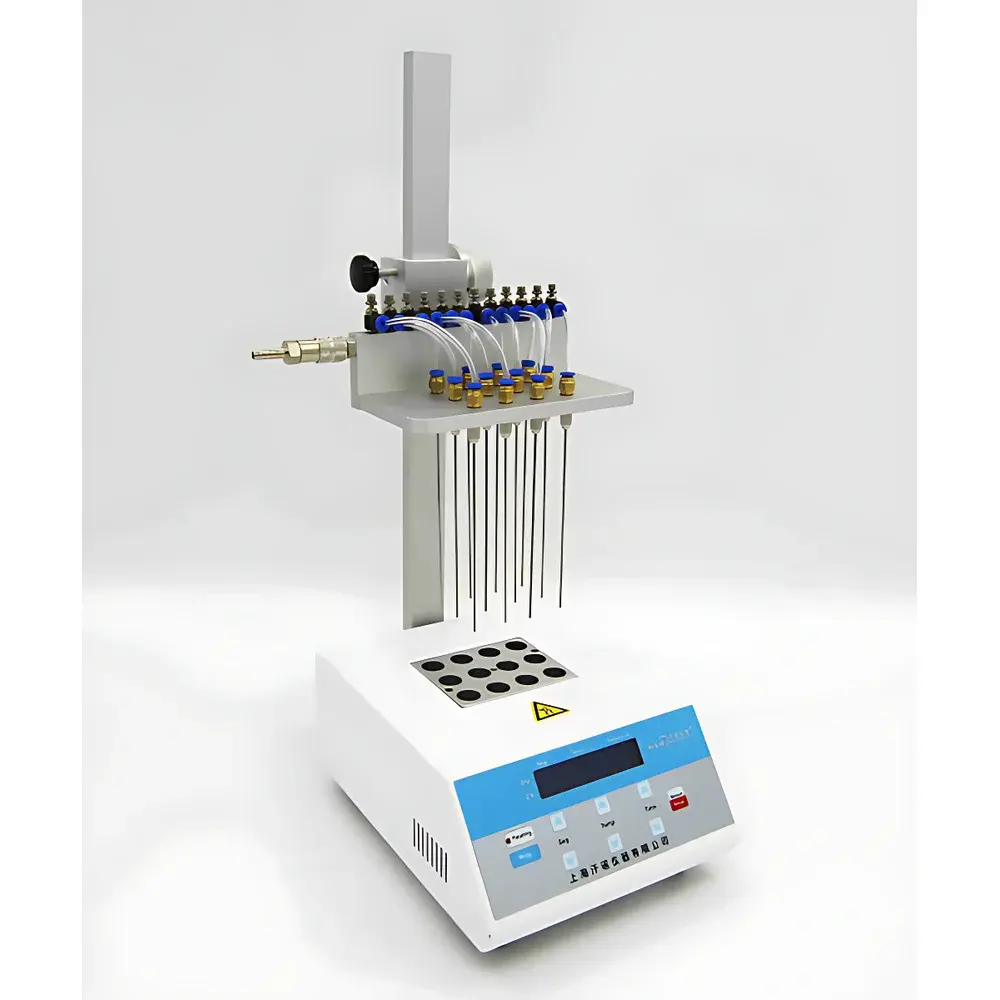
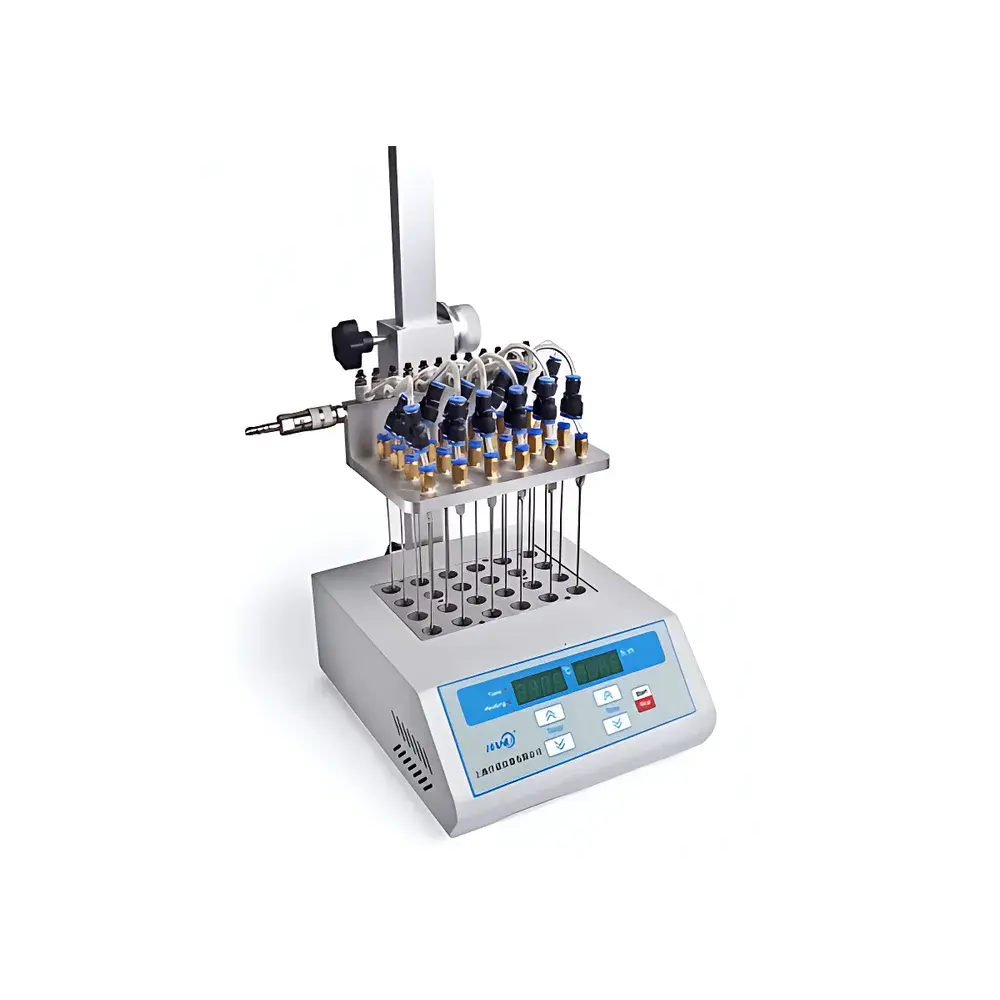
Hanuo HND400-1 Visual Nitrogen Evaporator
| Brand | Hanuo |
|---|---|
| Origin | Shanghai, China |
| Manufacturer Type | Distributor |
| Product Origin | Domestic (China) |
| Model | HND400-1 |
| Price Range | USD 420 – 1,400 (FOB) |
| Heating Method | Dry-block heating |
| Temperature Range | Ambient +5°C to 160°C |
| Temperature Stability | ±0.5°C (@40°C), ±1.0°C (@120°C) |
| Tube Diameter Compatibility | 10–29 mm |
| Gas Flow Rate | 15 L/min |
| Sample Positions | 12 |
| Heating Power | 500 W |
| Display Resolution | 0.1°C |
| Timer Range | 1–99 h 59 min or continuous |
| Ramp Time | ≤15 min (25°C → 160°C) |
| Vertical Travel | 200 mm |
| Operating Pressure | 0.1 MPa |
| Dimensions (W×D×H) | 260 × 220 × 475 mm |
| Net Weight | 7.3 kg |
Overview
The Hanuo HND400-1 Visual Nitrogen Evaporator is a precision dry-block thermal concentrator engineered for controlled, inert-gas-assisted solvent evaporation in analytical laboratories. It operates on the principle of directed nitrogen gas flow across heated sample surfaces—leveraging convective heat transfer and reduced partial pressure to accelerate solvent volatilization without thermal degradation. Unlike water-bath nitrogen evaporators, the HND400-1 employs an aluminum alloy heating block with high thermal conductivity and uniform heat distribution, enabling rapid temperature equilibration and minimal spatial temperature gradients (<±0.5°C across the block at 40°C). Its transparent front panel allows real-time visual monitoring of sample volume reduction, meniscus behavior, and endpoint determination—critical for method reproducibility in regulated workflows. Designed for compatibility with standard GC, HPLC, LC-MS, and ELISA sample preparation protocols, the system supports method development and routine QC/QA applications requiring trace-level analyte recovery.
Key Features
- Optically transparent front enclosure for unobstructed, continuous observation of all 12 sample positions during evaporation
- Microprocessor-controlled PID temperature regulation with digital LED display (0.1°C resolution) and one-point calibration capability
- Independent gas needle channels—each adjustable in height and flow rate—to prevent cross-contamination and accommodate varied vial geometries
- Aluminum heating block with optimized thermal mass and surface emissivity, delivering stable operation from ambient +5°C to 160°C
- Vertical motorized or manual lift mechanism (200 mm travel range) for precise positioning of gas nozzles relative to liquid surface
- Integrated timer with dual-mode operation: programmable duration (1–99 h 59 min) or continuous mode with audible end-of-cycle alert
- Gas distribution manifold rated for 0.1 MPa input pressure and capable of delivering up to 15 L/min total flow (adjustable per channel)
Sample Compatibility & Compliance
The HND400-1 accommodates round-bottom and flat-bottom tubes with outer diameters ranging from 10 mm to 29 mm via interchangeable aluminum heating modules (standard options include 10.5, 12.5, 13.5, 15.5, 16.5, 19.5, and 20.5 mm bore sizes—all 50 mm deep). Each module features precision-machined grooves aligned with gas nozzle trajectories to minimize turbulence and ensure laminar nitrogen delivery. The instrument meets IEC 61010-1 safety requirements for laboratory electrical equipment and is constructed with flame-retardant ABS housing and grounded metal components. While not certified to ISO/IEC 17025 or FDA 21 CFR Part 11 out-of-the-box, its digital temperature logging (via optional RS232/USB interface), audit-ready timer records, and user-accessible calibration offset support GLP-compliant documentation when integrated into validated laboratory systems.
Software & Data Management
The HND400-1 operates as a standalone instrument with embedded firmware; no proprietary software is required for basic operation. However, it supports external data acquisition through its serial communication port (RS232, configurable baud rate), enabling integration with LIMS or custom Python/Excel-based logging scripts for time-stamped temperature and timer status capture. All parameter settings—including setpoint, ramp rate, hold time, and gas valve state—are retained in non-volatile memory after power cycling. Firmware updates are performed via UART interface using manufacturer-provided utilities. For regulated environments, users may implement procedural controls—such as mandatory calibration logs prior to batch runs—and pair the unit with external temperature validation probes (e.g., NIST-traceable Pt100 sensors) to satisfy internal SOPs aligned with ISO 17025 clause 6.4.10.
Applications
- Pesticide residue analysis in food matrices (AOAC 2007.01, EN 15662), including QuEChERS extracts from fruits, vegetables, and cereals
- Environmental monitoring of semi-volatile organic compounds (SVOCs) and PAHs in drinking water, wastewater, and soil leachates (EPA Methods 8270, 8330)
- Pharmaceutical impurity profiling and stability-indicating assays per ICH Q2(R2), particularly for low-concentration genotoxic impurities
- Clinical toxicology sample prep for urinary benzodiazepines, opioids, and stimulants prior to GC-MS/MS analysis
- Natural product isolation workflows involving sequential solvent removal under inert atmosphere to preserve thermolabile terpenoids and alkaloids
FAQ
Is the HND400-1 suitable for use with chlorinated solvents such as chloroform or DCM?
Yes—provided appropriate fume hood ventilation and corrosion-resistant gas tubing (e.g., PTFE-lined) are used. Aluminum block surfaces are passivated but not fully resistant to prolonged exposure; periodic cleaning with ethanol followed by drying is recommended.
Can multiple modules be swapped during a single run without recalibration?
Module interchange is designed for pre-run configuration only. Thermal equilibrium must be re-established after swapping; the PID controller will auto-stabilize within ~3–5 minutes depending on setpoint.
Does the instrument support nitrogen gas pressure regulation onboard?
No—the HND400-1 accepts regulated inlet pressure (0.1 MPa typical) from an external source. Users must install a dedicated pressure regulator and particulate filter upstream of the gas inlet port.
What is the maximum recommended sample volume per tube for optimal evaporation kinetics?
For 12-mm-diameter tubes, ≤2 mL is advised; for 16-mm tubes, ≤4 mL ensures consistent surface area-to-volume ratio and avoids splashing under 15 L/min flow.
Is third-party validation support available from Hanuo for IQ/OQ protocols?
Hanuo provides technical specifications, dimensional drawings, and factory calibration certificates. Full qualification documentation (IQ/OQ/PQ) must be developed internally or by a qualified service provider per ISO/IEC 17025 requirements.



