
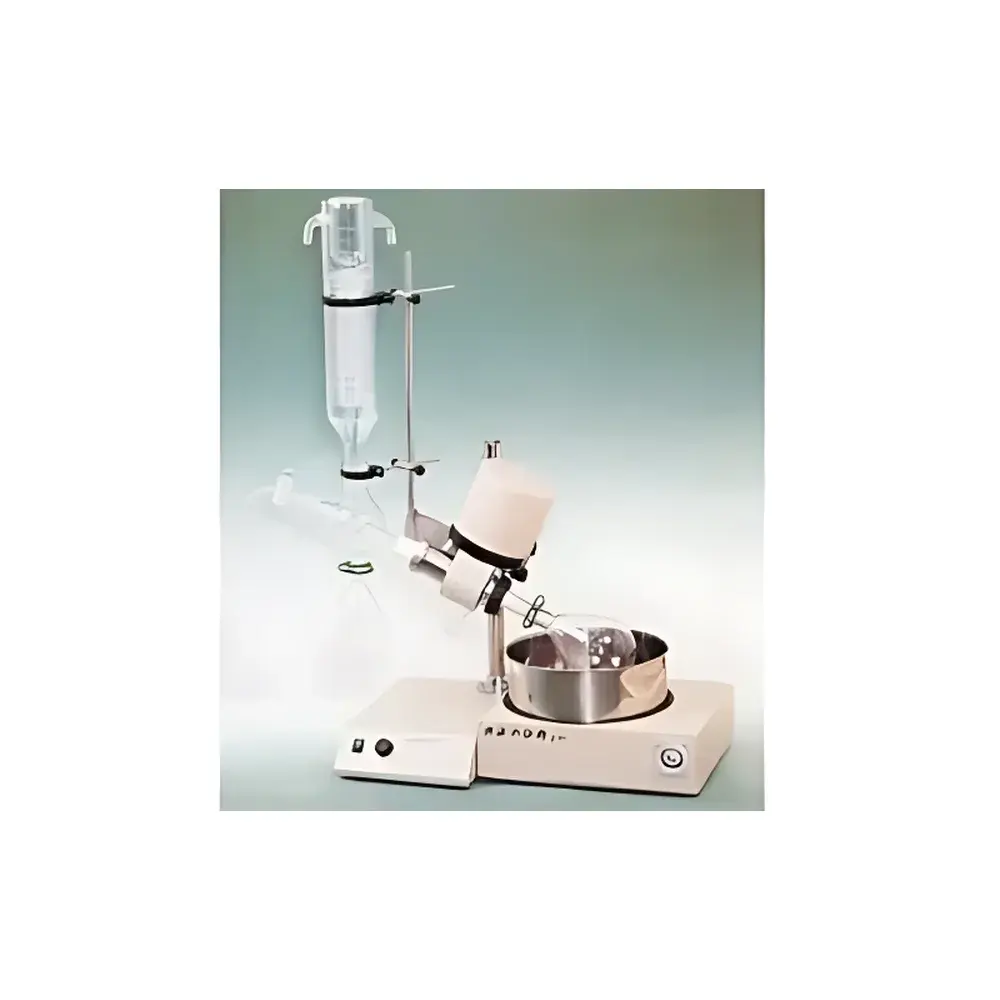
Hanuo RE-52CS Rotary Evaporator
| Brand | Hanuo |
|---|---|
| Origin | Shanghai, China |
| Model | RE-52CS |
| Capacity | 2 L |
| Ultimate Vacuum | 0.098 MPa (≈740 mmHg) |
| Rotation Speed | 0–150 rpm |
| Temperature Control Range | Ambient to 100 °C |
| Heating Bath Temperature Accuracy | ±1 °C (typical for analog-controlled water/oil bath) |
| Condenser Cooling Area | 0.11 m² |
| Condenser Type | Vertical dual-spiral coil |
| Lift Mechanism | Manual hand-lift vertical adjustment |
| Total Power Consumption | 60 W |
| Collection Flask Capacity | 2 L |
Overview
The Hanuo RE-52CS Rotary Evaporator is a benchtop-to-floor-standing solvent removal system engineered for reliable, scalable concentration and recovery of heat-sensitive compounds under reduced pressure. It operates on the fundamental principle of thin-film evaporation: a motor-driven rotating flask immersed in a thermostatically controlled heating bath generates a uniform, high-surface-area liquid film along the inner wall. Under vacuum—achievable down to 0.098 MPa—the solvent’s boiling point is significantly lowered, enabling gentle, efficient phase transition without thermal degradation. This makes the RE-52CS particularly suited for applications involving thermolabile biomolecules, active pharmaceutical ingredients (APIs), natural product extracts, and polymer solutions where conventional distillation would induce decomposition or racemization.
Key Features
- 2 L Large-Capacity Rotating Flask: Optimized geometry and wide neck design facilitate rapid solvent turnover and minimize bumping or foaming during evaporation of viscous or foaming samples.
- Manual Vertical Lift Mechanism: Ergonomic hand-lift assembly enables precise, repeatable positioning of the rotating flask relative to the heating bath and condenser—critical for method transfer and process reproducibility.
- Vertical Dual-Spiral Condenser: Constructed from borosilicate glass (3.3), this high-efficiency condenser provides 0.11 m² effective cooling surface area, ensuring >95% solvent recovery across common low-boiling solvents (e.g., acetone, ethyl acetate, dichloromethane, ethanol).
- Adjustable Rotation Speed (0–150 rpm): Stepless speed control allows optimization of film thickness and residence time for varying viscosities and volatility profiles—essential for maintaining laminar flow and maximizing mass transfer efficiency.
- Heating Bath Compatibility: Designed for integration with external water or oil baths (not included); temperature range extends from ambient to 100 °C with typical stability of ±1 °C at setpoint—sufficient for most standard organic solvents and aqueous mixtures.
- Low-Power, Robust Architecture: Total power draw of only 60 W reflects optimized mechanical and thermal design; all load-bearing components are precision-machined for long-term dimensional stability and minimal vibration transmission.
Sample Compatibility & Compliance
The RE-52CS accommodates a broad spectrum of sample matrices—including aqueous, alcoholic, chlorinated, and ether-based solutions—as well as moderately viscous extracts (e.g., crude plant tinctures, fermentation broths, polymer solutions up to ~500 cP). Its all-glass fluid path (standard ISO-KF 25 or NS 29 joints) ensures chemical inertness and facilitates cleaning validation per GLP/GMP guidelines. While the unit itself carries no CE or UL certification out-of-the-box (as supplied by general distributors), its mechanical and thermal design aligns with core safety expectations outlined in IEC 61010-1 for laboratory equipment. Users integrating the RE-52CS into regulated workflows (e.g., pharmaceutical QC labs) are advised to validate bath temperature accuracy, vacuum stability, and rotational repeatability per internal SOPs aligned with ISO/IEC 17025 or USP .
Software & Data Management
The RE-52CS is an analog-operated instrument with no embedded microcontroller or digital interface. All operational parameters—rotation speed, bath temperature, and vacuum level—are monitored and adjusted manually using calibrated dials and external gauges. This architecture eliminates firmware dependencies, reduces cybersecurity exposure, and supports straightforward IQ/OQ documentation in environments where simplicity and audit transparency are prioritized over automation. For laboratories requiring electronic data capture, the system is fully compatible with third-party vacuum controllers (e.g., Vacuubrand VRD/PC series), PT100-equipped digital baths (e.g., Julabo F25), and USB-connected data loggers compliant with FDA 21 CFR Part 11 when paired with validated software platforms.
Applications
- Concentration of dilute natural product extracts (e.g., alkaloids, flavonoids, terpenes) prior to HPLC analysis or crystallization.
- Removal of reaction solvents (THF, DMF, toluene) following synthetic organic transformations—minimizing residual solvent carryover in final APIs.
- Recovery and reuse of high-purity solvents in pilot-scale green chemistry workflows.
- Drying of heat-sensitive enzyme preparations or antibody-conjugated nanoparticles under mild vacuum and sub-boiling conditions.
- Preparative-scale solvent exchange (e.g., DMSO → PBS) in biopolymer formulation development.
- Teaching laboratory demonstrations of colligative properties, vapor pressure depression, and mass transfer kinetics in undergraduate chemistry and chemical engineering curricula.
FAQ
Does the RE-52CS include a heating bath?
No—the RE-52CS is a rotary evaporator head unit only. A compatible external water or oil bath (e.g., 5–10 L capacity, ±0.5 °C stability) must be selected and purchased separately.
What vacuum pump is recommended for optimal performance?
A two-stage diaphragm pump capable of reaching ≤0.095 MPa (e.g., KNF N840.3FT.18 or Vacuubrand PC 101) is recommended for consistent operation with volatile solvents and full 2 L flask loads.
Is the condenser cooled by circulating water or air?
The vertical dual-spiral condenser requires continuous recirculating coolant—typically tap water or a chiller set to 5–15 °C—to maintain condensation efficiency across multi-hour runs.
Can the RE-52CS be used for fractional distillation?
No—it lacks a fraction collector, variable-temperature condenser zones, or reflux ratio control; it is designed exclusively for single-stage solvent removal, not separation of miscible liquid mixtures.
What maintenance intervals are recommended for long-term reliability?
Inspect PTFE seals and vacuum tubing monthly; replace silicone vacuum grease every 6 months; verify rotation motor belt tension annually; clean condenser coils with 5% nitric acid solution after heavy use with amine- or salt-containing solutions.
Related Products



