
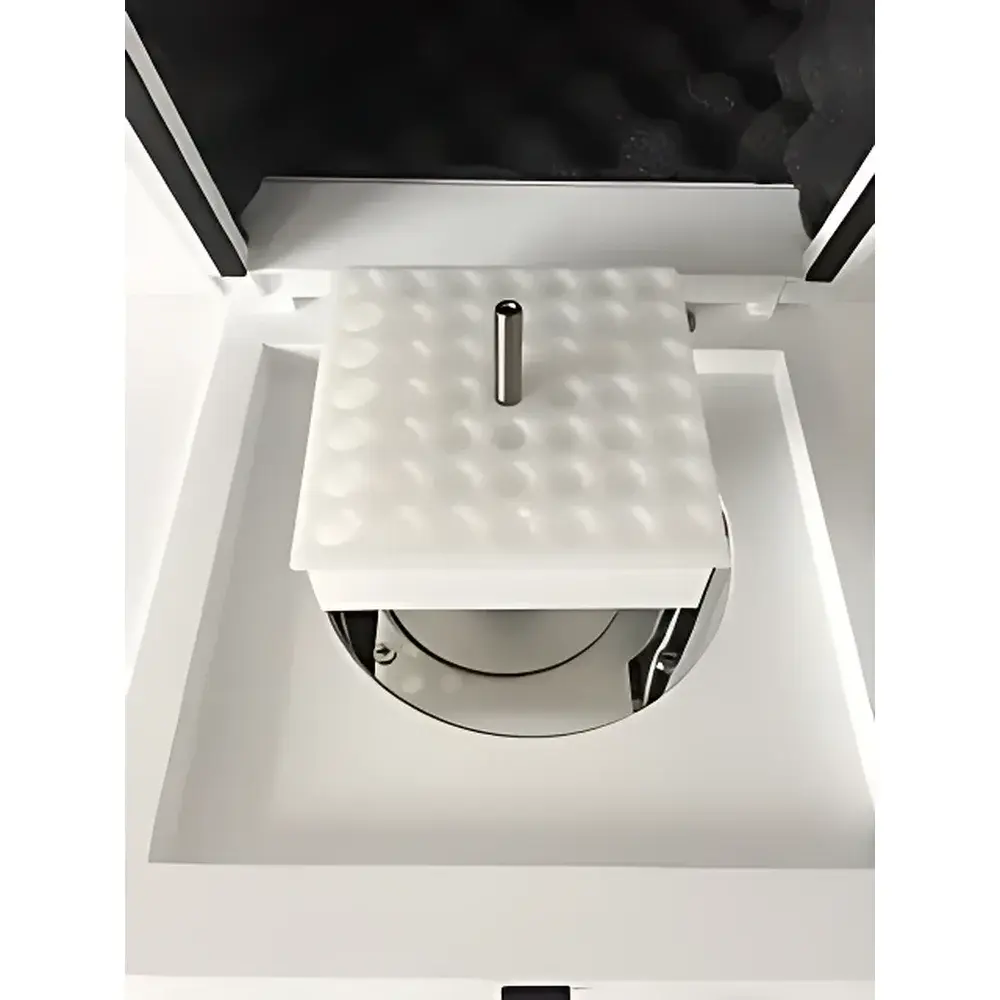
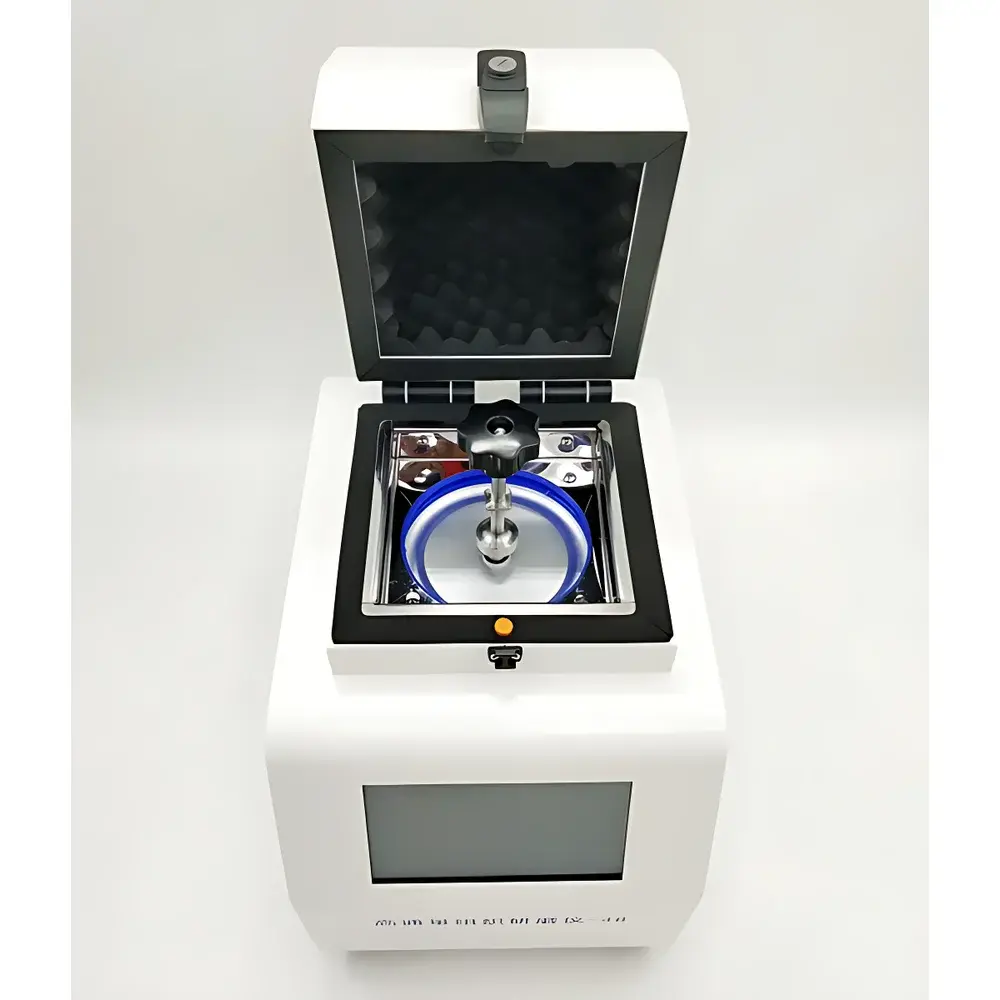
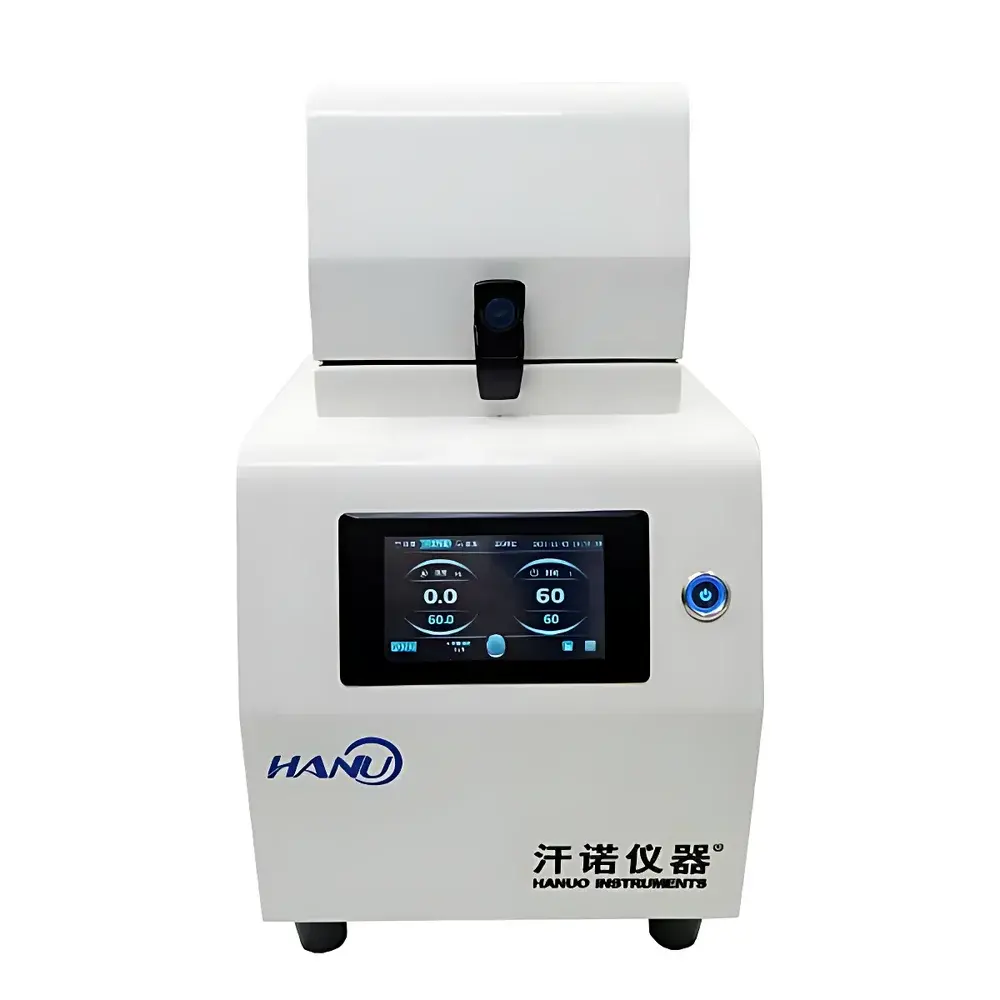
Hanuo Daxluot-24 High-Throughput Tissue Grinder
| Brand | Hanuo |
|---|---|
| Origin | Shanghai, China |
| Model | Daxluot-24 |
| Throughput | Up to 24 samples simultaneously (configurable for 12/24/48/96/192 samples per run) |
| Processing Time | ≤3 min per batch |
| Frequency Range | 0–70 Hz |
| Sample Capacity | 24 × 0.2–0.5 mL |
| Final Particle Size | ~5 µm |
| Grinding Modes | Dry, Wet, Cryogenic (liquid nitrogen-cooled) |
| Grinding Vessel Materials | Stainless steel, PTFE, Zirconia |
| Ball Diameter | 0.1–30 mm |
| Ball Materials | Alloy steel, Chromium steel, Zirconium oxide, Tungsten carbide, Quartz sand |
| Acceleration/Deceleration | ≤2 s to max/min speed |
| Noise Level | <55 dB(A) |
| Display | LCD interface with programmable timer (0 s–99 min) and frequency control |
| Safety Features | Auto-centering clamping system with mechanical safety lock |
| Dimensions (W×D×H) | 280 × 400 × 500 mm |
| Weight | 25 kg |
Overview
The Hanuo Daxluot-24 High-Throughput Tissue Grinder is a vertically vibrating benchtop homogenizer engineered for rapid, reproducible mechanical lysis of biological and environmental samples. It operates on the principle of high-frequency oscillatory impact—where grinding beads transfer kinetic energy to samples contained in sealed tubes, enabling efficient cell disruption, tissue fragmentation, and particle size reduction. Unlike horizontal or orbital shakers, its vertical vibration architecture ensures uniform energy distribution across all sample positions, eliminating inter-row variability and batch-to-batch inconsistency. Designed for laboratories requiring scalable nucleic acid, protein, or metabolite extraction workflows, the Daxluot-24 supports cryogenic, dry, and wet grinding modalities without cross-contamination—making it suitable for sensitive downstream applications including qPCR, RNA-seq, proteomics, and microbial community profiling.
Key Features
- Vertical Oscillation Architecture: Eliminates positional bias inherent in arc-motion grinders; delivers consistent energy input across all 24 sample positions.
- Cryogenic Compatibility: Integrated liquid nitrogen pre-cooling protocol allows rapid thermal stabilization of samples—tubes or adapters immersed for 1–2 minutes prior to mounting, minimizing LN₂ consumption and avoiding repeated freezing cycles.
- Programmable Precision Control: LCD interface enables precise setting of frequency (0–70 Hz), duration (0 s–99 min), and automated start/stop sequences—critical for method standardization under GLP or ISO 17025-compliant environments.
- Modular Sample Adapters: Supports interchangeable tube configurations: 24 × 0.2–0.5 mL, 24 × 2 mL, 12 × 5 mL, 8 × 7–15 mL, 2 × 25 mL, and 2 × 50 mL. Custom adapter designs available upon request for specialized vessels.
- Multi-Material Grinding Media: Compatible with stainless steel, chromium steel, zirconia, tungsten carbide, and quartz beads (0.1–30 mm diameter) to match sample hardness, viscosity, and downstream compatibility requirements.
- Integrated Safety System: Auto-centering clamping mechanism with mechanical safety lock prevents tube ejection during operation; meets IEC 61000-3-2 and EN 61000-6-2 electromagnetic compatibility standards.
Sample Compatibility & Compliance
The Daxluot-24 processes diverse sample types—including plant tissues (rice, wheat, maize, soybean seeds, leaves, roots), animal organs (liver, lung, muscle, bone, skin), microbial cells (Gram-positive/negative bacteria, yeast, spores, fungi), and environmental matrices (soil, sediment, biofilm). Its sub-5 µm final particle size facilitates complete lysis of recalcitrant cells resistant to sonication or enzymatic digestion. The instrument complies with general laboratory safety directives (EN 61010-1) and supports audit-ready workflows aligned with FDA 21 CFR Part 11 when paired with validated electronic lab notebook (ELN) integration. All wetted parts are chemically inert (PTFE, zirconia, 316 stainless steel), ensuring compatibility with organic solvents, chaotropic agents (e.g., guanidine thiocyanate), and acidic/basic buffers used in nucleic acid purification kits.
Software & Data Management
While the Daxluot-24 operates via standalone LCD control (no proprietary software required), its programmable parameters—frequency, time, and cycle count—are fully documentable for SOP adherence. Users may export run logs manually via timestamped operator notes or integrate with third-party LIMS platforms using RS-232 or optional USB data logging modules (sold separately). For regulated environments, validation documentation—including IQ/OQ protocols, calibration certificates for frequency accuracy (±0.5 Hz), and noise emission reports (<55 dB(A))—is available upon request to support GMP, CLIA, or ISO/IEC 17025 accreditation.
Applications
- High-throughput genomic DNA and total RNA isolation from fibrous or lipid-rich tissues
- Preparation of single-cell suspensions for flow cytometry or scRNA-seq library construction
- Rapid homogenization of soil microbiome samples for metagenomic DNA extraction
- Cell wall disruption of yeast and Gram-positive bacteria (e.g., Bacillus, Staphylococcus) for proteomic analysis
- Particle size reduction of pharmaceutical excipients or botanical powders for dissolution testing
- Pre-analytical sample conditioning prior to HPLC, GC-MS, or ICP-MS quantification
FAQ
What is the maximum recommended sample volume per tube in the 24-position configuration?
The standard 24-position adapter accommodates up to 2 mL per tube; however, loading volume should not exceed 70% of tube capacity to ensure effective bead movement and lysis efficiency.
Can the Daxluot-24 be used for protein extraction without denaturation?
Yes—when operated at lower frequencies (10–30 Hz) with chilled PTFE adapters and stainless-steel beads, it preserves native conformation for co-immunoprecipitation or enzyme activity assays.
Is routine calibration required for frequency accuracy?
Frequency output is factory-calibrated and stable over time; annual verification using an external tachometer is recommended for GLP-compliant labs.
Does the instrument support unattended overnight operation?
No—due to thermal management constraints and safety interlocks, continuous operation beyond 99 minutes is disabled; sequential runs require manual restart.
Are replacement adapters and grinding beads supplied by Hanuo certified for trace metal analysis?
Zirconia and quartz beads are available in ultra-low-metal variants (certified <1 ppb Cr/Ni/Fe); PTFE adapters meet ASTM D4894 specifications for extractables profiling.



