
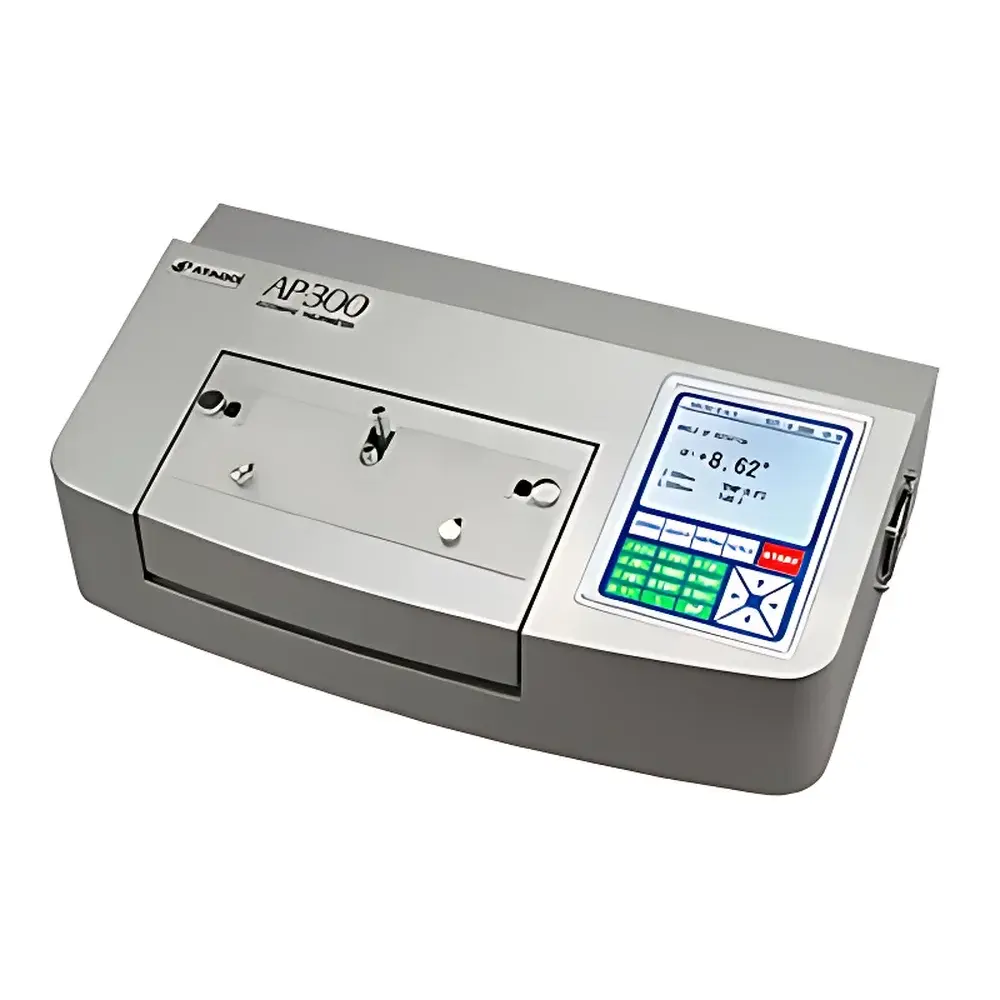
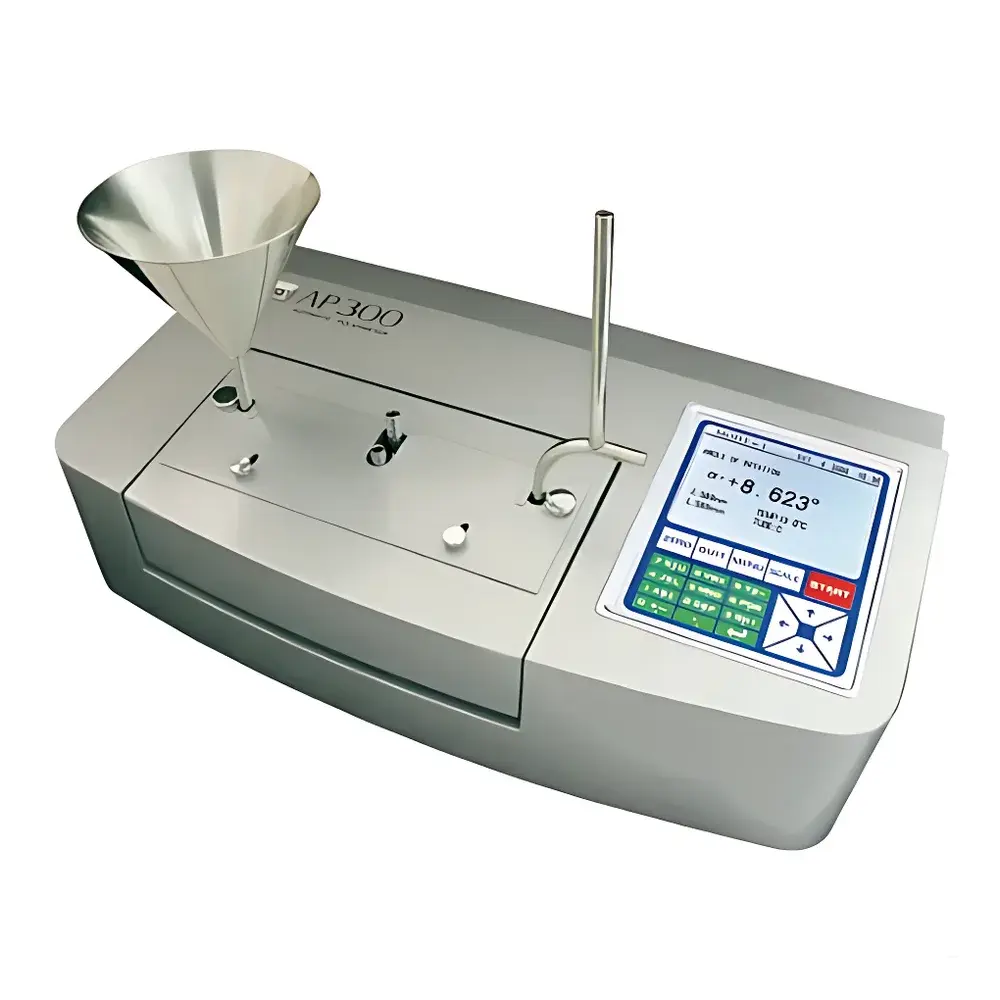
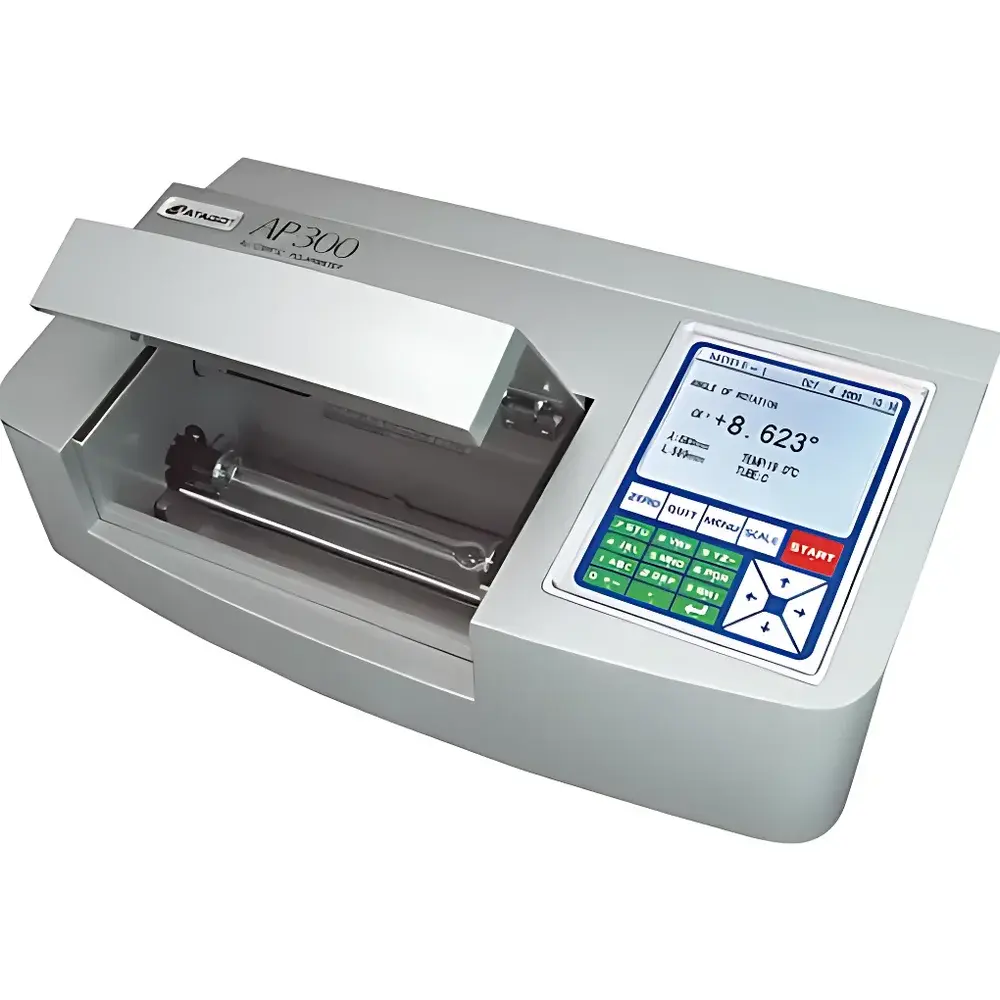
ATAGO AP-300 Pharmaceutical-Grade Automated Polarimeter
| Brand | ATAGO |
|---|---|
| Origin | Japan |
| Product Type | Automatic Polarimeter |
| Temperature Control | Integrated Thermostatic Capability (Optional Circulating Bath Support) |
| Display | Digital LCD |
| Light Source | Stable LED (589 nm Equivalent) |
| Measurement Range | AR Mode: –89.999° to +89.999° |
| ISS Mode | –130.000° to +130.000°Z |
| Resolution | 0.001° |
| Accuracy | ±0.01° |
Overview
The ATAGO AP-300 Pharmaceutical-Grade Automated Polarimeter is a precision optical instrument engineered for high-reproducibility measurement of optical rotation in chiral compounds under controlled thermal conditions. Based on the fundamental principle of plane-polarized light rotation upon transmission through optically active media, the AP-300 employs a stable, long-life LED light source calibrated to emit at an effective wavelength of 589 nm—equivalent to the sodium D-line—ensuring compliance with pharmacopeial standards including USP , EP 2.2.7, and JP 2.05. Designed specifically for regulated pharmaceutical environments, the system supports both Angle Rotation (AR) and International Sugar Scale (ISS) reporting modes, enabling direct correlation with concentration data for APIs, excipients, and intermediates such as L-glutamic acid, ascorbic acid, sucrose, and sodium glutamate. Its robust architecture integrates real-time digital signal processing and temperature-stabilized optics to minimize drift and maximize inter-laboratory comparability.
Key Features
- High-resolution angular detection with 0.001° resolution and ±0.01° accuracy across full measurement range (–89.999° to +89.999° in AR mode; –130.000° to +130.000°Z in ISS mode)
- Dual-mode operation: AR (Angle Rotation) for absolute optical rotation and ISS (International Sugar Scale) for direct %w/w sucrose-equivalent reporting
- Integrated temperature control interface compatible with external circulating baths (e.g., model 60-C3, 1921 series) for precise sample thermal management between 10°C and 40°C
- LED-based illumination system with >10,000-hour lifetime, eliminating mercury lamp replacement and spectral drift concerns
- Standard 100 mm thermostatic cell holder with jacketed quartz tube and sealing cap for GMP-compliant sample handling
- Built-in digital display with intuitive menu navigation and real-time measurement feedback
- Calibration traceability via certified quartz control plates (8°, 17°, or 34° options included)
Sample Compatibility & Compliance
The AP-300 accommodates standard 100 mm pathlength cells and supports aqueous, alcoholic, and low-viscosity organic solutions typical of pharmaceutical QC workflows—including syrup formulations, injectable preparations, amino acid solutions, and chiral intermediate batches. It meets essential regulatory requirements for method validation per ICH Q2(R2), supports audit-ready documentation when paired with DP-AD digital printer (included), and facilitates GLP/GMP-aligned operation through consistent thermal equilibration and operator-independent measurement cycles. While the base unit does not include 21 CFR Part 11-compliant software, its analog/digital output architecture allows integration into validated LIMS or ELN systems via RS-232 or optional USB interface (firmware v3.2+).
Software & Data Management
The AP-300 operates as a standalone benchtop instrument with embedded firmware supporting immediate readout, manual calibration, and batch-level averaging (up to 10 measurements per sample). Raw data export is enabled via DP-AD thermal printer (supplied), generating time-stamped, non-editable hardcopy reports containing date/time stamp, operator ID field, temperature reading, measured angle, and selected scale mode. For laboratories requiring electronic record retention, the instrument’s serial output enables connection to third-party data acquisition platforms compliant with ALCOA+ principles. Firmware updates are distributed directly by ATAGO Japan and documented per ISO/IEC 17025 traceability protocols.
Applications
- Quantitative assay of chiral active pharmaceutical ingredients (APIs) during release testing and stability studies
- Concentration verification of sugar-based excipients (e.g., dextrose, sucrose) in parenteral and oral liquid formulations
- Purity assessment of enantiomerically enriched intermediates in synthetic route development
- QC release testing for vitamins (e.g., L-ascorbic acid), amino acids (e.g., L-glutamic acid), and antibiotics (e.g., chloramphenicol)
- Educational demonstration of optical activity principles in university pharmaceutical sciences curricula
- In-process monitoring of crystallization and racemization kinetics under controlled temperature profiles
FAQ
Does the AP-300 meet pharmacopeial requirements for polarimetric analysis?
Yes—the AP-300 satisfies USP , EP 2.2.7, and JP 2.05 specifications for resolution, accuracy, wavelength equivalence, and thermal stability when operated with a validated circulating bath and certified quartz standards.
Is temperature regulation built into the instrument, or is external equipment required?
The AP-300 features a temperature sensor port and control interface but requires an external circulating bath (e.g., ATAGO 60-C3, Cat. No. 1921) for active thermal regulation. The C-Kit (Cat. No. 5294) includes this bath; the D-Kit (Cat. No. 5295) provides passive temperature compensation only.
Can the AP-300 be integrated into a networked laboratory information management system (LIMS)?
Direct network integration is not supported natively; however, RS-232 serial output enables connection to middleware or custom scripts for automated data ingestion into validated LIMS environments.
What calibration standards are supplied with the instrument?
One certified quartz plate is included (user-selectable from 8°, 17°, or 34° nominal rotation values), each accompanied by a factory calibration certificate traceable to NMIJ/AIST.
Is the LED light source replaceable by the user?
No—the LED module is sealed and field-replaceable only by authorized ATAGO service centers to maintain optical alignment and wavelength fidelity.





