
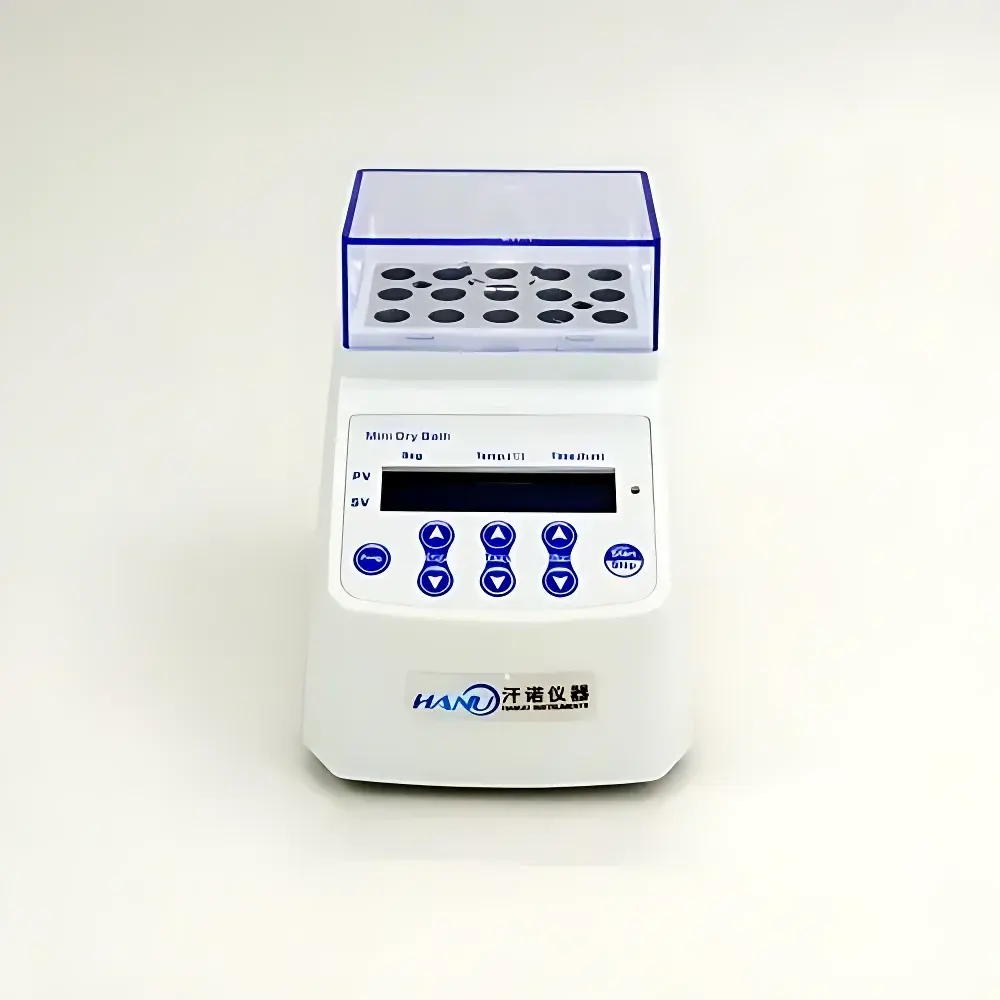
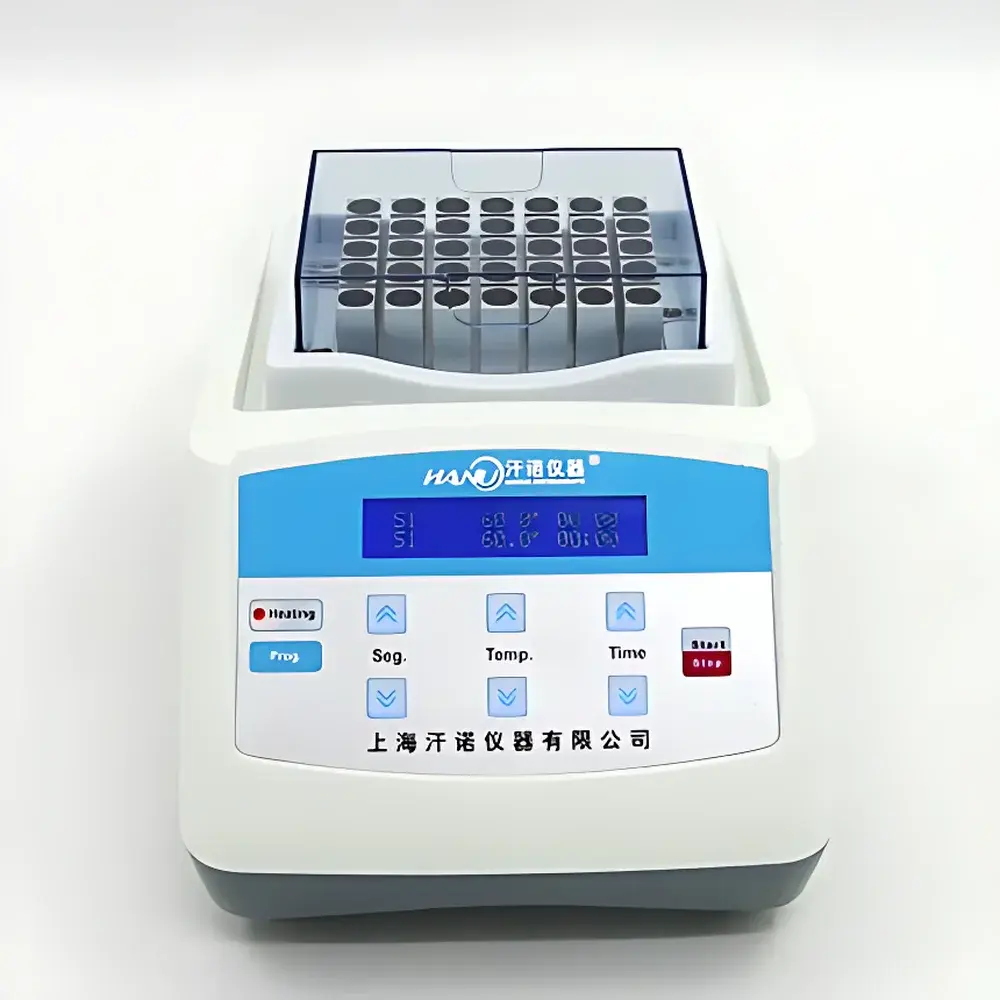
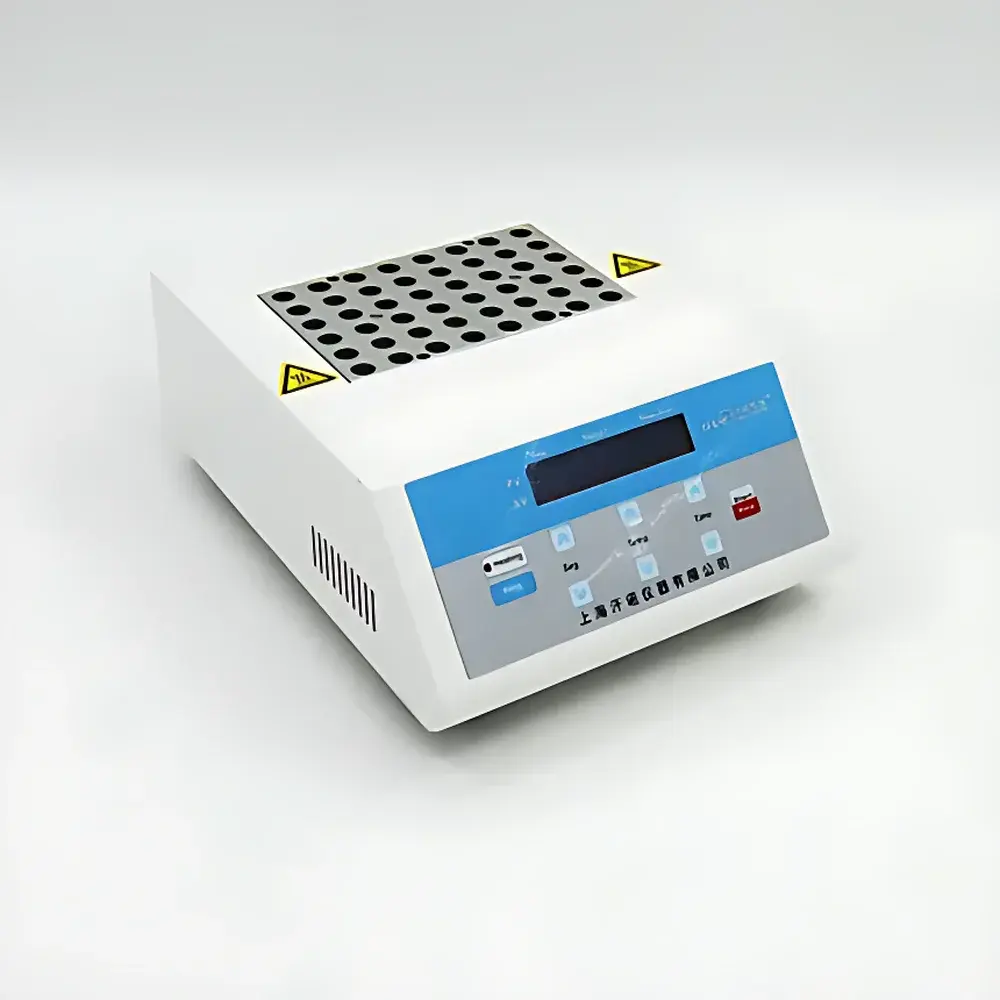
Hanuo MINIB-100 Portable Heated Metal Block Bath
| Brand | Hanuo |
|---|---|
| Model | MINIB-100 |
| Temperature Range | RT + 5°C to 100°C |
| Temperature Accuracy | ±0.3°C at 40°C |
| Temperature Uniformity | ≤ ±0.5°C across block |
| Stabilization Time | ≤15 min (20°C → 100°C) |
| Power Input | 24 V DC |
| Power Consumption | 45 W |
| Display Resolution | 0.1°C |
| Timer Range | 0–99 h 59 min |
| Max Overtemperature Protection | 105°C |
| Net Weight | 0.8 kg |
| Dimensions | 125 × 105 × 75 mm (L × W × H) |
| Module Compatibility | 0.2 mL, 0.5 mL, 1.5 mL, 2.0 mL tubes, cuvettes (8–12.5 × 12.5 mm), 15 mL & 50 mL conical tubes |
Overview
The Hanuo MINIB-100 Portable Heated Metal Block Bath is a compact, microprocessor-controlled thermal incubation device engineered for precise, stable, and rapid heating of small-volume samples in demanding laboratory, field, and mobile environments. Unlike water baths or circulating ovens, the MINIB-100 employs solid-state aluminum block thermoregulation—leveraging high thermal conductivity and low thermal mass to achieve fast ramp rates and minimal temperature overshoot. Its design adheres to fundamental principles of conductive heat transfer, where uniform thermal distribution across the metal block surface ensures consistent sample exposure without convective artifacts. With an operating range from ambient +5°C to 100°C and factory-calibrated stability of ≤±0.5°C at 100°C, the unit meets routine requirements for enzyme activation, DNA denaturation, cell lysis, reagent pre-warming, and immunoassay incubation. Its ultra-portable form factor (125 × 105 × 75 mm) and 24 V DC input enable seamless integration into vehicle-mounted labs, point-of-care testing stations, and remote field deployments where AC infrastructure is unavailable.
Key Features
- Compact footprint (≤125 mm length) and lightweight construction (0.8 kg) optimized for benchtop mobility and space-constrained workflows
- Real-time digital display showing current temperature (0.1°C resolution) and countdown timer (up to 99 h 59 min)
- Integrated overtemperature safety cutoff (105°C threshold) with automatic shutdown and audible alarm
- Self-diagnostic system that detects sensor failure, open-circuit conditions, or thermal runaway and triggers visual/audible alerts
- User-accessible temperature offset calibration function to compensate for long-term drift or application-specific thermal load variations
- Interchangeable, autoclavable aluminum modules—including configurations for 0.2 mL PCR strips (40×), 1.5/2.0 mL microcentrifuge tubes (15× each), standard cuvettes (8–12.5 mm width), and larger 15 mL / 50 mL conical tubes
- Low-power 45 W operation with efficient thermal insulation, minimizing energy consumption during extended incubations
Sample Compatibility & Compliance
The MINIB-100 supports a broad spectrum of common labware formats via standardized, tool-free module swaps—enabling rapid transition between nucleic acid workstations, clinical assay prep, and quality control pipelines. All modules are precision-machined from anodized aluminum to ensure corrosion resistance, mechanical durability, and compatibility with ethanol-based disinfectants and routine autoclaving (121°C, 20 min). The device complies with IEC 61010-1:2010 for electrical safety in laboratory equipment and incorporates reinforced isolation between power circuitry and thermal control logic. While not certified for GLP/GMP production environments, its traceable temperature accuracy (±0.3°C at 40°C), documented thermal uniformity (≤±0.5°C across active zone), and built-in alarm logging support audit-ready documentation for ISO/IEC 17025-accredited testing laboratories performing method validation under ASTM E2500 or USP .
Software & Data Management
The MINIB-100 operates as a standalone instrument with no external software dependency. All operational parameters—including setpoint, timer duration, and calibration offsets—are stored in non-volatile memory and retained after power cycling. Though it lacks USB or Bluetooth connectivity, its real-time display and deterministic alarm behavior provide immediate operator feedback aligned with FDA 21 CFR Part 11 principles of data integrity: actions (e.g., temperature adjustment, timer start) are directly observable and irreversibly reflected on-screen. For laboratories requiring electronic records, optional external data loggers (e.g., calibrated thermocouple arrays with timestamped CSV export) may be deployed alongside the unit to satisfy ALCOA+ criteria during process validation.
Applications
- PCR tube pre-heating and holding prior to thermocycling
- Enzyme reaction incubation at 37°C, 65°C, or other defined setpoints
- Antibody dilution warming to reduce viscosity and improve pipetting accuracy
- Sample thawing of frozen reagents or standards under controlled thermal profiles
- Cell culture reagent equilibration (e.g., trypsin, media supplements)
- Field-deployed nucleic acid extraction workflows using battery-powered 24 V DC sources
- Quality assurance checks for temperature-sensitive diagnostic kits
FAQ
What power supply specifications are required for the MINIB-100?
The unit accepts only regulated 24 V DC input (±10%), with a minimum current rating of 2.5 A. Use of unregulated adapters or automotive cigarette-lighter sockets without voltage stabilization may trigger intermittent fault alarms or reduced thermal stability.
Can the MINIB-100 maintain temperature during prolonged operation?
Yes—its passive thermal design and closed-loop PID control deliver ≤±0.5°C stability at 100°C for durations up to 99 hours 59 minutes, verified per ISO 8573-1 Annex B protocols using NIST-traceable reference probes.
Is module calibration traceable to national standards?
Individual modules are not independently calibrated; however, the base unit’s temperature sensor is factory-traceable to CNAS-accredited standards. Users may perform in-house verification using a calibrated PT100 probe inserted into designated test wells.
How often should temperature offset calibration be performed?
Recommended every 6 months under continuous use, or after any mechanical impact to the block or replacement of thermal interface components.
Are replacement modules available for custom tube formats?
Hanuo offers OEM module fabrication services upon provision of dimensional drawings and material certification requirements—subject to MOQ and lead time confirmation.



