
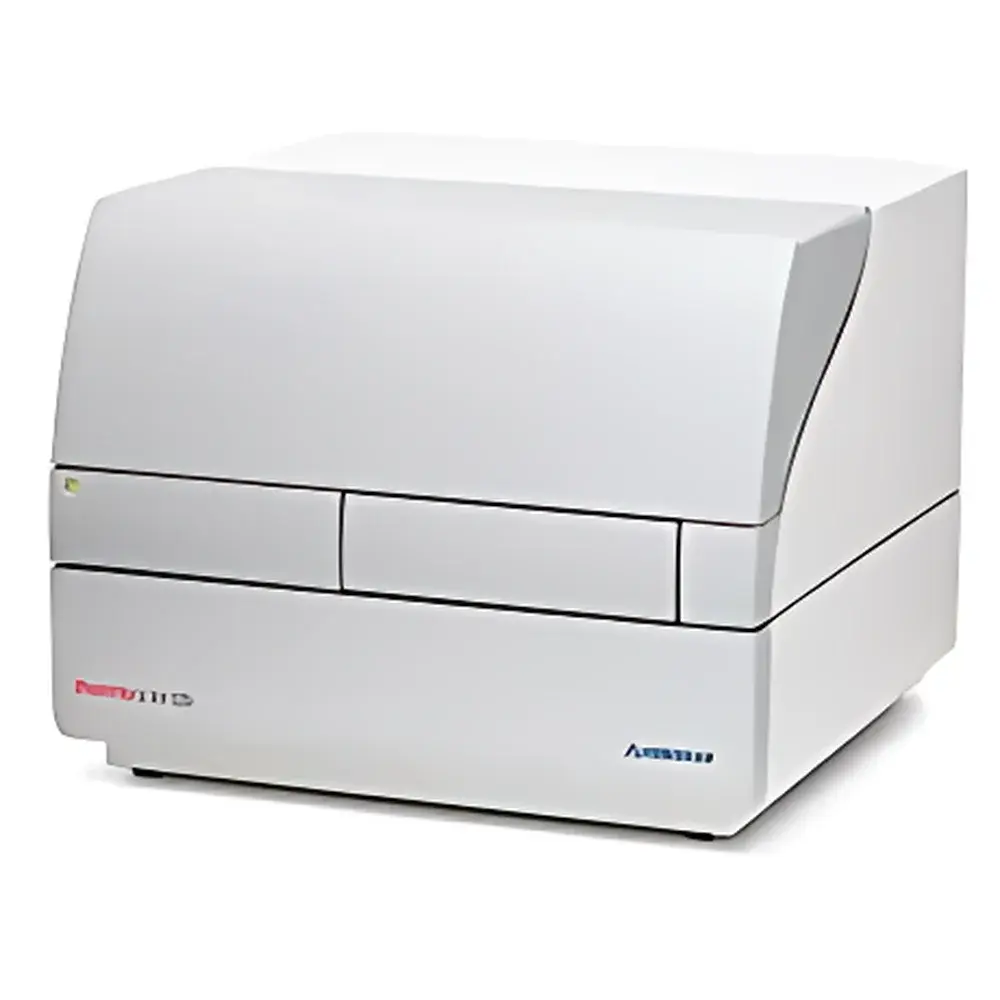
Thermo Scientific Fluoroskan Fluorescence Microplate Reader and Luminoskan Luminescence Microplate Reader
| Brand | Thermo Scientific |
|---|---|
| Origin | Singapore |
| Model | Fluoroskan / Fluoroskan FL / Luminoskan |
| Detection Mode | Fluorescence & Luminescence (Dual-Mode for Fluoroskan FL) |
| Detector Type | Photomultiplier Tube (PMT) |
| Plate Formats | 6–384-well microplates |
| Reading Speed | 18 s per 96-well plate |
| Measurement Modes | Endpoint, Kinetic, Multi-point per well |
| Excitation/Emission Flexibility | Top-read and bottom-read optical paths |
| Dynamic Range | >6 decades |
| Incubation Range | Up to 45 °C with orbital shaking |
| Liquid Handling | Optional integrated reagent dispensers (0, 1, or 2 dispensers) |
| Software | Thermo Scientific SkanIt PC and Cloud-based assay protocol library |
| Compliance | DLReady certified (Luminoskan & Fluoroskan FL), supports GLP/GMP workflows with audit trail capability |
Overview
The Thermo Scientific Fluoroskan series comprises high-performance fluorescence microplate readers, while the Luminoskan line delivers ultra-sensitive luminescence detection—both engineered for precision, reproducibility, and seamless integration into regulated life science laboratories. The Fluoroskan FL model unifies both modalities in a single dual-mode platform, enabling quantitative fluorescence intensity (FI), fluorescence polarization (FP), time-resolved fluorescence (TRF), Förster resonance energy transfer (FRET), bioluminescence resonance energy transfer (BRET), and both flash and glow luminescence assays. All instruments operate on photomultiplier tube (PMT)-based detection with optimized top- and bottom-reading optics, eliminating fiber-optic signal loss and maximizing photon collection efficiency. The optical architecture supports homogeneous assays (e.g., FRET in solution) via top-read and heterogeneous or cell-based assays (e.g., reporter gene expression in adherent cultures) via bottom-read—where reduced pathlength through culture medium minimizes absorbance interference and improves signal-to-noise ratio.
Key Features
- Dual optical pathways: Independent top- and bottom-read configurations with direct illumination and detection—no light guides or coupling losses—ensuring maximal sensitivity across assay formats.
- Integrated liquid handling: Optional programmable reagent dispensers (0, 1, or 2 units) enable synchronized dispensing and reading—critical for kinetic flash luminescence (e.g., luciferase ATP assays) and rapid stopped-flow fluorescence applications.
- Multi-point well scanning: Up to 9 user-defined measurement points per well compensate for cellular heterogeneity or uneven ligand distribution; supports fluorospot-style semi-quantitative analysis without imaging hardware.
- On-board incubation & shaking: Precise temperature control from ambient to 45 °C with orbital shaking (200–1,200 rpm) enables real-time monitoring of enzyme kinetics, cell signaling cascades, and metabolic activity under physiologically relevant conditions.
- Automated calibration & diagnostics: Pre-run self-checks verify lamp intensity, PMT gain, optical alignment, and dispenser function—flagging deviations before data acquisition to prevent invalid runs.
- DLReady certification: Luminoskan and Fluoroskan FL models comply with EN 61326-1 and IEC 61000-4 electromagnetic compatibility standards; certified for use in diagnostic development environments requiring traceable performance verification.
Sample Compatibility & Compliance
These readers accommodate standard ANSI/SLAS-compliant microplates (6–384-well), including opaque black/clear-bottom plates for fluorescence, white plates for luminescence, and specialized coated or membrane-based formats for cell attachment assays. Bottom-read capability is validated for monolayer and 3D spheroid cultures in clear-bottom plates. Instrument firmware and SkanIt software support 21 CFR Part 11 compliance through electronic signatures, role-based access control, and immutable audit trails—enabling deployment in GLP, GMP, and clinical research settings. All models meet ISO/IEC 17025 requirements for measurement uncertainty reporting when used with NIST-traceable reference standards.
Software & Data Management
SkanIt software provides an intuitive graphical interface for protocol setup, real-time monitoring, and statistical analysis—including linear, quadratic, sigmoidal (4PL/5PL), exponential, and custom curve fitting. The SkanIt Cloud Protocol Library hosts peer-reviewed, instrument-verified assay templates (e.g., Caspase-3 activity, cAMP ELISA, NF-κB reporter assays), reducing method development time and improving inter-laboratory reproducibility. Raw data export supports .xlsx, .csv, and XML formats compatible with LIMS and ELN systems. Batch processing, plate mapping, and Z’-factor calculation tools facilitate HTS validation per ASTM E1999-22 guidelines.
Applications
- Cell viability and cytotoxicity (e.g., AlamarBlue, Resazurin)
- Calcium flux and membrane potential assays (e.g., Fluo-4, JC-1)
- Reporter gene assays (luciferase, GFP, β-galactosidase)
- Protein–protein interactions (FRET/BRET)
- Enzyme kinetics (kinase, protease, phosphatase activity)
- High-throughput screening (HTS) of compound libraries
- Immunoglobulin quantification (fluoro-ELISA)
- Apoptosis and oxidative stress markers (e.g., caspase, ROS probes)
FAQ
What distinguishes Fluoroskan FL from standalone Fluoroskan or Luminoskan models?
The Fluoroskan FL integrates both fluorescence and luminescence detection modules in one chassis with shared optics, fluidics, and software—eliminating cross-platform calibration drift and enabling true multimodal assay multiplexing within a single run.
Can these readers be validated for regulated QC environments?
Yes. With SkanIt’s 21 CFR Part 11-compliant audit trail, electronic signature support, and IQ/OQ documentation packages available upon request, all models are suitable for pharmaceutical QC, biologics release testing, and clinical trial biomarker analysis.
Is bottom-reading supported for 384-well plates?
Bottom-read mode is fully functional for all supported plate formats, including 384-well clear-bottom plates; however, optimal signal-to-noise requires appropriate plate selection (e.g., low-fluorescence black plates with transparent bottoms).
How does multi-point reading improve data quality in cell-based assays?
By sampling multiple locations per well, multi-point acquisition mitigates bias from uneven cell confluence, edge effects, or localized transfection efficiency—yielding more representative average intensities than single-point measurement.
Are maintenance logs and service history accessible within SkanIt?
Yes. SkanIt maintains a timestamped service log tracking lamp usage hours, PMT voltage adjustments, calibration events, and error codes—exportable as PDF for internal QA review or regulatory inspection.




