
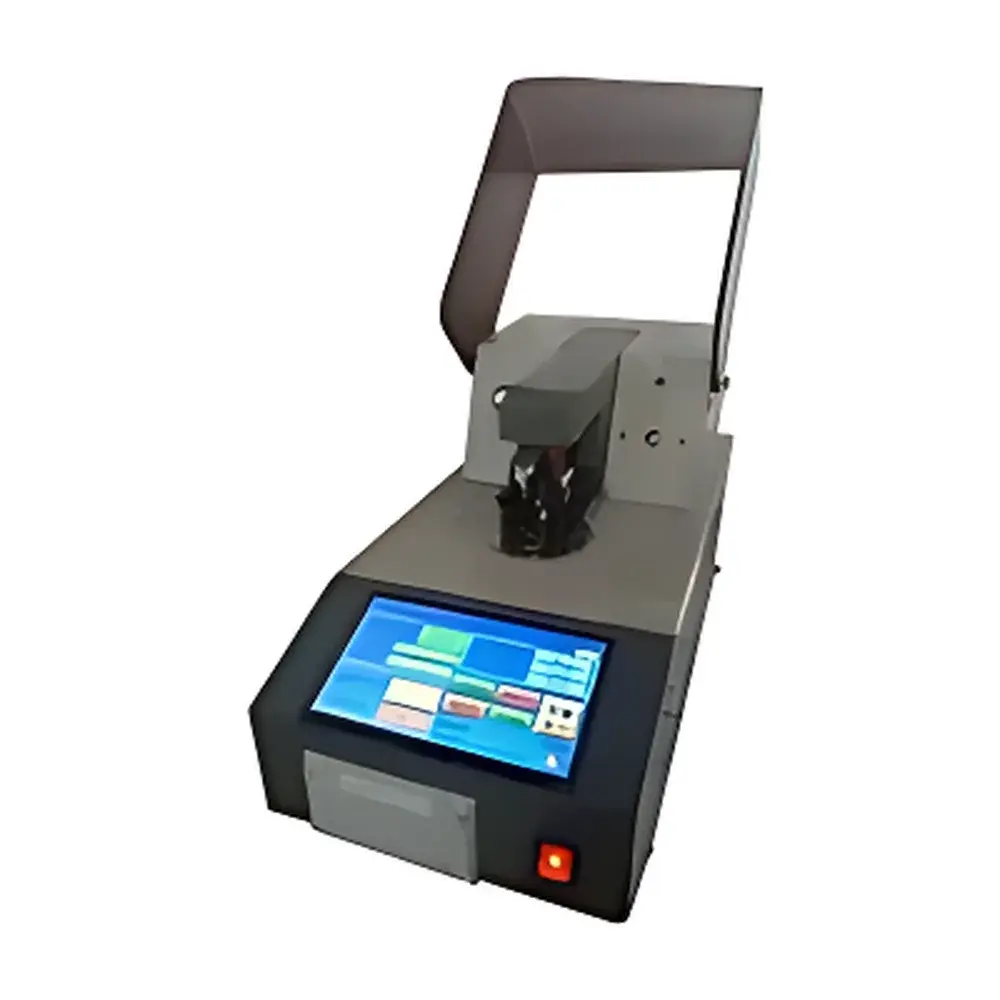
Xufeng XF-170 Automated Abel Closed-Cup Flash Point Tester
| Brand | Xufeng |
|---|---|
| Origin | Shanghai, China |
| Model | XF-170 |
| Detection Method | Closed-Cup (Abel) |
| Standards Compliance | ISO 13736, ISO 1516, ISO 1523, IP 170, GB/T 21789-2008, GB/T 27847-2011, GB/T 27848-2011 |
| Temperature Range (XF-170A) | +10 °C to +110 °C |
| Temperature Range (XF-170B) | 0 °C to +110 °C |
| Extended Range (with DW-25 chiller) | −30 °C to +80 °C |
| Cooling System | Integrated Peltier thermoelectric cooling bath |
| Stirring Speed | 0–30 rpm (adjustable) |
| Temperature Sensor | PT100 platinum resistance thermometer |
| Flash Detection | CRC-type thermocouple sensor |
| Ignition Options | Gas flame (external fuel supply) or electronic spark ignition |
| Display | Full-color capacitive touchscreen LCD |
| Power Consumption | 800 W |
| Dimensions | 400 × 380 × 350 mm (W×D×H) |
| Weight | ~20 kg |
Overview
The Xufeng XF-170 Automated Abel Closed-Cup Flash Point Tester is a precision-engineered instrument designed for the accurate and repeatable determination of flash point in accordance with internationally recognized closed-cup test methods—specifically the Abel procedure. It operates on the fundamental principle that flash point is the lowest temperature at which vapors above a liquid sample, when exposed to an ignition source under controlled conditions, produce a momentary flash of flame. The XF-170 implements this principle through strict thermal regulation, standardized cup geometry (Abel closed cup), programmable heating ramps, and automated ignition and detection sequences. Its architecture conforms to the physical and procedural requirements of ISO 13736 (petroleum products), ISO 1516 and ISO 1523 (low-viscosity liquids and solvents), IP 170 (Institute of Petroleum), and multiple Chinese national standards including GB/T 21789-2008, GB/T 27847-2011, and GB/T 27848-2011. The system integrates a Peltier-based thermoelectric cooling bath for precise sub-ambient temperature control—critical for testing low-flash-point materials such as light hydrocarbons, halogenated solvents, and bio-based formulations.
Key Features
- Multi-standard compliance with fully configurable test modes: ISO 13736, ISO 1516, ISO 1523, IP 170, and GB/T 21789-2008—each with preloaded heating rate profiles, stirring parameters, and ignition timing logic.
- Intelligent expected flash point search mode: Automatically scans temperature ranges to identify approximate flash points for unknown samples, minimizing manual pre-testing effort.
- User-definable test protocols: Enables customization of ramp rates, dwell times, ignition intervals, and detection sensitivity—supporting method development and internal SOP alignment.
- Full automation from start to report: After parameter entry via the 7-inch full-color capacitive touchscreen, the instrument executes cup loading (manual placement), temperature ramping, stirring (0–30 rpm adjustable), ignition (gas or electronic), flash detection via CRC thermocouple, and result validation without operator intervention.
- Dual cooling configurations: XF-170A (air-cooled, +10 °C to +110 °C); XF-170B (liquid-circulated Peltier bath, 0 °C to +110 °C; extendable to −30 °C to +80 °C when paired with optional DW-25 low-temperature chiller unit).
- Real-time thermal monitoring and diagnostics: PT100 sensor provides ±0.1 °C temperature stability; onboard self-diagnostic routines detect sensor faults, ignition failures, or thermal deviation and display actionable error codes.
- Integrated thermal printer: Outputs traceable hard-copy reports including test standard, sample ID, ambient pressure correction, observed flash point, and pass/fail status per regulatory requirements.
Sample Compatibility & Compliance
The XF-170 is validated for use with petroleum distillates, lubricants, biodiesel blends, industrial solvents (e.g., acetone, ethanol, xylene), paint thinners, cleaning agents, and low-viscosity synthetic fluids. Its Abel cup geometry ensures compatibility with volatile, low-surface-tension liquids where open-cup methods (e.g., Cleveland or Pensky-Martens) would yield non-representative results due to uncontrolled vapor loss. All operational parameters—including cup fill volume, stir rate, lid sealing torque, and ignition source positioning—adhere strictly to the dimensional and procedural specifications defined in ISO 13736 Annex A and GB/T 21789-2008 Clause 6. The instrument supports ambient pressure correction per ISO 1516:2014 Annex B, ensuring metrological traceability across laboratories operating at varying elevations. For regulated environments, data integrity is reinforced by time-stamped test logs, non-editable result storage, and optional audit trail configuration aligned with GLP and GMP documentation expectations.
Software & Data Management
The embedded firmware provides standalone operation without PC dependency. All test parameters, calibration records, and result histories are stored internally with timestamping and user login tracking (via optional password protection). Export functionality supports USB mass storage for CSV-formatted data transfer to LIMS or QA databases. While no proprietary PC software is bundled, the instrument’s RS-232 and USB-B interfaces permit integration into centralized laboratory informatics systems using standard SCPI-like command sets. Test reports include mandatory metadata: standard reference, instrument ID, operator code, atmospheric pressure input, calibration date of PT100 and CRC sensors, and detection confidence indicator. For FDA-regulated facilities, the system can be configured to meet 21 CFR Part 11 requirements—including electronic signatures and audit trail activation—through documented configuration control and third-party validation support packages.
Applications
- Quality control of refinery intermediates and finished fuels (naphtha, kerosene, diesel) per ASTM D93 / ISO 2719 equivalence pathways.
- Safety classification of chemical raw materials under UN GHS and CLP regulations—determining Packing Group I, II, or III assignments.
- Regulatory submission testing for REACH, TSCA, and EPA reporting where closed-cup flash point defines flammability hazard categories.
- R&D screening of novel solvent formulations, lithium battery electrolytes, and low-VOC coatings requiring sub-zero flash point quantification.
- Contract testing laboratories performing accredited flash point analysis under ISO/IEC 17025:2017—leveraging the XF-170’s documented repeatability (≤±0.5 °C per ISO 13736 repeatability clause) and interlaboratory reproducibility performance.
FAQ
What distinguishes the Abel closed-cup method from Pensky-Martens or Cleveland open-cup tests?
The Abel method uses a sealed cup with a defined vapor space and controlled ignition timing, making it especially suitable for low-flash-point, high-volatility liquids where open-cup evaporation leads to overestimation. It is mandated for certain solvent classifications under ISO and GB standards.
Can the XF-170 operate without external gas supply?
Yes—the XF-170AE and XF-170BE variants feature integrated electronic spark ignition and require no propane/butane connection, enhancing lab safety and installation flexibility.
Is calibration verification traceable to national standards?
The PT100 sensor and CRC flash detector are factory-calibrated against NIST-traceable references; users receive a calibration certificate with uncertainty budget. Annual recalibration is recommended per ISO/IEC 17025 Clause 6.5.
How does the Peltier cooling system improve test reliability compared to compressor-based chillers?
Peltier elements offer faster thermal response, finer resolution (±0.1 °C), zero vibration transfer to the cup assembly, and maintenance-free operation—critical for detecting subtle flash events in narrow temperature windows.
Does the instrument support multi-sample throughput?
While the base XF-170 is single-cup, its modular control architecture allows integration with XF-2S or XF-4S multi-position test modules for parallel closed-cup or mixed open/closed testing under synchronized protocol execution.







