
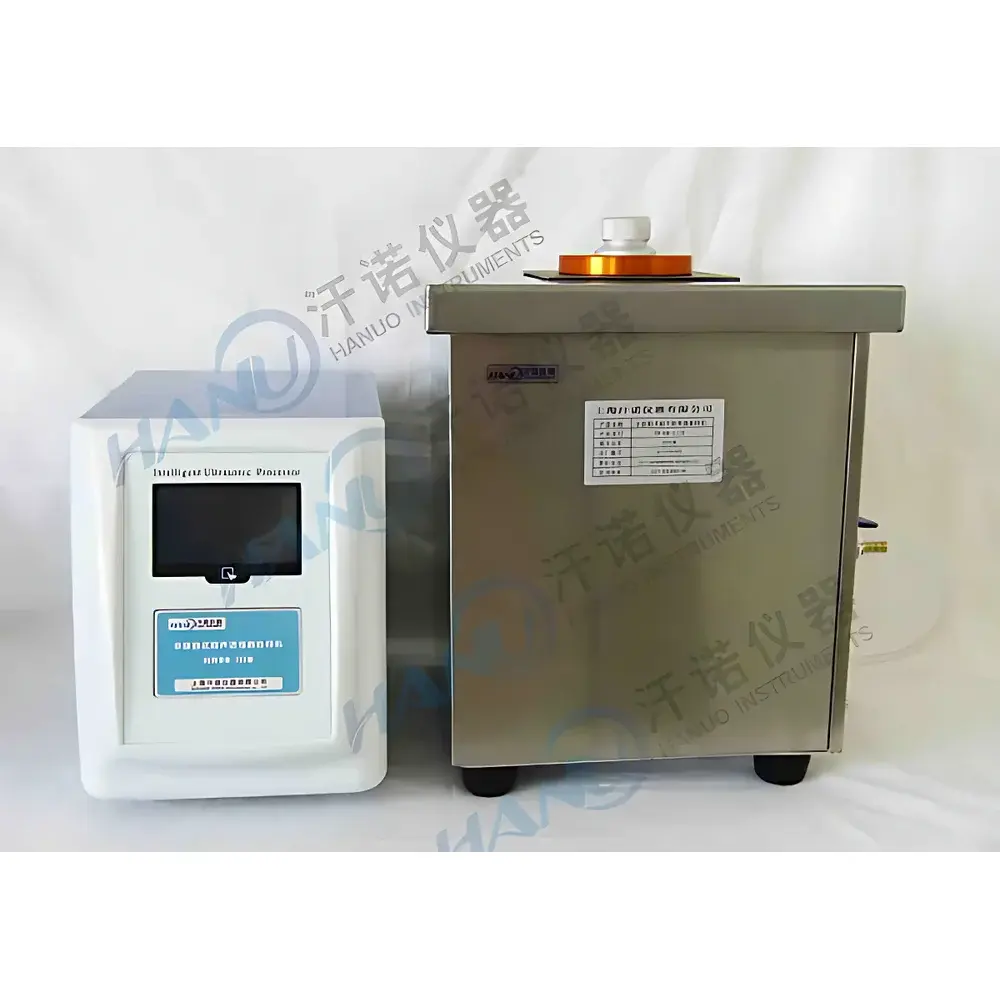
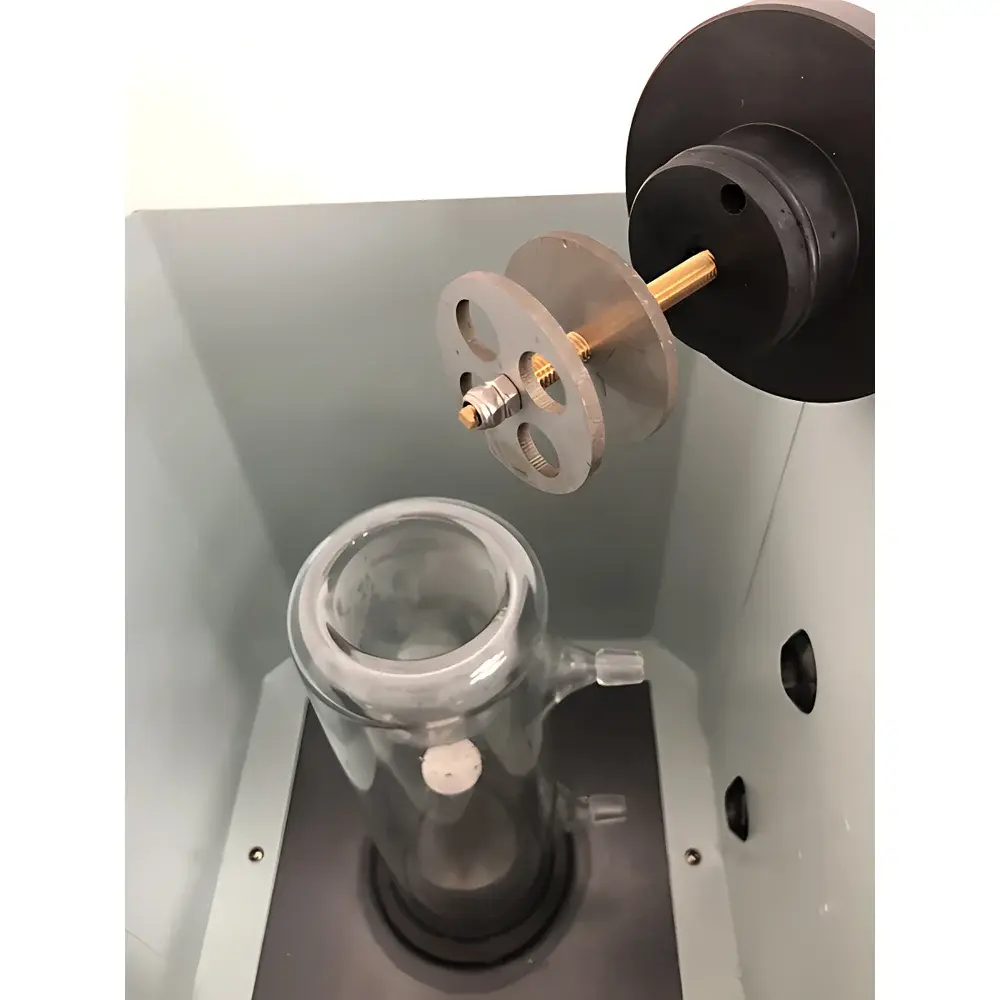
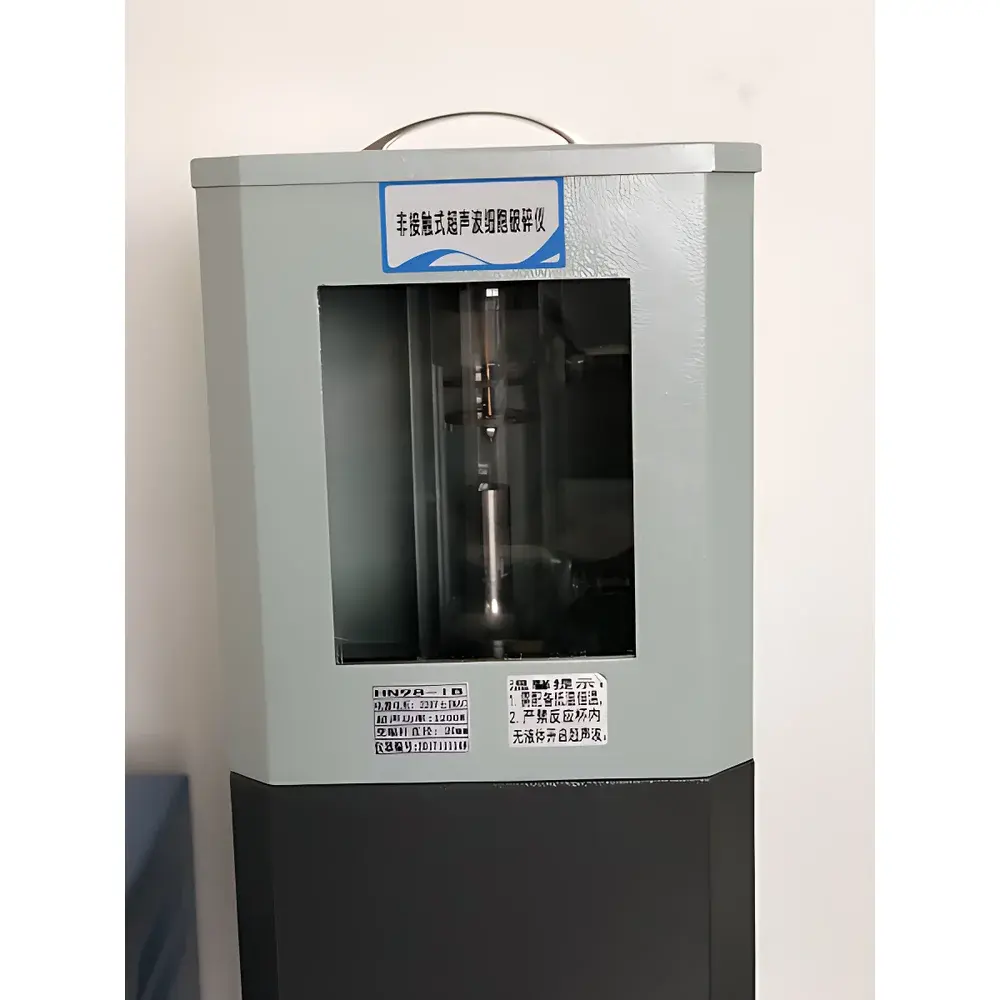
Hanuo HN98-IIB Non-Contact Ultrasonic Cell Disruptor
| Brand | Hanuo |
|---|---|
| Origin | Shanghai, China |
| Manufacturer Type | Authorized Distributor |
| Product Category | Domestic |
| Model | HN98-IIB |
| Instrument Type | Non-Contact Ultrasonic Cell Disruptor |
| Ultrasonic Frequency | 20 kHz |
| Maximum Ultrasonic Power | 1200 W |
| Temperature Range | 0–99 °C |
| Sample Volume per Tube | 0.1–2 mL |
| Number of Simultaneous Samples | 4 or 6 |
| Duty Cycle | 1–99.9% |
| Input Voltage | 220 V / 110 V, 50 Hz / 60 Hz |
| Cooling Interface | Yes (for external chiller connection) |
| Display | Large LCD |
Overview
The Hanuo HN98-IIB Non-Contact Ultrasonic Cell Disruptor is an engineered solution for controlled, reproducible, and contamination-free lysis of biological samples under sterile conditions. Unlike traditional probe-based sonicators, this system employs high-intensity focused ultrasound transmitted through the walls of sealed microcentrifuge tubes—eliminating direct probe contact with samples and thereby preventing cross-contamination, aerosol generation, and thermal degradation at the interface. The device operates at a nominal frequency of 20 kHz, generating cavitation within the liquid phase of each tube via acoustic coupling through water-bath immersion. This non-invasive energy transfer enables efficient shearing of chromosomal DNA, disruption of mammalian and microbial cells, and release of viral particles—including adenovirus and AAV—without compromising structural integrity or immunogenicity. Its design aligns with core requirements for Chromatin Immunoprecipitation (ChIP), epigenetic profiling, nucleosome mapping, and next-generation sequencing library preparation where sample integrity, low background, and inter-sample consistency are critical.
Key Features
- Non-contact operation ensures complete physical separation between transducer and sample—ideal for BSL-2/BSL-3 workflows and aseptic processing.
- Simultaneous processing of up to six 0.1–2 mL tubes in independent positions, enabling parallelization without manual repositioning or probe sterilization.
- Adjustable duty cycle (1–99.9%) and programmable pulse timing allow precise control over total acoustic energy delivery—critical for optimizing lysis efficiency while minimizing protein denaturation or RNA fragmentation.
- Integrated temperature monitoring and external cooling port support connection to recirculating chillers, maintaining sample temperatures between 0–99 °C to preserve labile biomolecules during extended sonication cycles.
- Large backlit LCD interface provides real-time feedback on elapsed time, power output, cycle count, and active parameters—supporting SOP-driven operation and audit-ready documentation.
- Acoustic dampening enclosure with hinged access door reduces ambient noise and contains any residual vapor pressure buildup during high-power operation.
Sample Compatibility & Compliance
The HN98-IIB accommodates standard 1.5 mL and 2.0 mL conical microcentrifuge tubes from major suppliers (e.g., Eppendorf, Axygen, Thermo Fisher). It is validated for use with primary cells, cultured cell lines, bacterial pellets, yeast, tissue homogenates, and viral lysates. Due to its closed-tube architecture, the system meets essential biosafety requirements outlined in CDC/NIH Biosafety in Microbiological and Biomedical Laboratories (BMBL) guidelines for handling infectious agents. While not certified to ISO 13485 or FDA 21 CFR Part 11 out-of-the-box, its parameter logging capability, user-accessible calibration mode, and deterministic pulse control support integration into GLP- and GMP-compliant environments when paired with validated electronic lab notebook (ELN) systems and instrument qualification protocols (IQ/OQ/PQ).
Software & Data Management
The HN98-IIB operates via embedded firmware with no proprietary PC software dependency. All operational parameters—including frequency stability, power ramp profiles, and cycle repetition—are stored in non-volatile memory and recalled per user-defined protocol. Time-stamped run logs (date, duration, power setting, duty cycle, tube position) can be exported via USB interface for traceability. For laboratories requiring full 21 CFR Part 11 compliance, third-party instrument integration platforms (e.g., LabArchives, Benchling, or custom LIMS modules) may capture metadata via RS-232 or TTL-triggered event signals. Firmware updates are delivered via secure download and require local administrator authentication.
Applications
- Chromatin shearing for ChIP-seq, CUT&RUN, and ATAC-seq assays.
- Preparation of high-titer recombinant adenovirus and lentivirus stocks without loss of infectivity.
- Extraction of DNA-protein complexes, terminal protein-linked DNA, and nucleosome core particles.
- Soil metagenomic extraction where mechanical lysis must avoid clay-induced inhibition and humic acid carryover.
- Fragmentation of FFPE-derived nucleic acids prior to hybrid capture or amplicon sequencing.
- Standardized cell lysis for quantitative proteomics and phosphoproteome analysis.
FAQ
Is the HN98-IIB compatible with cryogenic sample handling?
Yes—the unit supports external coolant circulation down to –20 °C when connected to a certified low-temperature chiller; tube racks are designed to maintain thermal uniformity across all positions.
Can I use it for RNA isolation without RNase contamination?
Absolutely—the closed-tube workflow eliminates probe-mediated RNase introduction; users should still follow standard RNase-free consumables and buffer practices.
What is the maximum recommended total sonication time per sample?
For optimal chromatin integrity in ChIP applications, cumulative on-time should not exceed 15 minutes per sample when using 30-second pulses with 30-second rest intervals.
Does it support variable amplitude control?
No—the HN98-IIB delivers fixed-amplitude ultrasonic output at 1200 W peak power; intensity modulation is achieved exclusively via duty cycle and pulse duration adjustment.
How often does the transducer require recalibration?
Under normal laboratory use, annual verification against a calibrated hydrophone (per ASTM E1001) is recommended; field-level power validation can be performed using calorimetric methods per ISO 17025-accredited procedures.
Related Products




