
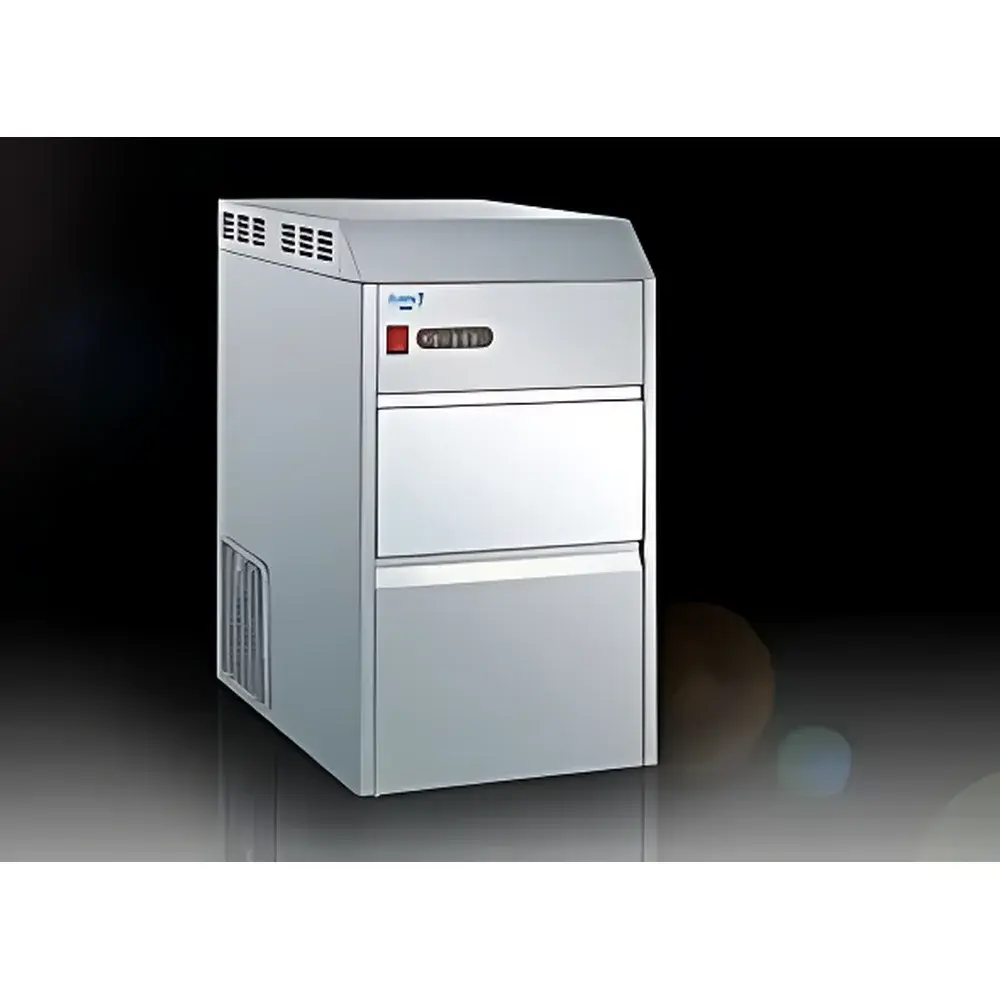
Hanuo FM40 Standalone Flake Ice Machine
| Brand | Hanuo |
|---|---|
| Origin | Shanghai, China |
| Model | FM40 |
| Ice Production Capacity | 40 kg/24h |
| Storage Capacity | 15 kg |
| Ice Type | Irregular flake ice |
| Construction Material | Stainless steel (304) |
| Cooling Method | Air-cooled |
| Power Input | 280 W |
| Dimensions (W×D×H) | 380 × 543 × 722 mm |
| Net Weight | 40 kg |
| Ice Formation Principle | Dual-screw extrusion |
Overview
The Hanuo FM40 Standalone Flake Ice Machine is an air-cooled, self-contained refrigeration system engineered for consistent, on-demand production of irregular flake ice—characterized by high surface-area-to-volume ratio, rapid thermal transfer, and excellent conformity to irregularly shaped objects. Unlike cubed or nugget ice, flake ice is formed through a dual-screw extrusion process: water is frozen onto a vertically oriented evaporator drum under controlled refrigerant flow; the resulting thin ice layer is continuously scraped off by rotating augers and compressed through twin counter-rotating screws, yielding dry, non-adhesive, low-density flakes (typically 1–2 mm thick, 5–15 mm in diameter). This principle ensures minimal residual moisture, reduced bridging in storage bins, and superior cooling efficiency per unit mass—making the FM40 especially suitable for applications demanding gentle, uniform chilling without mechanical damage or dilution.
Key Features
- Standalone architecture with integrated compressor, condenser, evaporator, and storage bin—no external water chiller or glycol loop required.
- Dual-screw extrusion mechanism delivers high-purity flake ice with <5% surface moisture content and negligible clumping under ambient storage conditions.
- Air-cooled condensing system eliminates dependency on facility water supply for heat rejection—ideal for laboratories, mobile clinics, and locations with limited plumbing infrastructure.
- 304 stainless steel construction throughout critical wetted and structural components—including evaporator drum, auger housing, ice chute, and storage bin—ensuring corrosion resistance and compliance with ISO 8573-1 (compressed air purity) and FDA 21 CFR Part 110 (food-grade equipment design).
- Intelligent microprocessor control with real-time monitoring of evaporator temperature, compressor discharge pressure, and ambient intake air temperature—enabling adaptive cycle timing and automatic defrost initiation based on thermal load history.
- Front-access service panel and modular component layout facilitate routine maintenance (e.g., condenser coil cleaning, screw alignment verification) without full disassembly.
Sample Compatibility & Compliance
The FM40 produces flake ice optimized for direct contact with temperature-sensitive biological specimens (e.g., tissue samples, blood bags, PCR reagents), pharmaceutical intermediates, and fresh seafood—where rapid, non-abrasive cooling is critical. Its ice output meets ASTM F2692-22 “Standard Specification for Flake Ice Used in Food and Medical Applications” for particle morphology, melt rate, and microbiological safety when operated with potable water and maintained per manufacturer-recommended sanitation intervals. The unit complies with IEC 61000-6-3 (EMC emission limits) and IEC 60335-1/60335-2-72 (safety requirements for refrigerating appliances), and its stainless steel surfaces support GLP-aligned cleaning validation protocols (e.g., ATP bioluminescence testing post-sanitization).
Software & Data Management
While the FM40 operates via embedded firmware without cloud connectivity, its control module logs operational parameters—including daily ice yield, cumulative runtime, number of defrost cycles, and fault codes—with timestamped records retained for ≥30 days. Audit trails are exportable via USB interface in CSV format, supporting traceability requirements under ISO/IEC 17025 Clause 7.7 (result reporting) and FDA 21 CFR Part 11 Subpart B (electronic records integrity) when paired with validated laboratory information management systems (LIMS). Optional RS-485 Modbus RTU output enables integration into building management systems (BMS) for centralized energy monitoring and predictive maintenance scheduling.
Applications
- Life sciences labs: Cold chain maintenance during sample transport, histology specimen embedding, and enzyme activity assays requiring sub-10°C stabilization.
- Hospital blood banks: Rapid cooling of platelet concentrates and whole blood units prior to centrifugation or storage at 20–24°C.
- Food safety testing labs: Temperature-controlled sample homogenization and microbial enrichment media preparation.
- Pharmaceutical QC: Chilling of HPLC autosampler trays and dissolution test vessels to prevent analyte degradation.
- Field-deployable research: Use in mobile veterinary units or marine biology stations where portability, low water consumption, and ambient-air heat rejection are essential.
FAQ
What is the recommended water quality specification for optimal ice clarity and equipment longevity?
Potable water meeting WHO Guidelines for Drinking-water Quality (2nd ed.) is required; total dissolved solids (TDS) should not exceed 500 ppm, and iron content must remain below 0.1 ppm to prevent evaporator discoloration and scale formation.
Can the FM40 operate continuously in ambient temperatures above 35°C?
Yes—its air-cooled condenser is rated for continuous operation up to 43°C ambient, though sustained operation >38°C may reduce daily output by ~8–12% due to decreased condensing efficiency.
Is the ice storage bin insulated, and what is its thermal decay rate?
The 15 kg bin features 30 mm polyurethane foam insulation (λ = 0.022 W/m·K); under ISO 8573-1 Class 4 ambient conditions (25°C, 60% RH), ice mass loss averages 0.8 kg/24h when bin is 80% full and door remains closed.
Does the unit include a built-in water filtration system?
No—external sediment and carbon filtration (e.g., 5 µm prefilter + activated carbon stage) is mandatory and must be installed upstream of the machine’s water inlet per Section 5.2 of the FM40 Installation Manual.
How often does the dual-screw assembly require lubrication or alignment verification?
Screw bearings are sealed-for-life and require no periodic greasing; alignment inspection is recommended every 6,000 operating hours or annually—whichever occurs first—as part of preventive maintenance per ISO 55001 asset management guidelines.
Related Products



