
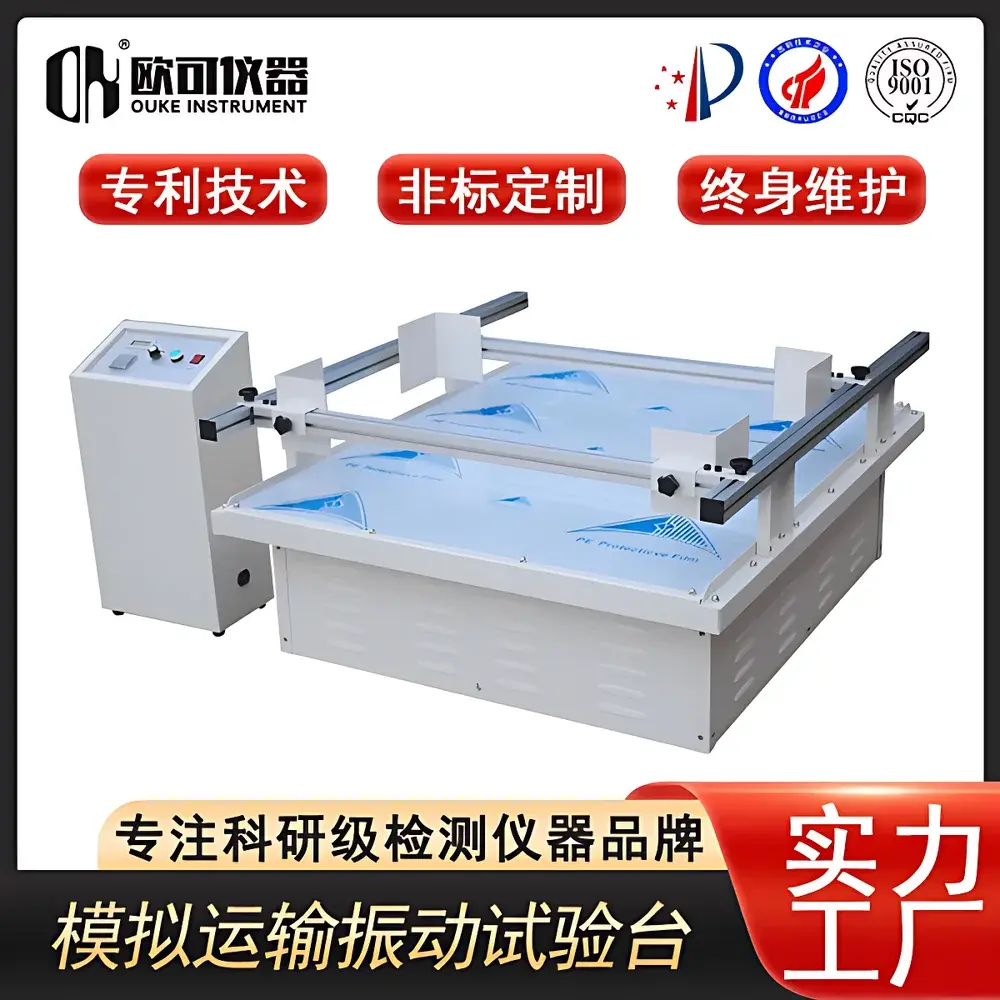
OK-100 Orbital Vibration Tester
| Brand | OK Instruments |
|---|---|
| Origin | Guangdong, China |
| Manufacturer Type | Direct Manufacturer |
| Country of Origin | China |
| Model | OK-1000.1213 |
| Load Capacity | 100 kg |
| Test Table Dimensions (L×W) | 120 × 100 cm |
| Vibration Mode | Orbital (Reciprocating) |
| Speed Range | 60–300 rpm |
| Peak-to-Peak Amplitude | 25.4 mm |
| Compliance | ISTA 1A/2A/3A, EN 71-1, ASTM D999, ASTM D4728 |
| Timer Range | 0.1 s – 999.99 h |
| Drive System | AC Variable-Frequency or DC Speed Control |
| Power Supply | 220 V, 50/60 Hz |
Overview
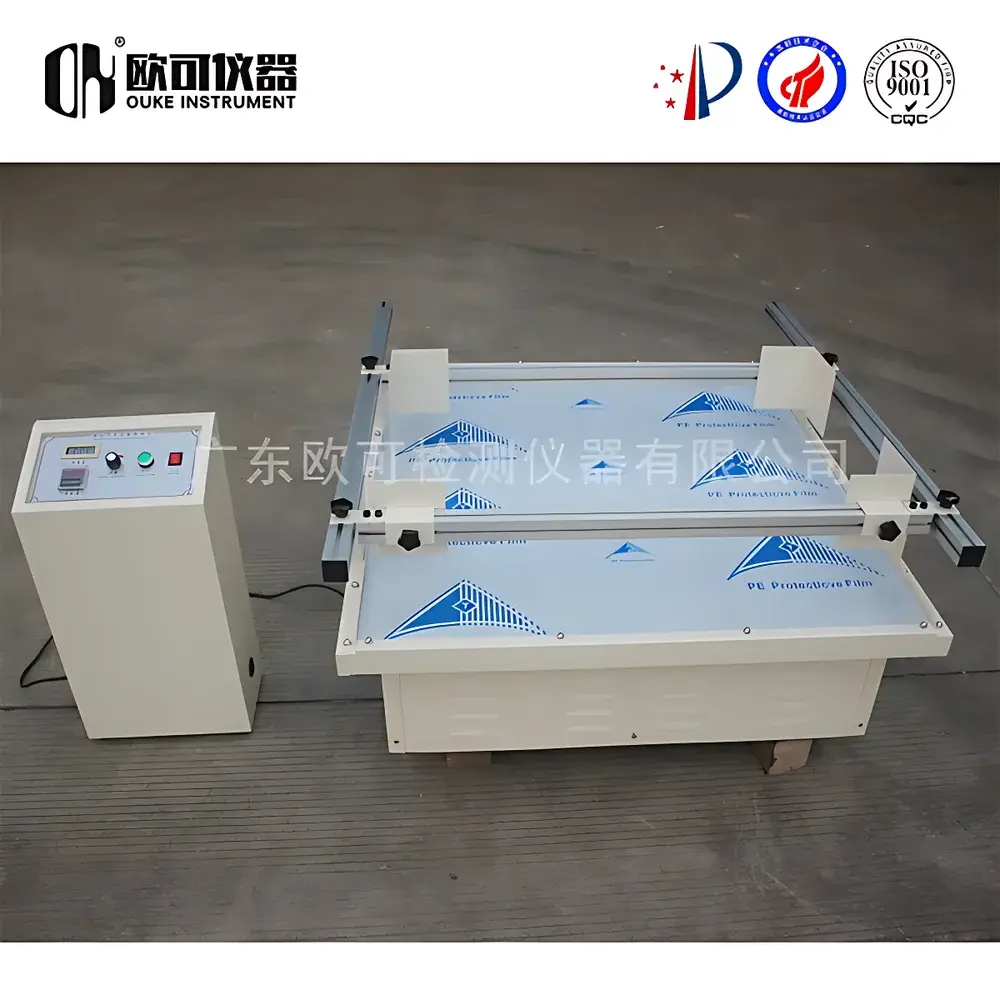
The OK-100 Orbital Vibration Tester is an engineered laboratory-grade simulation system designed to replicate the dynamic mechanical stresses encountered during ground transportation—specifically truck, rail, and intermodal freight handling. It operates on the principle of controlled orbital (reciprocating) motion, generating reproducible low-frequency vibration profiles in accordance with internationally recognized packaging performance standards. Unlike resonant shaker systems, this unit delivers fixed-amplitude, variable-speed sinusoidal displacement at frequencies between 1.5 Hz and 5.0 Hz (equivalent to 60–300 rpm), enabling standardized fatigue assessment of packaged goods under defined cumulative cycle counts (e.g., 14,200 total vibrations per ISTA 2A). Its robust mechanical architecture, precision-machined linear slide rails, and low-noise drive assembly ensure stable operation in shared laboratory or office environments—without requiring dedicated foundation mounting or acoustic enclosures.
Key Features
- Orbital vibration mechanism with ±12.7 mm displacement (25.4 mm peak-to-peak), mechanically fixed to comply with ISTA and ASTM amplitude requirements
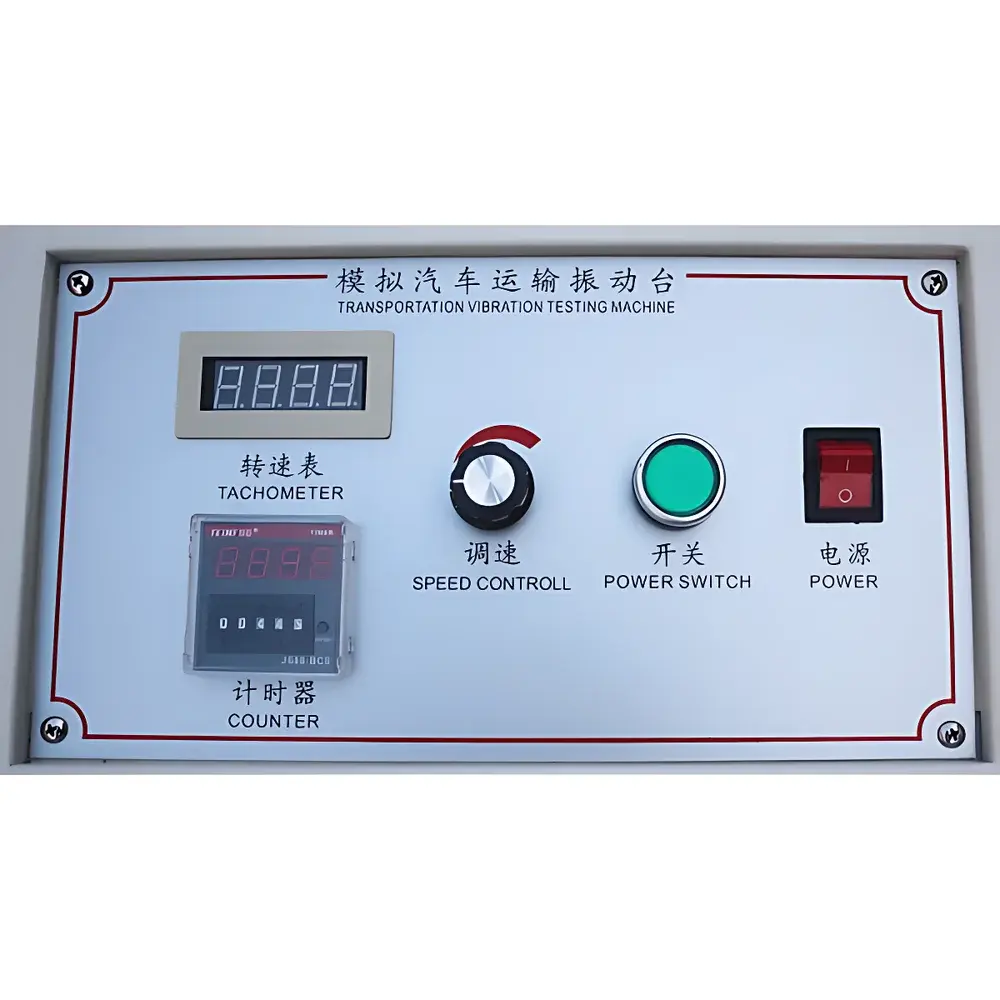
- Digitally calibrated speed control (60–300 rpm) via AC variable-frequency or DC motor drive, offering high repeatability across test runs
- Integrated microprocessor-based timer with resolution down to 0.1 seconds and maximum span of 999.99 hours for extended durability validation
- Low-noise (<65 dB(A)) operation enabled by precision-ground linear guide rails and balanced eccentric mass assembly—suitable for ISO Class 5 cleanroom-adjacent labs and multi-tenant office buildings
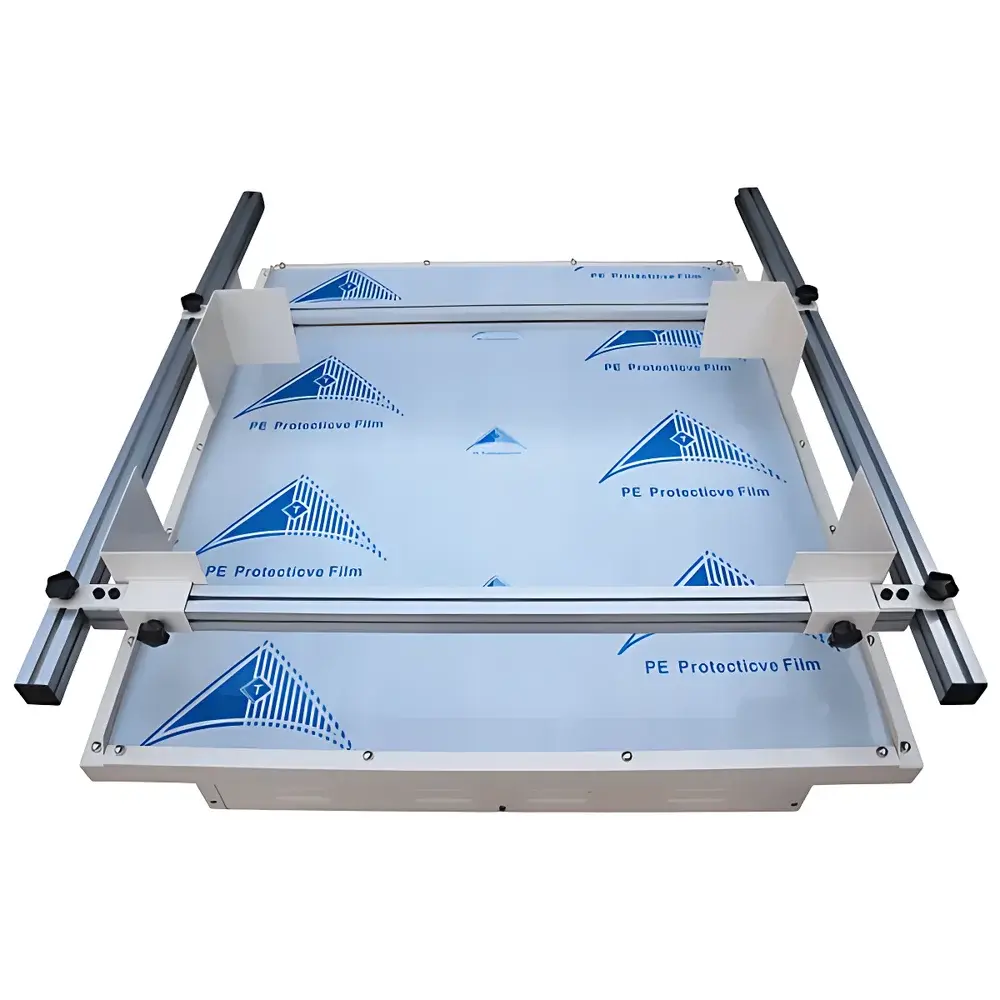
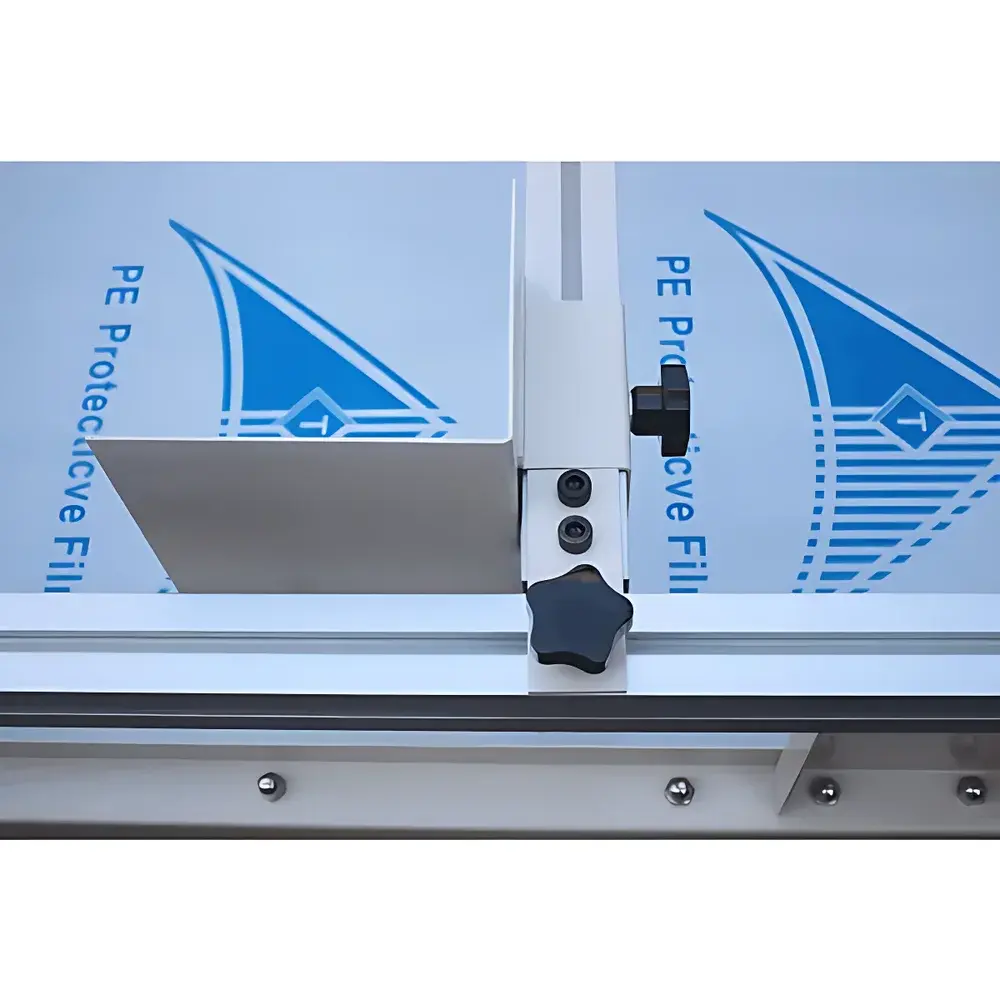
- Modular load platform (120 × 100 cm) constructed from reinforced aluminum alloy with T-slot configuration for rapid fixture adaptation
- Front-panel LED display showing real-time rpm, elapsed time, and remaining test duration; no external PC required for basic operation
Sample Compatibility & Compliance
The OK-100 accommodates packaged units up to 100 kg and 120 × 100 cm footprint, supporting cartons, palletized loads, foam-wrapped electronics, toy kits, ceramic ware, and furniture assemblies. Its vibration profile meets the mechanical input specifications of multiple international transport simulation protocols: ISTA Procedure 1A (non-certified shipper), 2A (certified shipper), and 3A (individual package); EN 71-1 (safety of toys); and ASTM D999 (vibration testing of packaged-products) and D4728 (random vibration testing). While not a certified calibration instrument per ISO/IEC 17025, the system’s mechanical design adheres to traceable dimensional tolerances and speed stability limits defined in ASTM E178 for equipment used in comparative conformance testing. All units undergo factory verification using calibrated laser vibrometry prior to shipment.
Software & Data Management
The OK-100 operates as a standalone electromechanical tester with embedded firmware—no proprietary software installation is required for routine use. However, optional RS-232 or USB-to-serial interface modules enable integration with third-party data acquisition platforms (e.g., LabVIEW, MATLAB, or custom Python scripts) for automated logging of start/stop timestamps, speed deviations, and thermal drift monitoring. For regulated environments operating under GLP or GMP frameworks, users may implement external audit-trail solutions that record operator ID, test parameters, and pass/fail decisions in CSV or XML format. The device does not natively support FDA 21 CFR Part 11 electronic signatures, but its deterministic behavior and immutable timer logic allow full traceability when paired with validated documentation workflows.
Applications
- Pre-shipment validation of corrugated shipping containers, retail-ready packaging, and e-commerce fulfillment units
- Design iteration support for cushioning systems—including polyethylene foam, molded pulp, air pillows, and honeycomb inserts
- Root-cause analysis of field failures related to stacking damage, corner crush, or internal component loosening
- Supplier qualification testing per OEM packaging specifications (e.g., Apple, Dell, IKEA, Hasbro)
- Academic research in packaging engineering, materials science, and supply chain resilience modeling
- Quality assurance audits aligned with ISO 9001 clause 8.5.1 (control of production and service provision)
FAQ
Does the OK-100 meet ISTA certification requirements for lab accreditation?
No—the OK-100 is a compliance-simulating tester, not a certified ISTA Member Laboratory device. It produces the specified waveform and amplitude but requires independent validation by an ISTA-certified lab for formal certification reports.
Can the test table be customized for non-standard sample dimensions?
Yes. OK Instruments offers mechanical redesign of the platform (up to 150 × 130 cm) and load-bearing reinforcement for models OK-200 through OK-500. Custom T-slot patterns and mounting hole templates are provided upon request.
Is vibration frequency independently adjustable beyond the 60–300 rpm range?
No. The mechanical linkage and cam geometry fix the operational frequency band to 1.5–5.0 Hz (60–300 rpm), consistent with ISTA-defined transport spectra. Higher frequencies require electrodynamic shakers, which fall outside this product class.
What maintenance is required to sustain metrological stability?
Biannual inspection of guide rail lubrication, belt tension (if AC-driven), and eccentric mass bolt torque is recommended. No recalibration is needed unless physical impact damage occurs to the motion transmission system.
Does the unit include safety interlocks or emergency stop functionality?
Yes—a hardware-based E-stop button with NC circuit interruption is integrated into the front panel, compliant with IEC 60204-1 Clause 9.2.4 for industrial machinery safety.



