
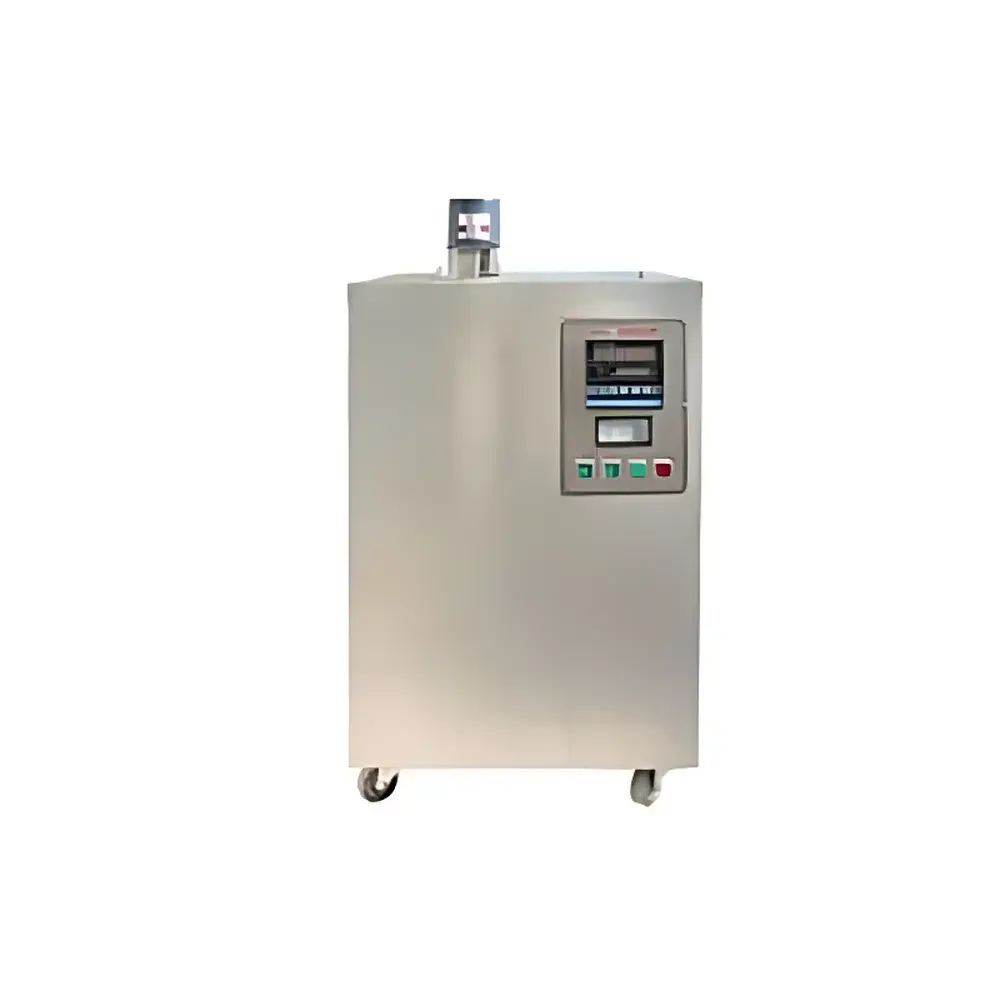
Hanuo HN300A Precision Immersion Circulating Oil Bath
| Brand | Hanuo |
|---|---|
| Origin | Shanghai, China |
| Model | HN300A |
| Temperature Range | Ambient to 300 °C |
| Temperature Stability | ±0.01 °C (30 min) |
| Bath Volume | 23 L |
| Circulation Type | Internal recirculation |
| Working Medium | Methyl silicone oil |
| Uniformity | ±0.01 °C |
| Power Supply | 220 V / 50 Hz |
| Total Power | 3.0 kW |
| Working Chamber Dimensions | Ø150 mm × 480 mm |
| Recommended Ambient Operating Temperature | <35 °C |
Overview
The Hanuo HN300A Precision Immersion Circulating Oil Bath is an engineered thermal calibration and stabilization platform designed for metrological-grade temperature applications in national metrology institutes, accredited calibration laboratories, and R&D facilities requiring traceable thermal control up to 300 °C. Unlike general-purpose heating baths, the HN300A employs a full-immersion, forced-convection architecture optimized for high spatial uniformity and temporal stability—critical for primary and secondary thermometer calibration per ISO/IEC 17025, ASTM E77, and JJG 50–2019 standards. Its core function relies on precise resistive heating of methyl silicone oil within a thermally insulated stainless-steel reservoir, coupled with a high-efficiency internal circulation pump that ensures laminar, low-turbulence flow across the entire working zone (Ø150 mm × 480 mm). This configuration minimizes axial and radial thermal gradients, enabling reproducible immersion depth-dependent measurements essential for calibrating standard mercury-in-glass thermometers, platinum resistance thermometers (PRTs), thermistor probes, and noble-metal thermocouples (e.g., PtRh10–Pt, PtRh13–Pt).
Key Features
- High-stability temperature control with ≤±0.01 °C short-term fluctuation over 30 minutes and ≤±0.01 °C spatial uniformity across the defined working volume—verified via multi-point probe mapping per ILAC-G8:2021 guidelines.
- Full-immersion design with optimized bath geometry and internal recirculation ensures consistent thermal coupling between the medium and immersed reference sensors or DUTs (devices under test).
- Stainless-steel construction with double-wall insulation and vapor-resistant lid minimizes heat loss and oil oxidation at elevated temperatures.
- Dedicated methyl silicone oil compatibility (operating range: −40 °C to +300 °C) ensures long-term thermal stability, low volatility, and minimal viscosity drift across the full temperature span.
- Microprocessor-based PID controller with programmable ramp rates, soak timers, and real-time deviation alarms supports GLP-compliant calibration workflows.
- Integrated safety systems include overtemperature cut-off, dry-run protection, and ground-fault circuit interruption (GFCI) compliant with IEC 61010-1.
Sample Compatibility & Compliance
The HN300A accommodates standard-length reference thermometers (up to 450 mm), industrial PRTs (DIN EN 60751 Class A/AA), thermistor assemblies, and thermocouple calibration blocks requiring stable oil immersion. It meets mechanical and thermal requirements for use in accordance with ISO 5725 (accuracy, repeatability), ASTM E220 (thermocouple calibration), USP (thermal calibration of analytical instruments), and Chinese national verification regulation JJG 50–2019. The unit is CE-marked for EMC and LVD compliance and supports audit-ready documentation for ISO/IEC 17025 accreditation—particularly for laboratories performing thermometer calibration as part of their scope of accreditation.
Software & Data Management
While the HN300A operates via front-panel controls, it features RS-232 and optional RS-485 digital interfaces for integration into automated calibration systems. When connected to compliant software (e.g., MET/TEMP II, CalTemp Pro, or LabVIEW-based custom solutions), the bath enables remote setpoint programming, real-time temperature logging, and automatic data export in CSV or XML formats. All temperature readings are timestamped and support 21 CFR Part 11–compliant electronic records when paired with validated software—ensuring audit trails, user access control, and electronic signatures for regulated environments including pharmaceutical QC and aerospace testing labs.
Applications
- Primary and secondary calibration of liquid-in-glass thermometers (including standard mercury and Beckmann types).
- Calibration and verification of industrial platinum resistance thermometers (PRTs), thermistors, and base-metal/noble-metal thermocouples.
- Thermal validation of analytical instruments such as HPLC column ovens, GC injectors, and viscometers requiring stable oil-phase heating.
- Material testing protocols involving thermal aging, coefficient of thermal expansion (CTE) determination, and rheological studies requiring controlled oil-bath environments.
- Reference standard maintenance in metrology labs where traceability to national temperature standards (e.g., NIM, NIST, PTB) is required.
FAQ
What temperature media are compatible with the HN300A?
Methyl silicone oil is the recommended and validated medium; other high-temperature oils (e.g., phenyl methyl silicone) may be used only after verifying thermal stability, flash point (>320 °C), and viscosity profile across the operating range.
Is external circulation supported?
No—the HN300A provides internal recirculation only. For external loop applications, consider the HN300C variant with dual-port fluid coupling.
Can the bath be used below 90 °C?
Yes—though optimal stability (±0.01 °C) is guaranteed from 90 °C to 300 °C; operation below 90 °C is possible but uniformity and stability specifications are not formally validated.
What maintenance is required for long-term accuracy?
Annual verification of temperature sensor linearity, recalibration of the internal Pt100 sensor against a certified reference thermometer, and periodic oil replacement (every 12–18 months depending on usage frequency and thermal cycling profile) are recommended.
Does the unit comply with FDA or EU GMP requirements?
The hardware itself is not GMP-certified, but its design, interface capabilities, and operational traceability support integration into GMP-regulated workflows when deployed with validated software and documented SOPs per Annex 11 and ALCOA+ principles.



