
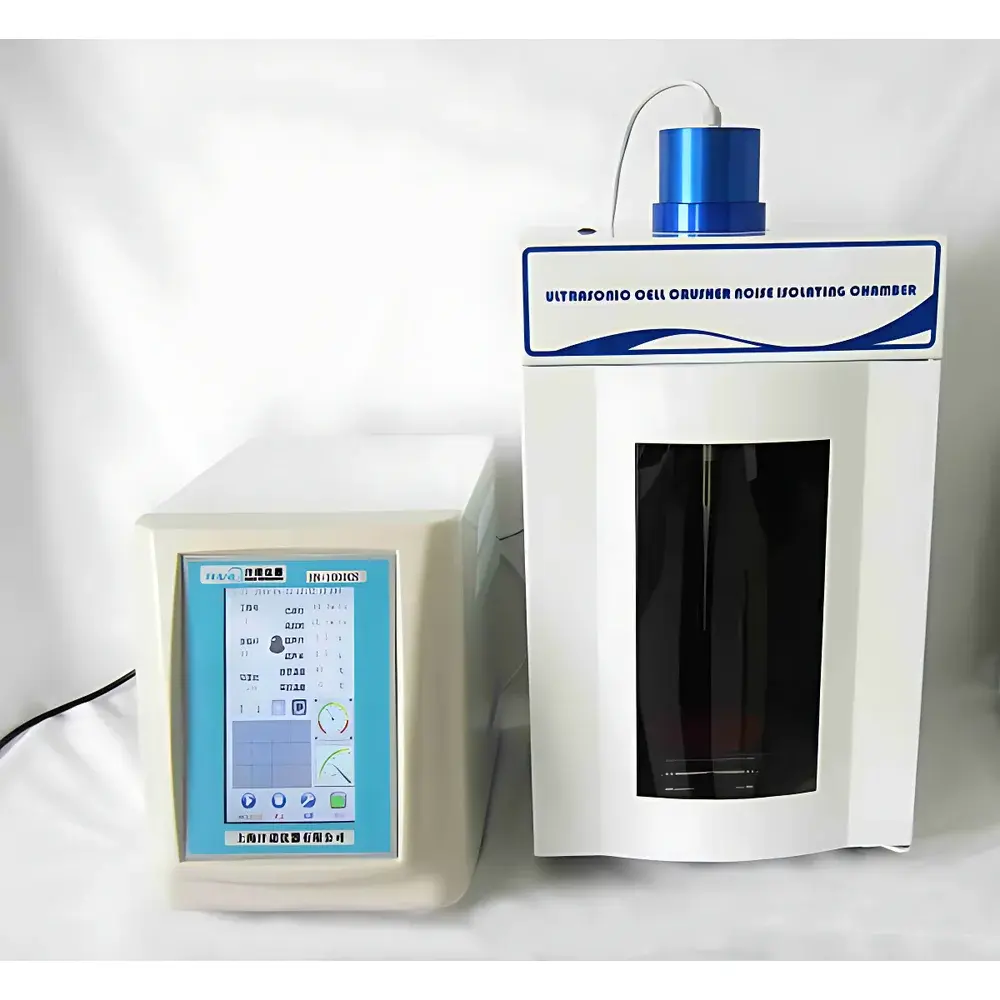
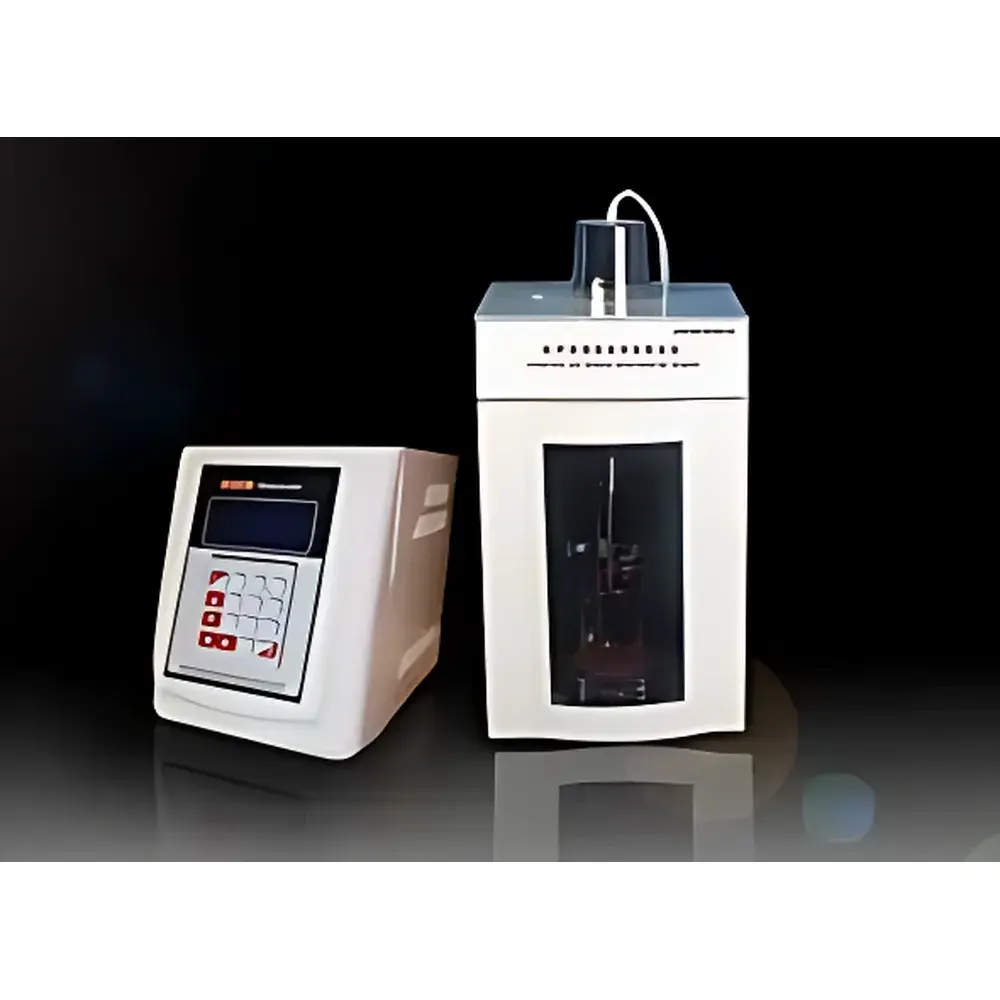
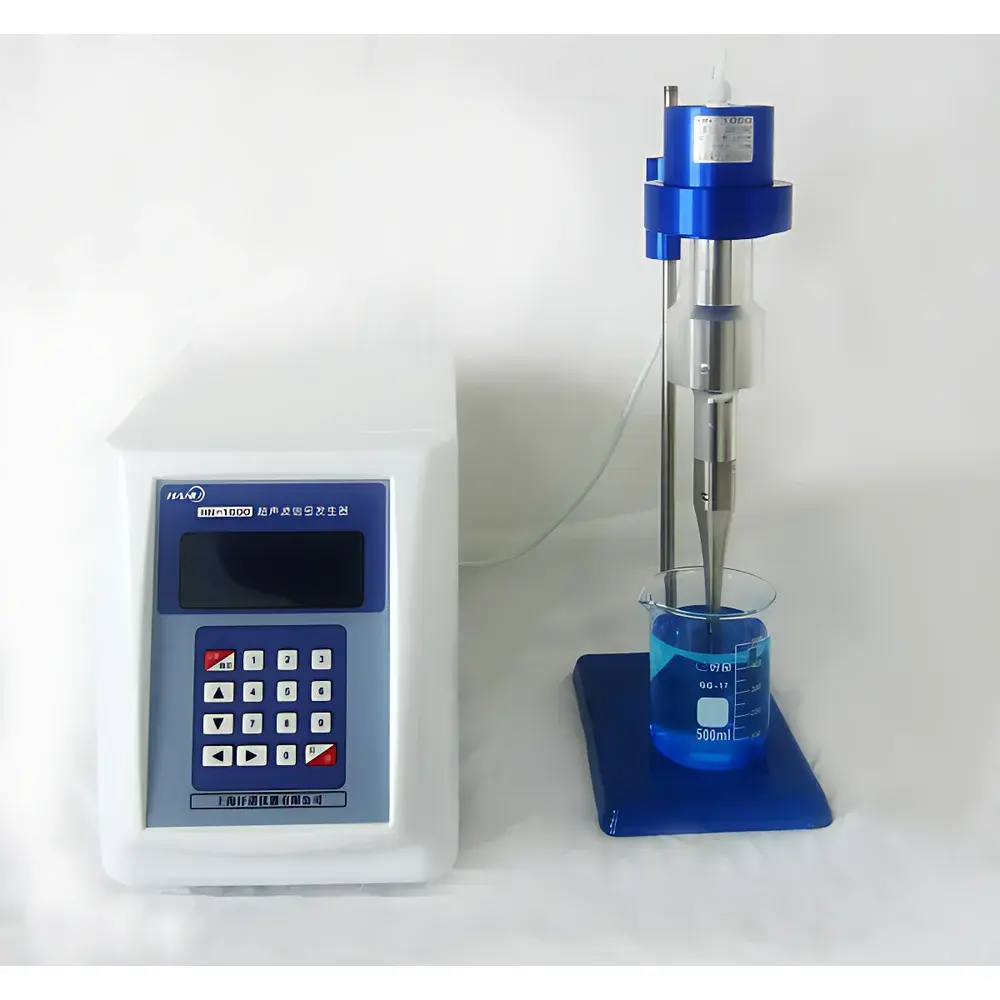
Hanuo HN-1000 High-Power Ultrasonic Cell Disruptor & Nanomaterial Homogenizer
| Brand | Hanuo |
|---|---|
| Origin | Shanghai, China |
| Model | HN-1000 |
| Ultrasonic Output Power | 1000 W |
| Operating Frequency | 20–25 kHz |
| Temperature Control Range | –5 °C to 100 °C (with optional chiller) |
| Maximum Sample Volume | 1000 mL |
| Pulse Mode Interval | 0.1–99.9 s adjustable |
| Total Processing Time | 0–99 h 59 min 59 s |
| Programmable Memory | 20 user-defined protocols |
| Probe Material | Titanium Alloy (Ti-6Al-4V) |
| Touchscreen Interface | 4.3″ TFT LCD |
| Input Voltage | AC 220 V ±5%, 50 Hz |
| Compliance | CE-marked design principles |
Overview
The Hanuo HN-1000 is a high-power, microprocessor-controlled ultrasonic cell disruptor engineered for reproducible, scalable nanomaterial homogenization and biological sample lysis. It operates on the principle of acoustic cavitation—where high-intensity ultrasonic waves (20–25 kHz) generate transient microbubbles in liquid media that collapse violently, producing localized shear forces, extreme temperatures (>5000 K), and pressures (>1000 atm). This physical mechanism enables efficient disruption of cell membranes, bacterial walls, and subcellular organelles, as well as deagglomeration, emulsification, and dispersion of nanoparticles—including liposomes, polymeric micelles, exosomes, and metal oxide colloids. Unlike rotor-stator or bead-beating methods, ultrasonic processing delivers non-thermal, contact-free energy transfer with minimal sample cross-contamination risk. The HN-1000 is purpose-built for laboratories requiring rigorous control over sonication parameters in applications ranging from mRNA vaccine formulation support to nanotoxicology screening and CRISPR-Cas9 ribonucleoprotein complex preparation.
Key Features
- Full-touch 4.3″ TFT interface with intuitive graphical navigation for real-time monitoring of power output (%), elapsed time, pulse interval, and sample temperature.
- Titanium alloy (Ti-6Al-4V) probe with precision-machined horn geometry—resistant to corrosion, erosion, and thermal fatigue under continuous high-load operation.
- Automatic frequency tracking circuitry maintains resonant coupling between generator and transducer across variable load conditions (e.g., viscosity shifts during lysis or emulsification).
- Amplitude stabilization algorithm dynamically adjusts drive voltage to preserve consistent tip displacement (±2% deviation) regardless of impedance changes induced by sample composition or volume.
- Programmable pulse mode (0.1–99.9 s on/off intervals) minimizes thermal accumulation—critical for heat-sensitive biomolecules such as enzymes, antibodies, and nucleic acids.
- Integrated temperature sensor (PT100-class) embedded in the probe base enables closed-loop feedback control when used with optional recirculating chiller (–5 °C to 100 °C range).
- Twenty protocol storage slots with password-protected access ensure method traceability and operator-level security—aligned with ALCOA+ data integrity expectations.
Sample Compatibility & Compliance
The HN-1000 accommodates diverse sample formats: single-vessel processing (up to 1000 mL in double-jacketed glass reactors), microcentrifuge tubes (0.2–2 mL), and custom reaction vessels via interchangeable probes (Φ6 mm to Φ25 mm diameter). It supports ISO 13485-aligned quality systems through optional RS232/USB connectivity for electronic record capture—including timestamped parameter logs, alarm events (overtemperature, overload, timeout), and probe usage history. While not inherently FDA 21 CFR Part 11-compliant, the system architecture permits integration with validated third-party LIMS or ELN platforms supporting electronic signatures and audit trails. All electrical design conforms to IEC 61010-1 safety standards for laboratory equipment; mechanical components meet ISO 8573-1 Class 3 compressed air purity requirements where applicable.
Software & Data Management
Standalone operation requires no external PC—full parameter configuration, execution, and result review occur on-device. For advanced data handling, optional communication modules enable export of CSV-formatted session logs (power profile, temperature curve, fault codes) to external storage or network drives. When deployed in regulated environments, users may configure automated backups at protocol completion or trigger alarms upon deviation from SOP-defined thresholds (e.g., >45 °C sustained for >15 s). Firmware updates are delivered via USB stick with SHA-256 checksum verification to ensure code integrity—supporting long-term validation maintenance per GAMP 5 guidelines.
Applications
- Cell lysis for protein extraction (E. coli, yeast, mammalian suspension cultures) with >95% recovery efficiency verified by SDS-PAGE densitometry.
- Nanoparticle dispersion stabilization in aqueous and organic phases—validated for TiO₂, SiO₂, and PLGA nanocarriers per ASTM D7856-14 standard practice.
- Liposome formation and size reduction (DLS-confirmed PDI <0.15 after 5 min sonication at 40% amplitude).
- Chromatin shearing for ChIP-seq library prep (fragment size distribution 200–600 bp, CV <8%).
- Exosome isolation from cell culture supernatants and biofluids using differential ultracentrifugation–sonication hybrid protocols.
- Surface functionalization of carbon nanotubes and graphene oxide via covalent grafting acceleration under inert atmosphere.
FAQ
Is the HN-1000 suitable for sterile processing?
Yes—titanium probes can be autoclaved (121 °C, 20 min); however, the main unit and touchscreen must remain outside sterilization chambers. Optional disposable polymer probe sleeves are available for single-use applications.
Can it be integrated into automated liquid handling workflows?
Yes—digital I/O ports (TTL-level) allow synchronization with robotic arms or peristaltic pumps for timed start/stop triggering and interlock signaling.
What cooling options are certified for GMP use?
The Hanuo CWC-200 recirculating chiller (–10 °C to +40 °C, ±0.2 °C stability) carries CE and UL recognition and includes glycol-compatible fluid paths compliant with USP extractables testing.
Does it support IQ/OQ documentation packages?
Factory-installed calibration certificates (traceable to NIST standards) and vendor-provided IQ/OQ templates are available upon request for installation and operational qualification under ISO/IEC 17025 frameworks.




