
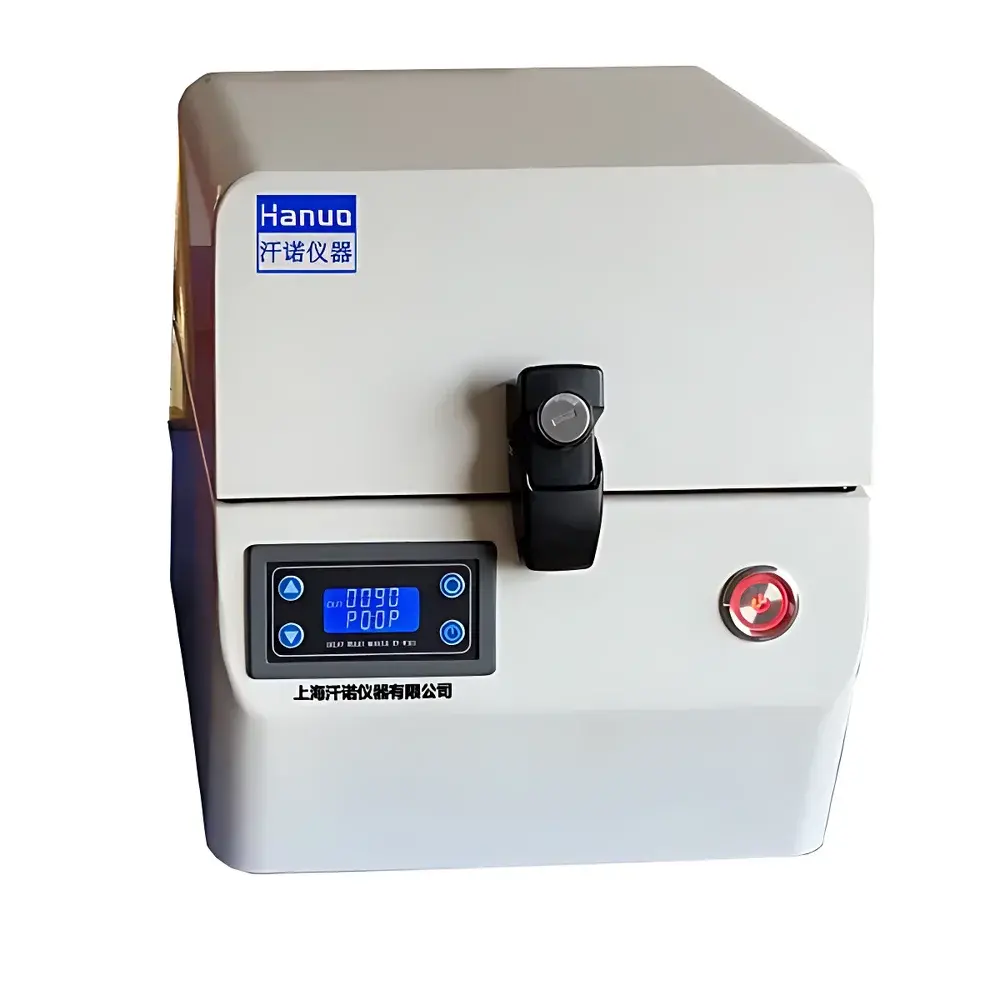
Hanuo Daxluot-M4 Portable Single-Seed Grinding Mill
| Brand | Hanuo |
|---|---|
| Origin | Shanghai, China |
| Manufacturer Type | Authorized Distributor |
| Country of Origin | China |
| Model | Daxluot-M4 |
| Power Supply | DC 24 V, 4 A |
| Rated Power | 60 W |
| Display | LCD |
| Timing Range | 1–9999 s |
| Rotational Speed | 4000 rpm |
| Throughput | 5 mL × 2 (standard) |
| Noise Level | <54 dB(A) |
| Final Particle Size | ≤1 µm |
| Grinding Media Options | Stainless Steel, Chrome Steel, Zirconia, Tungsten Carbide, Quartz Sand |
| Safety Lock | Integrated |
| Grinding Mode | Dry or Wet |
| Motion Principle | 3D Horizontal Orbital Vibration |
Overview
The Hanuo Daxluot-M4 Portable Single-Seed Grinding Mill is an engineered solution for high-fidelity, low-contamination sample preparation in grain and oilseed quality control laboratories. Designed specifically for single-grain or single-seed homogenization—such as wheat kernels, rice grains, soybeans, maize, rapeseed, and other cereal or oil-bearing seeds—the instrument employs a precisely controlled 3D horizontal orbital vibration mechanism. This motion generates kinetic energy transfer from grinding beads to the sample surface via inertial impact against a curved internal chamber wall, enabling rapid mechanical disintegration without thermal degradation. Unlike rotary or rotor-stator mills, the Daxluot-M4 avoids shear-induced macromolecular denaturation, preserving native protein conformation, starch crystallinity, and lipid integrity—critical parameters in proximate analysis, mycotoxin extraction, genomic DNA isolation, and near-infrared (NIR) calibration sample preparation.
Key Features
- Compact, battery-compatible DC-powered architecture (24 V, 4 A) enables field-deployable operation in grain elevators, mobile testing units, or remote agri-labs without AC infrastructure.
- LCD interface with non-volatile parameter memory retains user-defined protocols—including time, speed, and bead configuration—across power cycles, supporting GLP-compliant workflow repeatability.
- Modular adapter system supports multiple throughput configurations: standard 5 mL × 2 vials; optional 2 mL × 4 or 2 mL × 6 racks—facilitating parallel processing of heterogeneous seed lots while minimizing cross-contamination risk through physical compartmentalization.
- Integrated safety interlock prevents operation unless the lid is fully engaged and locked, meeting IEC 61000-6-2 electromagnetic compatibility and basic functional safety expectations for benchtop lab equipment.
- Acoustically optimized housing maintains noise emission below 54 dB(A) at 1 m distance—compliant with ISO 7779 and suitable for open-plan QC labs or shared research facilities.
- Grinding media selection (stainless steel, chrome steel, zirconia, tungsten carbide, quartz sand) allows method-specific optimization: zirconia for nucleic acid work (low metal leaching), tungsten carbide for high-hardness oilseeds, quartz for trace-metal-free mineral analysis per ASTM D5685.
Sample Compatibility & Compliance
The Daxluot-M4 accommodates intact, unshelled, or dehulled seeds ranging from 2 mm (e.g., sesame) to 12 mm (e.g., large sunflower kernels), provided sample mass does not exceed 80% of vial volume to ensure effective bead-sample interaction. It supports both dry grinding (for moisture-sensitive NIR reference materials) and wet grinding (with chilled ethanol or liquid nitrogen slurry for proteomic workflows). The system meets fundamental design requirements outlined in ISO/IEC 17025:2017 Clause 6.4.3 for equipment suitability in accredited testing laboratories. While not certified to FDA 21 CFR Part 11, its parameter memory and audit-ready operation log (via optional RS232 output) support data integrity practices aligned with GMP Annex 11 and AOAC Official Method validation frameworks.
Software & Data Management
The Daxluot-M4 operates as a standalone instrument with embedded firmware; no host PC or proprietary software is required for routine use. All operational parameters—including elapsed time, set duration, and cycle completion status—are logged locally on the LCD and retained in volatile memory. For integration into LIMS environments, the optional RS232 serial interface permits timestamped export of run metadata (start time, duration, error codes) in ASCII format, compatible with LabWare, STARLIMS, or custom Python-based ingestion pipelines. Firmware updates are performed via micro-USB using manufacturer-provided binaries—documented in the technical manual under revision control (Rev. 3.1, 2024).
Applications
- Preparation of homogeneous subsamples for aflatoxin B1 quantification (AOAC 994.02, EN 14123-1).
- Routine homogenization prior to Kjeldahl nitrogen analysis (ISO 5983-1) or near-infrared spectroscopy calibration (ASABE S557.1).
- Cell lysis of oilseed endosperm for fatty acid methyl ester (FAME) profiling (AOAC 996.06).
- Generation of particle-size-distributed flour analogs for rheological dough testing (ICC Standard No. 173).
- High-reproducibility grinding of certified reference materials (CRMs) used in interlaboratory proficiency testing schemes (e.g., FAPAS Grain Protein Program).
FAQ
What is the maximum recommended sample weight per vial for optimal grinding efficiency?
For consistent ≤1 µm particle size distribution, load no more than 300 mg of dry seed per 5 mL vial or 150 mg per 2 mL vial—excess mass dampens bead mobility and reduces impact energy transfer.
Can the Daxluot-M4 be used for cryogenic grinding?
Yes—when paired with pre-chilled stainless steel or zirconia beads and liquid nitrogen-cooled vials, it achieves sub-zero grinding temperatures; however, condensation management and vial sealing must comply with ISO 20578 safety guidelines for cryo-handling.
Is validation documentation available for method transfer in regulated environments?
Hanuo provides a Factory Acceptance Test (FAT) report, electrical safety certificate (GB 4793.1–2019), and a performance verification protocol template aligned with ISO/IEC 17025 Section 6.4.1—available upon request with proof of purchase.
How often should grinding beads be replaced?
Bead lifetime depends on material hardness and usage frequency; zirconia beads typically last ≥500 cycles under standard wheat grinding conditions, while stainless steel requires replacement after ~200 cycles when processing abrasive oilseeds like flax or mustard.
Does the instrument support programmable multi-step protocols?
No—the Daxluot-M4 executes single-stage timed runs only; multi-step sequences (e.g., pause-cool-resume) require external timer coordination or integration with programmable environmental chambers.
Related Products




