
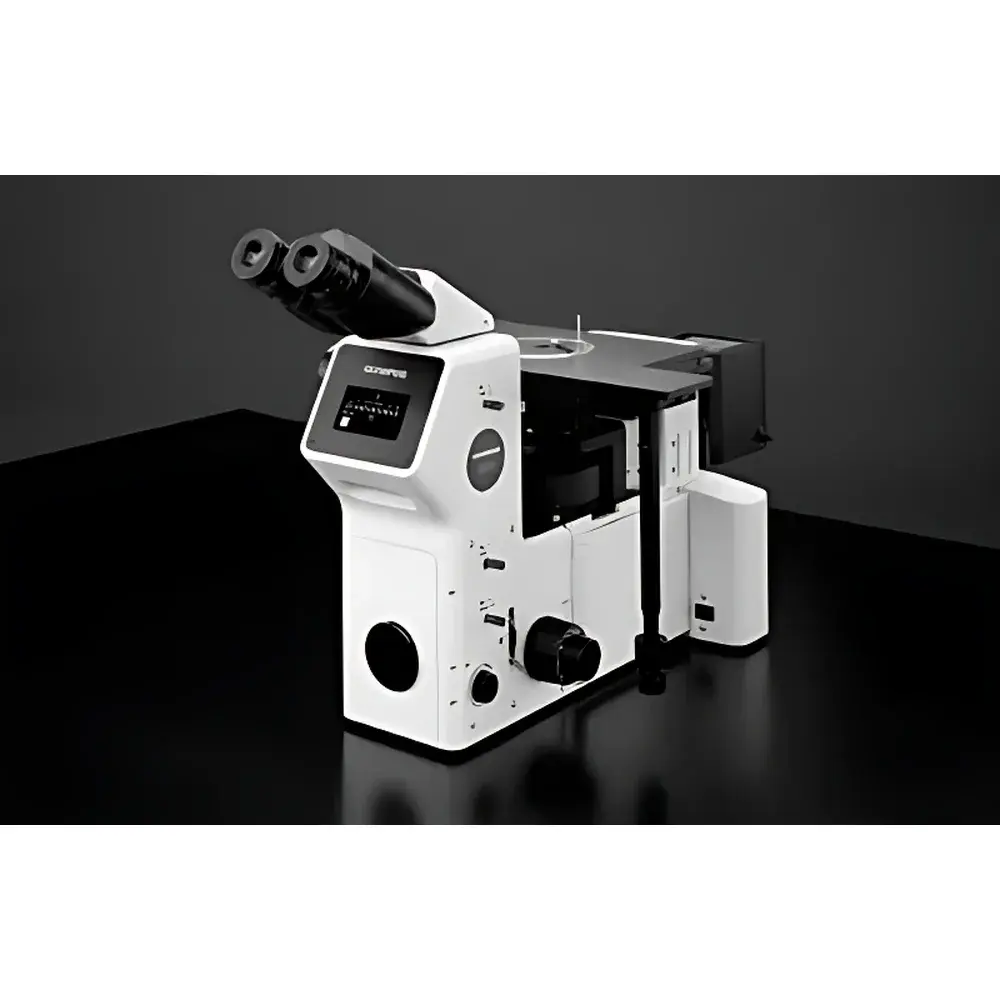
Olympus GX71 Research-Grade Inverted Metallurgical Microscope
| Brand | Olympus |
|---|---|
| Origin | Japan |
| Manufacturer Type | Original Equipment Manufacturer (OEM) |
| Product Category | Imported Instrument |
| Model | GX71 |
| Pricing | Upon Request |
Overview
The Olympus GX71 is a research-grade inverted metallurgical microscope engineered for high-precision microstructural analysis of opaque, reflective, and polished materials—including metals, alloys, ceramics, composites, and electronic packaging substrates. Built upon Olympus’ UIS2 (Universal Infinity System 2) optical platform, the GX71 delivers diffraction-limited resolution, exceptional contrast, and chromatic fidelity across all incident-light observation modes: brightfield, darkfield, differential interference contrast (DIC), simple polarized light, and fluorescence. Its inverted configuration positions the objective lenses beneath the specimen stage—ideal for large, heavy, or temperature-sensitive samples mounted on custom fixtures, hot stages, or in situ mechanical testing rigs. The system’s fully corrected infinity optics support modular beam splitting, multi-port imaging, and seamless integration with digital cameras, motorized stages, and automated illumination management—making it a foundational platform for quantitative metallography, failure analysis, and process validation in industrial R&D and quality control laboratories.
Key Features
- UIS2 infinite-corrected optical system optimized for high numerical aperture (NA) objectives and minimal aberration across visible and near-UV spectral ranges
- Inverted design with fixed stage and moving objective turret—enables stable imaging of bulky specimens up to 38 kg and accommodates accessories such as heating/cooling stages and tensile testers
- Triple-output optical path: front port (inverted image), side port (inverted image), and trinocular port—supports simultaneous visual observation, real-time camera capture, and auxiliary detector integration
- Motorized components including objective nosepiece (6-position brightfield/DIC or 5-position BF/DF/DIC), mirror turret (for rapid switching between BF, DF, DIC, POL, and FL), and filter wheel—controllable via ergonomic front-panel switch or PC-based software
- Integrated zoom intermediate magnification (1×–2×) enables fine-detail visualization without compromising field uniformity or parfocality across all output ports
- Ultra-widefield eyepieces (Field Number 26.5 mm)—largest standard FOV among inverted metallurgical microscopes—reduces panning fatigue and accelerates area-scan workflows
- Dual illumination architecture: reflected-light system with selectable 100 W halogen (BF/DF), 100 W mercury (FL), or 75 W xenon (broadband FL); transmitted-light base with 100 W halogen for semi-transparent specimens or dual-mode contrast enhancement
Sample Compatibility & Compliance
The GX71 accommodates specimens up to 50 mm × 50 mm × 150 mm (W × D × H) on its precision-machined mechanical stage, with coarse/fine focus travel of 9 mm and micrometric sensitivity of 0.1 mm per full rotation. Its robust cast-aluminum frame (38 kg operational mass) ensures vibration damping and thermal stability during extended acquisition sessions. The system complies with ISO 9001 manufacturing standards and supports GLP/GMP documentation requirements through optional audit-trail-enabled software modules. Optical components meet JIS B 7151 and ASTM E3-22 specifications for metallographic specimen evaluation. Fluorescence configurations adhere to ISO 10934-1 for emission filter bandpass accuracy and excitation uniformity. All electrical subsystems conform to IEC 61010-1 safety standards for laboratory equipment.
Software & Data Management
The GX71 integrates natively with Olympus cellSens™ Digital Imaging Software (v2.4+), providing calibrated measurement tools (grain size per ASTM E112, inclusion rating per ASTM E45, phase fraction analysis), multi-channel fluorescence overlay, Z-stack reconstruction, and time-lapse acquisition scheduling. Data export supports TIFF, JPEG2000, and vendor-neutral NDPI-compatible formats. For regulated environments, optional cellSens Security Pack enables 21 CFR Part 11 compliance—including electronic signatures, role-based access control, and immutable audit trails for image acquisition parameters, user actions, and metadata annotations. Raw image data retains embedded EXIF-style metadata (objective ID, magnification, exposure, lamp intensity, filter position), ensuring traceability throughout analytical workflows.
Applications
- Quantitative metallography: grain boundary mapping, precipitate distribution analysis, and intergranular corrosion assessment per ASTM E112, E384, and ISO 643
- Failure analysis: fracture surface characterization, inclusion identification (ASTM E45), and heat-affected zone (HAZ) evaluation in welded joints
- Coating and plating inspection: thickness uniformity, delamination detection, and interface integrity under DIC and polarized light
- Electronic materials: solder joint microstructure, void analysis in Cu/Ni/Au stacks, and thermal cycling-induced crack propagation
- Advanced ceramics and composites: fiber orientation mapping, porosity quantification, and matrix–reinforcement interfacial bonding assessment
- In situ dynamic studies: coupled with environmental chambers or mechanical testers for real-time deformation imaging
FAQ
Is the GX71 compatible with third-party digital cameras?
Yes—the GX71’s standardized C-mount and F-mount adapters support scientific CMOS and CCD cameras from major vendors (e.g., Hamamatsu, Teledyne Photometrics, Basler), provided they comply with Olympus’ mechanical back-focus and flange distance specifications.
Can the system be upgraded to support confocal or Raman modalities?
While the GX71 itself is not a confocal platform, its multi-port optical architecture and modular mirror turret allow integration of external laser scanning units or fiber-coupled Raman spectrometers via the side or front port—subject to alignment calibration and optical throughput validation.
Does Olympus provide application-specific objective lenses for high-temperature or vacuum environments?
Olympus offers specialized long-working-distance (LWD) and dry immersion objectives rated for operation up to 150 °C; vacuum-compatible objectives are available through OEM partnerships but require custom mounting interfaces and outgassing certification.
What maintenance intervals are recommended for the UIS2 optical train?
Olympus recommends biannual inspection of mirror coatings, filter transmission curves, and lamp alignment; annual recalibration of motorized components is advised for labs performing ISO/IEC 17025-accredited measurements.
Is training and technical support available globally?
Olympus Industrial Microscopy provides factory-certified on-site installation, operator training, and remote diagnostics via authorized service centers in over 40 countries—with documented SLAs for critical response times in semiconductor and aerospace QA/QC facilities.





