
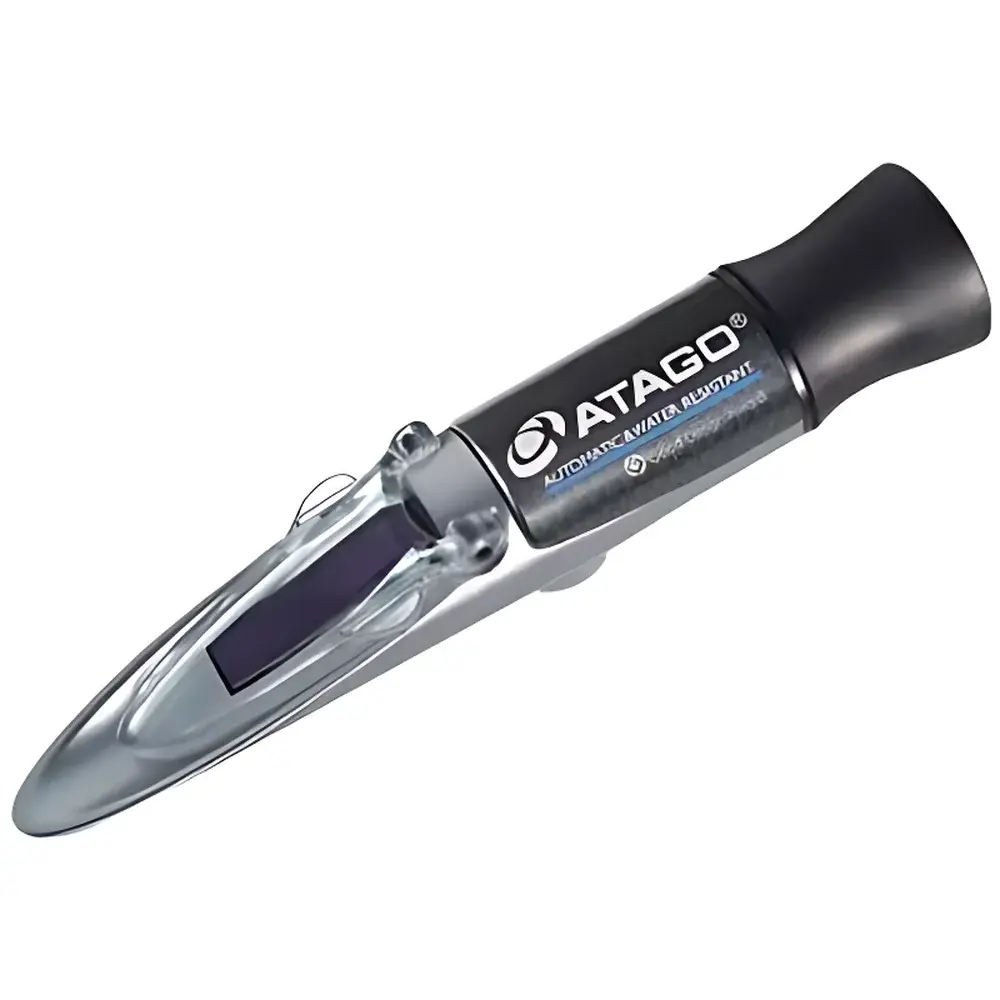
ATAGO MASTER-53S Handheld Analog Refractometer for Dairy and Opaque Samples
| Brand | ATAGO |
|---|---|
| Origin | Japan |
| Model | MASTER-53S |
| Product Type | Handheld Analog Refractometer |
| Measurement Range | 0.0–53.0% Brix |
| Resolution | 0.2% Brix |
| Accuracy | ±0.2% Brix at 20°C |
| Temperature Compensation | Automatic (ATC) |
| Dimensions | 3.2 × 3.4 × 16.8 cm |
| Weight | 130 g |
| Optical Scale Type | Analog (non-digital), Visual Reading via Eyepiece |
Overview
The ATAGO MASTER-53S is a precision-engineered handheld analog refractometer specifically optimized for the rapid, on-site determination of soluble solids concentration—expressed as % Brix—in turbid,乳-white (milky-opaque) liquid samples commonly encountered in dairy processing, food manufacturing, and industrial quality control environments. Unlike standard refractometers that rely on clear, transparent solutions, the MASTER-53S employs a high-contrast optical prism system and calibrated scale geometry designed to deliver reliable readings even when measuring heterogeneous or light-scattering media such as raw milk, pasteurized cream, yogurt, mayonnaise, coffee with milk, and cutting fluids. Its measurement principle is based on the critical angle of total internal reflection at the prism-sample interface, where refractive index correlates directly with solute concentration under controlled temperature conditions. Built-in Automatic Temperature Compensation (ATC) ensures consistent accuracy across ambient operating temperatures from 10°C to 40°C, eliminating manual correction and reducing operator dependency.
Key Features
- Optimized optical design for accurate Brix measurement in opaque and semi-opaque samples—including whole milk, flavored dairy beverages, fermented products, and emulsified industrial fluids.
- Robust all-metal body with ergonomic grip and protective rubber armor, engineered for durability in production-floor, farm, or field use.
- True analog scale with high-contrast black-on-white graduation (0.0–53.0% Brix, 0.2% resolution), viewable through an integrated eyepiece with adjustable diopter for operator-specific visual acuity.
- Automatic Temperature Compensation (ATC) using bimetallic thermal elements, maintaining calibration stability without external power or software intervention.
- No batteries or electronics required—ensures zero downtime, minimal maintenance, and intrinsic compliance with explosion-proof or EMI-sensitive environments.
- Compact form factor (3.2 × 3.4 × 16.8 cm) and lightweight construction (130 g) enable one-handed operation and portability across multiple sampling points.
Sample Compatibility & Compliance
The MASTER-53S is validated for routine use with viscous, particulate-laden, or optically dense matrices that would otherwise obscure the shadow line in conventional Abbe-type refractometers. Its prism surface geometry and illumination path minimize scattering artifacts, enabling reproducible measurements in samples with suspended fat globules (e.g., raw milk), protein aggregates (e.g., acidified yogurt), or oil-in-water emulsions (e.g., mayonnaise). While not certified to ISO/IEC 17025 for accredited testing, the instrument conforms to JIS Z 8806 (Japanese Industrial Standard for refractometers) and supports GLP-aligned workflows when used with documented calibration procedures, traceable reference sucrose standards (e.g., NIST-traceable Brix solutions), and operator training records. It is routinely deployed in facilities adhering to HACCP, ISO 22000, and FDA 21 CFR Part 11–compatible documentation systems—though as a non-digital instrument, it does not generate electronic audit trails.
Software & Data Management
As a fully analog, battery-free instrument, the MASTER-53S does not incorporate embedded firmware, Bluetooth connectivity, or data logging capabilities. All measurements are recorded manually by the operator into paper-based or LIMS-integrated logbooks. This architecture ensures long-term reliability, immunity to firmware obsolescence, and compatibility with regulated environments where electronic validation is cost-prohibitive or unnecessary. For laboratories requiring digital traceability, ATAGO recommends pairing the MASTER-53S with its optional RS-232-compatible digital models (e.g., PAL series) or integrating manual readings into validated ELN platforms via structured entry protocols. Calibration verification is performed using certified sucrose standards at defined intervals per internal SOPs—typically before each shift or after instrument cleaning.
Applications
- Dairy farms and collection centers: Rapid assessment of raw milk Brix as a proxy for lactose + solids-not-fat content prior to chilling or transport.
- UHT and pasteurization lines: In-process verification of concentrate consistency in cream, whey permeate, or recombined milk formulations.
- Yogurt and fermented dairy production: Monitoring sugar depletion during fermentation or final sweetener addition in flavored variants.
- Food service and QSR chains: On-the-spot validation of milk-to-coffee ratios, syrup dilution in dairy-based beverages, and consistency of dessert sauces.
- Metalworking and machining facilities: Quick-check of coolant concentration (e.g., glycol/water mixtures) to prevent microbial growth or lubricity loss.
- R&D labs conducting formulation screening: Comparative analysis of prototype emulsions, dressings, or plant-based dairy alternatives where opacity precludes digital refractometry.
FAQ
Does the MASTER-53S require calibration before each use?
Calibration is recommended before first use of the day and after exposure to extreme temperature shifts or aggressive cleaning agents; a single-point verification using a 0% or 30% Brix standard is sufficient for routine operation.
Can it measure samples below 10°C or above 40°C?
While the ATC mechanism functions between 10–40°C, readings outside this range will deviate from stated accuracy; samples should be equilibrated within the compensated range prior to measurement.
Is the prism surface resistant to dairy proteins and fatty residues?
Yes—the optical glass prism is coated with a chemically inert, scratch-resistant layer compatible with common dairy sanitizers (e.g., peracetic acid, caustic soda); however, prompt rinsing with distilled water after each use is required to prevent film buildup.
How does it differ from digital refractometers like the PAL-1?
The MASTER-53S offers superior robustness and lower TCO in high-humidity or splash-prone settings but lacks data export, multi-parameter algorithms, or automatic unit conversion—making it ideal for dedicated, high-frequency Brix checks rather than multi-analyte research.
Is NIST-traceable calibration support available?
ATAGO provides factory calibration certificates; users may obtain traceable verification through third-party metrology labs using certified sucrose reference materials aligned with NIST SRM 84d or equivalent.





