
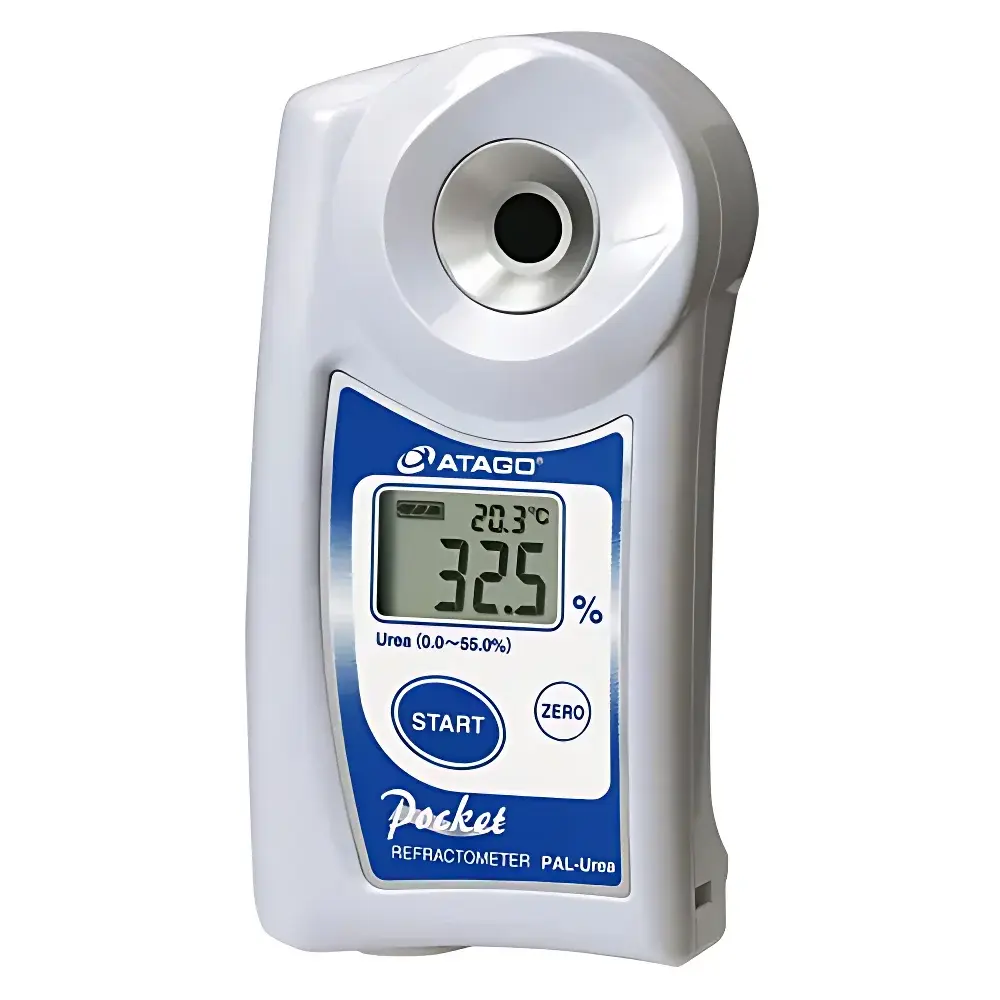
ATAGO PAL-Urea Portable Digital Urea Concentration Refractometer
| Brand | ATAGO |
|---|---|
| Origin | Japan |
| Model | PAL-Urea |
| Product Type | Handheld Refractometer |
| Temperature Compensation | Yes (ATC) |
| Digital Display | Yes |
| Measurement Range | 0.0–55.0% w/w Urea |
| Accuracy | ±0.2% w/w Urea |
| Resolution | 0.1% w/w |
| Operating Temperature | 10–40°C (with Automatic Temperature Compensation) |
| IP Rating | IP65 |
| Power Supply | 2 × AAA batteries |
| Dimensions | 5.5 × 3.1 × 10.9 cm |
| Weight | 100 g (main unit only) |
| Typical Measurement Cycles | ~11,000 measurements per battery set |
Overview
The ATAGO PAL-Urea is a handheld digital refractometer engineered for rapid, field-deployable quantification of aqueous urea concentration in Diesel Exhaust Fluid (DEF), also known as AdBlue® in Europe. It operates on the principle of critical-angle refractometry: light passing through a prism-sample interface undergoes total internal reflection at an angle dependent on the sample’s refractive index, which correlates linearly with urea mass fraction in water within the calibrated range. This optical measurement method eliminates reliance on chemical reagents or laboratory infrastructure, enabling real-time verification of DEF formulation integrity directly at fueling stations, service depots, or vehicle maintenance bays. The instrument is specifically calibrated for the urea–water binary system, with traceability to NIST-traceable reference standards and validated against ASTM D7598 (Standard Test Method for Determination of Urea in Diesel Exhaust Fluid by Refractometry). Its design supports compliance-driven workflows where DEF concentration must be maintained at 32.5 ± 0.7% w/w to ensure optimal NOx reduction efficiency in Selective Catalytic Reduction (SCR) systems.
Key Features
- Automatic Temperature Compensation (ATC) across 10–40°C, eliminating manual correction and ensuring consistent accuracy under variable ambient conditions.
- Digital LCD display with 0.1% resolution and intuitive one-button operation—sample application, measurement initiation, and result readout completed in ≤3 seconds.
- IP65-rated enclosure providing dust-tightness and protection against low-pressure water jets, suitable for industrial and outdoor environments.
- Compact form factor (5.5 × 3.1 × 10.9 cm) and lightweight construction (100 g) for ergonomic handling during high-frequency spot checks.
- Low-power architecture supporting approximately 11,000 measurements on two standard AAA alkaline batteries—no charging infrastructure required.
- Prism surface fabricated from sapphire-grade optical glass for scratch resistance, long-term calibration stability, and compatibility with aggressive DEF formulations.
Sample Compatibility & Compliance
The PAL-Urea is validated exclusively for aqueous urea solutions meeting ISO 22241 specifications, including commercial DEF, bulk storage tank samples, and post-dilution verification of dosing systems. It is not intended for use with contaminated, turbid, or glycol-containing fluids. The device complies with CE marking requirements for portable optical instrumentation and meets the mechanical robustness criteria outlined in ISO 9001-certified manufacturing processes. While not a regulated medical device, its measurement uncertainty profile (±0.2% w/w) satisfies the tolerance thresholds specified in EPA Certification Guidance for SCR System Maintenance (EPA-420-B-17-021) and EU Regulation (EC) No 692/2008 Annex VI.B.3. Calibration verification can be performed using certified reference materials traceable to national metrology institutes.
Software & Data Management
The PAL-Urea operates as a standalone, embedded-system instrument without onboard data logging or wireless connectivity. All measurements are displayed in real time and retained only visually—no internal memory or export capability is provided. This architecture aligns with GLP-compliant field verification protocols where immediate operator interpretation and manual recording into auditable logbooks or LIMS-integrated forms are standard practice. For laboratories requiring electronic data capture, users may integrate results via secondary documentation tools or connect optional barcode scanners (e.g., ATAGO BC-100) to automate sample ID entry. Firmware updates are not supported; calibration stability is verified annually using ATAGO-certified calibration solutions (Cat. No. 4519).
Applications
- On-site verification of DEF concentration prior to dispensing at truck stops and fleet refueling facilities.
- Routine quality assurance checks during DEF blending, bottling, or bulk transfer operations.
- Field diagnostics of SCR system performance anomalies linked to incorrect DEF concentration or degradation.
- Supplier qualification audits and incoming material inspection per ISO 22241-1:2019 clause 5.2 (Urea Content).
- Technical training and vocational education modules on emissions control fluid metrology.
- Regulatory inspections conducted by environmental agencies verifying adherence to DEF specification mandates.
FAQ
What is the recommended calibration frequency for the PAL-Urea?
ATAGO recommends calibration verification before each shift or daily usage cycle using the supplied zero-standard (distilled water) and 32.5% urea reference solution (Cat. No. 4519). Full recalibration by authorized service centers is advised annually or after physical impact.
Can the PAL-Urea measure other aqueous solutions such as antifreeze or battery electrolyte?
No. The PAL-Urea’s optical calibration curve and ATC algorithm are mathematically optimized solely for the urea–water system. Using it for other solutes introduces unquantified systematic error and voids measurement validity.
Does the instrument comply with FDA 21 CFR Part 11 requirements?
Not applicable—the PAL-Urea does not generate, store, or transmit electronic records; therefore, it falls outside the scope of Part 11 regulatory controls. Its use remains compatible with Part 11–governed workflows when results are transcribed into compliant electronic systems.
How does ATC function without external temperature sensors?
A thermistor embedded in the prism block continuously monitors sample–prism thermal equilibrium, dynamically adjusting the refractive index–concentration conversion algorithm in real time based on pre-characterized thermal coefficients.
Is cleaning the prism required between measurements?
Yes. A lint-free optical tissue moistened with distilled water should be used to remove residual DEF film after each measurement to prevent crystallization and maintain optical clarity. Isopropyl alcohol is not recommended due to potential elastomer degradation in the sample well seal.




