
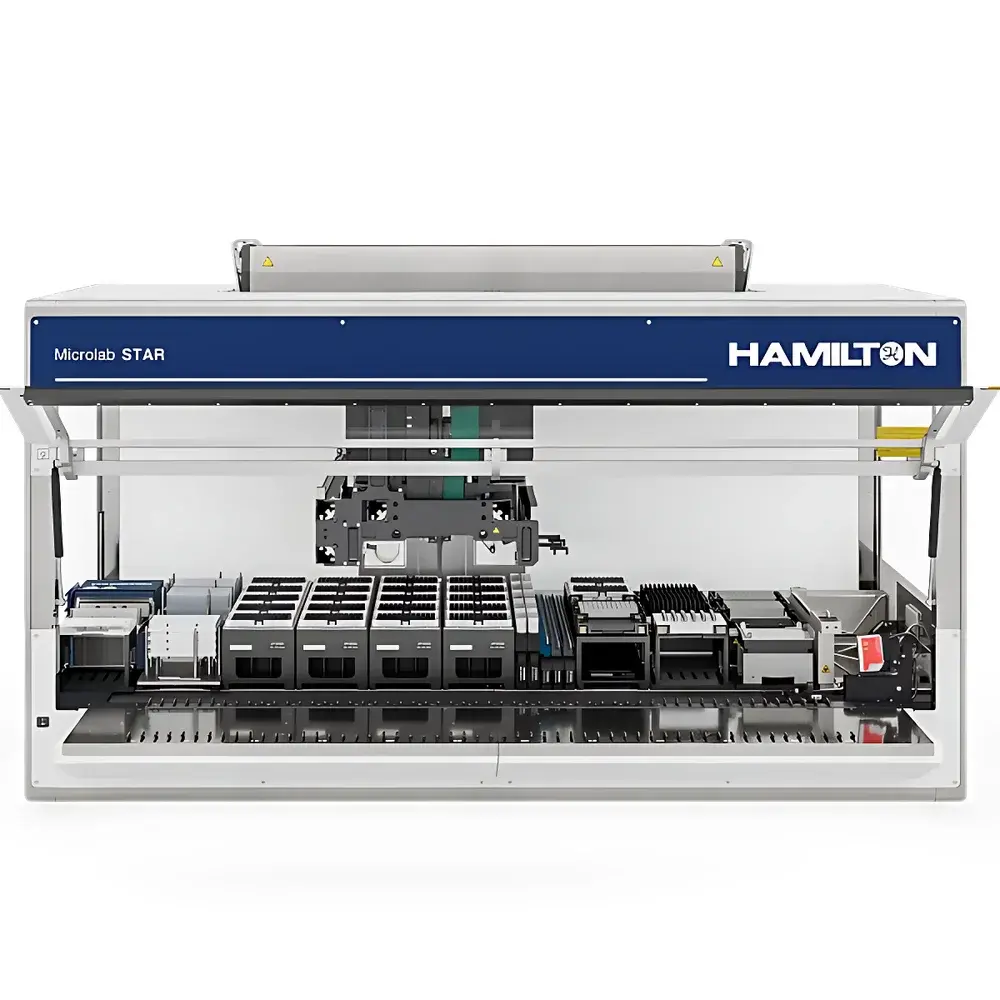
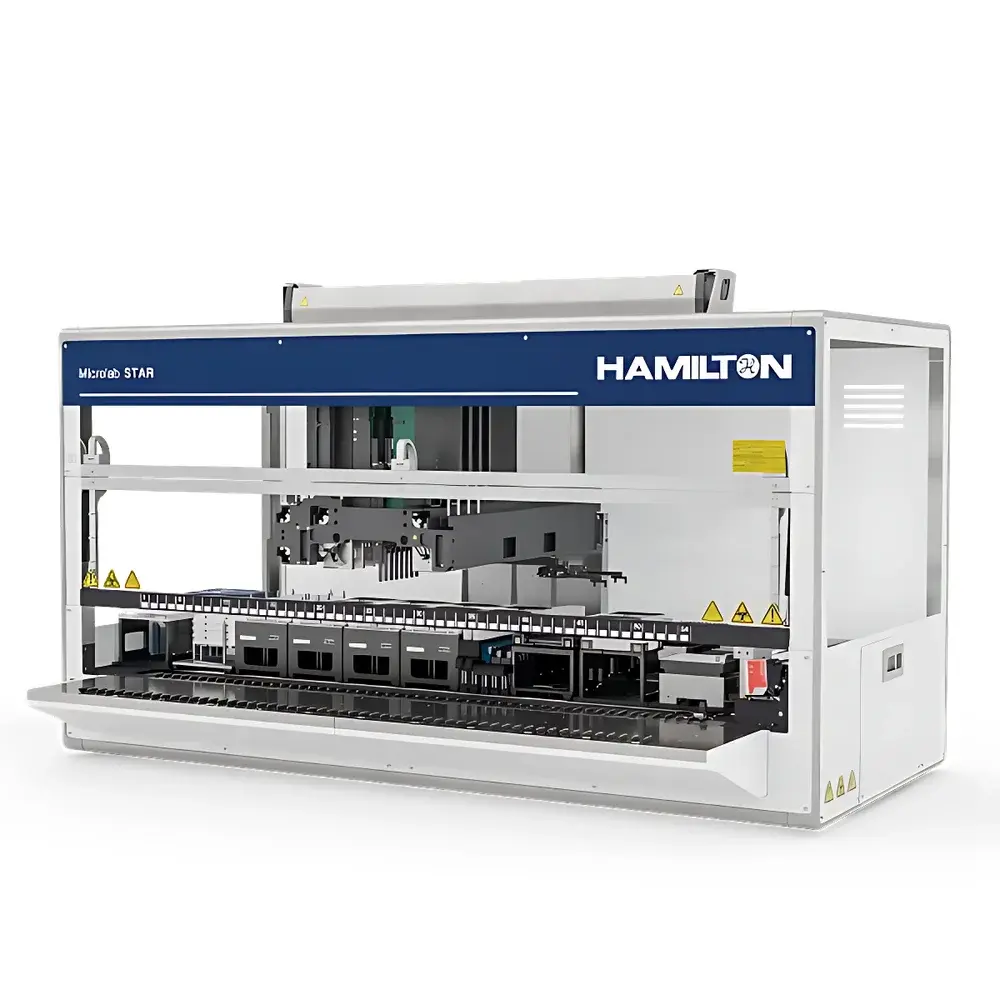
Hamilton NGS STAR Fully Automated Sample Preparation System for Next-Generation Sequencing Library Construction
| Brand | Hamilton |
|---|---|
| Origin | Switzerland |
| Manufacturer | Hamilton Robotics |
| Product Type | Imported |
| Model | NGS STAR |
| Sample Type | Liquid |
| Throughput | 96 samples per run |
| Deck Positions | 15 |
| Pipetting Range | 1–1000 µL |
| Temperature Control | Ambient (room temperature) |
| Automation Method | Fully automated liquid handling |
| Reagent Kit Compatibility | Open-platform — compatible with all major NGS library prep kits (e.g., Illumina, Thermo Fisher, QIAGEN, NEB, Takara Bio) |
Overview
The Hamilton NGS STAR is a benchtop, fully automated sample preparation system engineered specifically for reproducible, walk-away next-generation sequencing (NGS) library construction. Built upon the proven Microlab STAR liquid handling platform, the NGS STAR integrates precision pipetting, intelligent deck management, and modular peripheral compatibility to execute complex, multi-step library prep workflows—including fragmentation, end-repair, A-tailing, adapter ligation, size selection (via magnetic bead-based purification), and PCR amplification—without manual intervention. Its core architecture leverages Hamilton’s CO-RE® (Compressed O-Ring Elastomer) tip technology for high-fidelity, low-volume liquid transfer and iSWAP robotic arm for reliable plate and consumable handling. Designed for laboratories performing targeted sequencing, whole-genome sequencing (WGS), exome sequencing, RNA-Seq, and epigenomic profiling, the system operates under ambient temperature conditions while supporting integration with external thermal modules to meet thermocycling requirements.
Key Features
- 96-well parallel processing capability with dual 8-channel or configurable multi-probe head (MPH) for simultaneous, synchronized liquid transfers
- 15-position deck layout optimized for standardized SBS-format plates, tubes, reagent reservoirs, and accessories including magnetic stands, heating shakers (HHS), and thermal cyclers (ODTC)
- Accurate, low-volume pipetting across 1–1000 µL range using air-displacement technology with real-time pressure monitoring and tip touch detection
- Integrated barcode reader for unambiguous sample and reagent tracking—enforcing traceability from tube labeling through final library plate generation
- Open-system design validated for use with commercially available NGS library preparation kits from Illumina, Thermo Fisher Scientific, QIAGEN, New England Biolabs, Takara Bio, and others—no proprietary chemistry lock-in
- Modular scalability: supports future upgrades to higher throughput via additional deck positions, extended tip racks, or integrated plate stackers
Sample Compatibility & Compliance
The NGS STAR accepts standard liquid biological samples—including genomic DNA, fragmented DNA, cDNA, and sheared chromatin—delivered in 96-well plates or tube racks. All protocols are developed and verified under Good Laboratory Practice (GLP)-aligned documentation standards. The system supports audit-ready operation when paired with Hamilton VANTAGE software configured for 21 CFR Part 11 compliance, including electronic signatures, user access controls, and immutable audit trails. While ambient deck temperature control suffices for most enzymatic steps, optional integration with Hamilton HHS (heating/shaking module) and ODTC (on-deck thermal cycler) enables precise thermal regulation during ligation, PCR, and incubation phases—ensuring adherence to kit manufacturer specifications (e.g., Illumina TruSeq, NEBNext). No modifications to hardware or firmware are required to switch between applications or vendors.
Software & Data Management
Method development and execution are managed through Hamilton VANTAGE software—a graphical, drag-and-drop interface that supports protocol cloning, parameter tuning, and conditional logic (e.g., skip steps based on QC input). Pre-validated method packages are provided for common NGS workflows and can be deployed without customization. All runs generate structured log files containing timestamped events, pipetting metadata (volume, source/destination, tip ID), error codes, and environmental status (e.g., barcode scan success, door open/close). Data export is supported in CSV, XML, and LIMS-compatible formats. Integration with laboratory information management systems (LIMS) is achieved via HL7 or REST API interfaces, enabling bidirectional sample manifest exchange and result ingestion.
Applications
The NGS STAR delivers consistent performance across diverse genomics applications: targeted panel sequencing (e.g., oncology hotspot panels), whole-exome sequencing (WES), whole-genome sequencing (WGS), RNA-Seq (poly-A selection and rRNA depletion), ChIP-Seq, ATAC-Seq, and methylation sequencing (e.g., bisulfite conversion-compatible workflows). Its flexibility extends to clinical research settings where standardized, auditable library prep is essential prior to validation under ISO 15189 or CLIA frameworks. Academic core facilities, biopharma R&D labs, and contract research organizations (CROs) leverage the system to reduce hands-on time by >70% versus manual methods while maintaining inter-run CVs <5% for key metrics such as library concentration and fragment size distribution.
FAQ
Is the NGS STAR compatible with Illumina Nextera Flex for Enrichment?
Yes—the system has been validated with Illumina’s Nextera Flex for Enrichment kit using standard deck configurations and pre-loaded method scripts.
Can I integrate my existing thermal cycler with the NGS STAR?
Only Hamilton-certified on-deck thermal cyclers (ODTC series) are supported to ensure mechanical alignment, communication protocol integrity, and safety interlock compliance.
Does the system support dual-indexed library preparation?
Yes—dual indexing workflows are natively supported via sequential adapter addition steps with automatic tip washing and cross-contamination prevention logic.
What level of technical support is included post-purchase?
Hamilton provides comprehensive installation qualification (IQ), operational qualification (OQ), and preventive maintenance contracts aligned with ISO/IEC 17025 calibration guidelines.
Are consumables proprietary?
No—standard SBS-format plates, filter tips (including CO-RE®), and magnetic beads from third-party suppliers may be used without restriction.



