
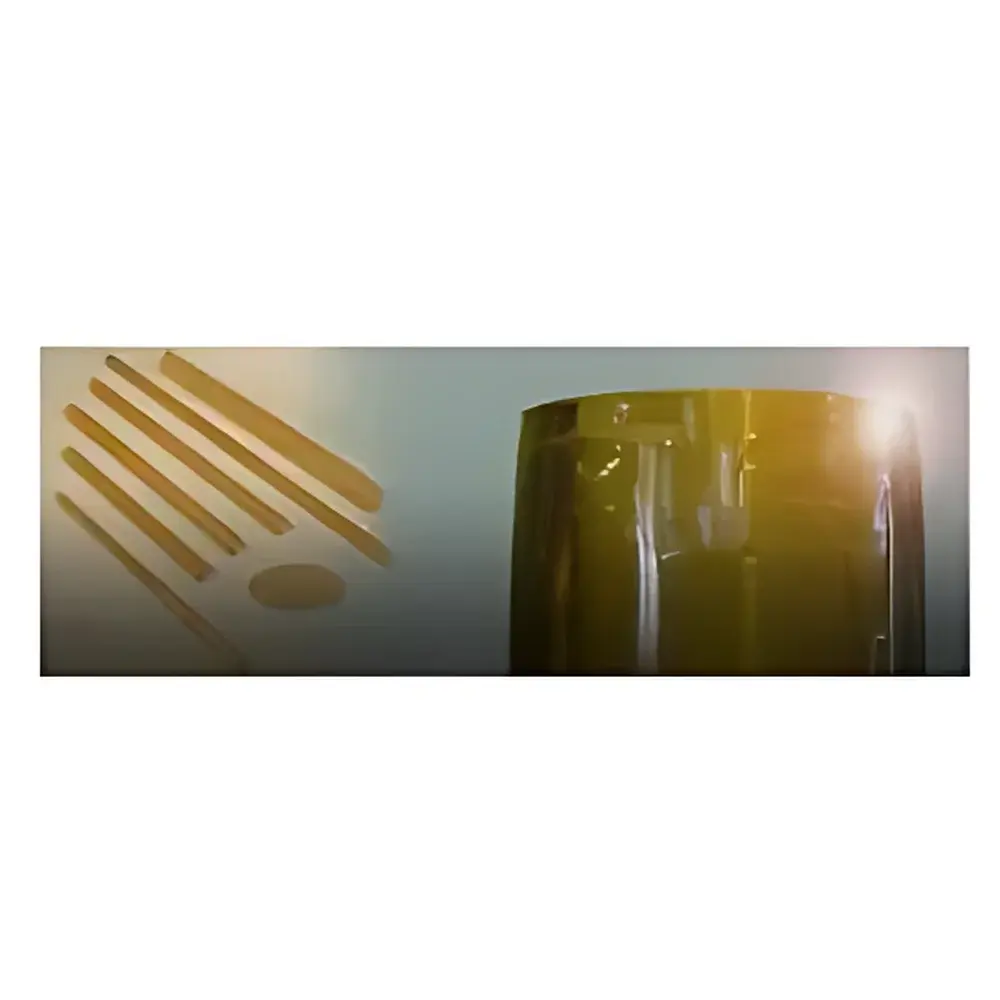
Er:YAG Laser Crystal by SYNOPTICS
| Brand | SYNOPTICS |
|---|---|
| Origin | USA |
| Manufacturer Type | Authorized Distributor |
| Import Status | Imported |
| Model | Er:YAG |
| Wavelength Emission | 2.94 µm |
| Host Material | Y₃Al₅O₁₂ (YAG) |
| Er³⁺ Doping Concentration | 50 at.% (~7×10²⁰ cm⁻³) |
| Crystal Orientation | [111] ±5° |
| Wavefront Distortion | ≤λ/2 per inch @ 1 µm (double-pass interferometric measurement) |
| Diameter Tolerance | +0.000"/−0.002" |
| Length Tolerance | +0.040"/−0.000" |
| Surface Finish | 55 ±5 µin Ra |
| Edge Chamfer | 0.005" ±0.003" @ 45° ±5° |
| Surface Flatness | λ/10 @ 633 nm |
| Parallelism | ≤30 arcsec |
| Perpendicularity | ≤5 arcmin |
| Surface Quality | 10-5 (MIL-O-13830A) |
| AR Coating | R < 0.25% @ 2.94 µm |
| Coating Adhesion & Durability | Compliant with MIL-C-48497A |
| Pulsed Laser Damage Threshold | >10 J/cm² |
| Pump Band | 600–899 nm |
| Stimulated Emission Cross Section | 3×10⁻²⁰ cm² |
| Upper Laser Level | ⁴I₁₁/₂ → ⁴I₁₃/₂ |
Overview
The Er:YAG (Erbium-doped Yttrium Aluminum Garnet) laser crystal is a solid-state gain medium engineered for high-efficiency, eye-safe mid-infrared laser emission at 2.94 µm — a wavelength strongly absorbed by water and hydroxyapatite. This intrinsic absorption characteristic makes Er:YAG the benchmark material for precision ablation in biomedical applications, particularly hard-tissue surgery and dental procedures. The crystal operates on the ⁴I₁₁/₂ → ⁴I₁₃/₂ transition of trivalent erbium ions embedded in a cubic Y₃Al₅O₁₂ host lattice. Its broad pump absorption band (600–899 nm) enables efficient diode-pumping or flashlamp excitation, while its high thermal conductivity and mechanical robustness support stable continuous-wave and Q-switched operation under demanding duty cycles. Manufactured under ISO 9001:2008 quality management systems, this Er:YAG crystal integrates monocrystalline growth via the Czochralski method with precision optical fabrication, broadband anti-reflection coating, and interferometric metrology — ensuring reproducible performance across OEM laser systems and research-grade amplifiers.
Key Features
- High-purity YAG substrate with controlled stoichiometry and low residual stress, minimizing thermally induced birefringence
- Uniform 50 atomic % Er³⁺ doping concentration (~7×10²⁰ cm⁻³), optimized for saturated gain and minimal upconversion loss
- [111]-oriented crystallographic alignment (±5° tolerance) to maximize polarization stability and minimize walk-off in end-pumped configurations
- λ/10 surface flatness and <30 arcsec parallelism, enabling diffraction-limited beam propagation in resonator cavities
- Hard, durable AR coating centered at 2.94 µm (R 10 J/cm², 10 ns pulse)
- Surface quality compliant with MIL-O-13830A (10-5 scratch-dig), critical for minimizing scattering losses and catastrophic surface failure under high fluence
Sample Compatibility & Compliance
This Er:YAG crystal is designed for integration into Class IV medical and industrial laser systems conforming to IEC 60825-1:2014 and FDA 21 CFR Part 1040.10/1040.11. Its dimensional and optical specifications align with industry-standard mounting interfaces for rod-type gain media in longitudinal-pumped Nd:YAG-pumped or diode-pumped Er:YAG oscillators. All manufacturing and metrology processes adhere to ISO 9001:2008 requirements, with full traceability of raw materials, growth logs, interferometric test reports, and coating spectral data provided upon request. The crystal meets GLP-compliant documentation standards for regulated preclinical device development and supports audit-ready records for FDA 510(k) submissions and CE marking under MDR Annex II.
Software & Data Management
While the Er:YAG crystal itself is a passive optical component, its performance parameters are fully compatible with standard laser system modeling platforms including LASCAD, RP Photonics’ RP Resonator, and COMSOL Multiphysics® for thermal lensing and mode analysis. SYNOPTICS provides comprehensive optical characterization datasets (transmission spectra, wavefront maps, coating reflectance curves, and damage threshold histograms) in CSV and HDF5 formats. These files integrate seamlessly with laboratory LIMS environments and support automated QA/QC workflows compliant with 21 CFR Part 11 when paired with validated instrument control software from leading OEMs (e.g., Coherent, Quantel, or IPG Photonics).
Applications
- Dental caries removal and cavity preparation, leveraging selective ablation of enamel and dentin with minimal thermal necrosis
- Orthopedic and neurosurgical bone cutting, where 2.94 µm radiation achieves precise osteotomy with reduced charring versus CO₂ lasers
- Soft-tissue dermatology and ENT procedures requiring high water-absorption efficiency and shallow penetration depth (~1–3 µm)
- Pump-probe spectroscopy in atmospheric physics, targeting rotational-vibrational transitions of H₂O, CO₂, and CH₄ near 2.9 µm
- Mid-IR frequency conversion seeding, serving as a stable source for OPOs and DFG stages targeting 3–12 µm spectral regions
- Calibration reference for FTIR spectrometers and quantum cascade laser linearity verification
FAQ
What pump sources are compatible with this Er:YAG crystal?
Flashlamps and tunable Ti:sapphire lasers (600–800 nm) are widely used; high-brightness 790 nm and 800 nm laser diodes are increasingly preferred for compact, air-cooled systems.
Is the crystal suitable for CW operation?
Yes, though thermal management is critical; effective heat sinking and cryogenic cooling (77 K) significantly improve slope efficiency and beam quality in CW configurations.
Can custom coatings be applied?
Yes — SYNOPTICS offers dual-band AR coatings (e.g., 2.94 µm + pump band), HR/HR cavity mirrors, and polarizing coatings upon specification, with full spectral and durability testing.
How is crystal homogeneity verified?
Via quantitative phase imaging using a double-pass ZYGO GPI interferometer at 1064 nm, supplemented by photoluminescence mapping to detect Er³⁺ clustering or segregation anomalies.
Does SYNOPTICS provide mounting hardware or thermal interface solutions?
Standard copper or molybdenum mounts with indium foil or diamond paste thermal interfaces are available as optional accessories, with thermal expansion matching validated per ASTM E228.





