
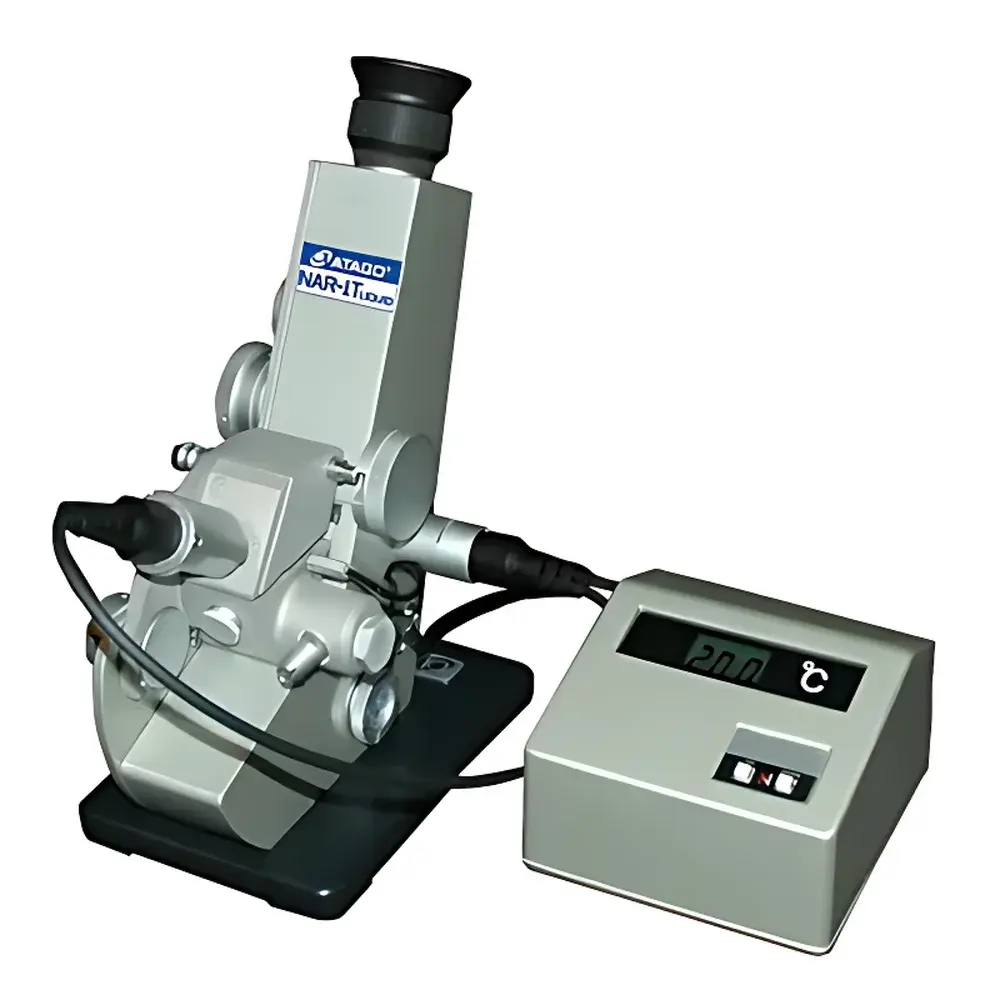
ATAGO NAR-1T Solid-State Refractometer for Brix and Refractive Index Measurement
| Brand | ATAGO |
|---|---|
| Origin | Japan |
| Model | NAR-1T |
| Type | Benchtop Abbe Refractometer |
| Temperature Control | Yes |
| Digital Display | Yes |
| Refractive Index (nD) Range | 1.3000–1.7000 |
| Brix Range | 0.0–95.0% |
| Resolution | nD = 0.001, Brix = 0.5% |
| Accuracy | ±0.0002 (nD), ±0.1% (Brix) |
| Temperature Measurement Range | 0–50°C |
| Temp. Accuracy | ±0.2°C |
| Light Source | LED (589 nm equivalent) |
| Power Supply | 115/220/240 V, 50/60 Hz |
Overview
The ATAGO NAR-1T Solid-State Refractometer is a precision benchtop Abbe refractometer engineered for high-accuracy measurement of refractive index (nD) and soluble solids content (Brix %) in both solid and liquid transparent or translucent samples. Based on the fundamental principle of total internal reflection at the prism-sample interface, the instrument determines nD by locating the critical angle of refraction under monochromatic illumination—here achieved via a stabilized LED source calibrated to emit at 589 nm, precisely matching the sodium D-line wavelength specified in ISO 2173 and AOAC Official Method 932.12. This spectral fidelity ensures metrological traceability and eliminates variability associated with aging tungsten lamps or ambient daylight interference. Unlike conventional handheld or analog refractometers, the NAR-1T integrates active temperature control and real-time digital thermometry (0.0–50.0°C, ±0.2°C accuracy), enabling automatic temperature compensation per ASTM D1218 and USP . Its optical architecture complies with Abbe refractometer design standards defined in JIS K 0061 and DIN 12111, supporting rigorous QC/QA workflows in food, polymer, pharmaceutical, and materials R&D laboratories.
Key Features
- Precision LED light source emitting at 589 nm—spectrally aligned with the sodium D-line for compliance with international refractive index definitions
- Integrated Peltier-based temperature control system with digital temperature sensor (0.0–50.0°C range, ±0.2°C accuracy, 0.1°C resolution)
- High-resolution digital display: nD to 0.001, Brix to 0.5%, with measurement accuracy of ±0.0002 (nD) and ±0.1% (Brix)
- Dual-mode operation: validated for both solid-state samples (e.g., plastic films, glass substrates, polymer pellets) and homogeneous liquids (e.g., syrups, sauces, solvents)
- Robust Abbe optical path with sapphire-coated main prism (RE-1104) and interchangeable auxiliary prism (RE-1111) for extended sample adaptability
- Compliant power architecture supporting global voltage inputs (115/220/240 V, 50/60 Hz) and low thermal drift design for stable long-term calibration retention
Sample Compatibility & Compliance
The NAR-1T accommodates a broad spectrum of optically transparent or semi-transparent materials including but not limited to: cured polymer sheets, injection-molded plastic components, optical glass substrates, gelatin-based gels, fruit purees, salad dressings, vegetable oils, aqueous sugar solutions, and pharmaceutical excipient suspensions. Its solid-sample capability addresses longstanding challenges in characterizing refractive properties of display panel substrates and colored thermoplastics—applications where conventional immersion-based refractometers fail due to lack of direct contact geometry. The instrument meets essential regulatory and quality framework requirements: it supports GLP-compliant documentation when paired with ATAGO’s optional calibration standards (e.g., RE-110010, RE-110030, RE-1195); its temperature-compensated output aligns with FDA 21 CFR Part 11 data integrity expectations when used with audit-trail-enabled lab software; and its measurement methodology conforms to ISO 2173 (fruit juices), AOAC 932.12 (soluble solids), and ASTM D1218 (petroleum products).
Software & Data Management
While the NAR-1T operates as a standalone instrument with local digital readout, its analog voltage output (0–1 V DC proportional to nD) enables seamless integration into centralized laboratory data acquisition systems. When connected to compatible DAQ hardware and validated LIMS or ELN platforms, measurements support automated timestamping, operator ID logging, and electronic signature capture—fulfilling ALCOA+ principles (Attributable, Legible, Contemporaneous, Original, Accurate). Optional certified reference materials (e.g., sucrose standards RE-110010/30/50) provide documented traceability to NIST SRM 84d. All calibration records—including prism cleaning logs, temperature sensor verification, and linearity checks—can be maintained in accordance with ISO/IEC 17025 clause 7.7 and GMP Annex 11 Annex A requirements for analytical instrumentation.
Applications
- Quality control of salad dressings, vinaigrettes, and emulsified condiments via Brix correlation to total soluble solids (TSS) content
- Refractive index profiling of optical-grade polymers (e.g., PMMA, PC, PET) during formulation development and incoming raw material inspection
- Batch consistency verification of transparent coatings, adhesives, and encapsulants in electronics manufacturing
- Routine monitoring of sugar concentration in fruit-based food matrices where enzymatic interference limits enzymatic assay reliability
- Characterization of dispersion homogeneity in colloidal suspensions and hydrogels using refractive index gradients
- Supporting ASTM D523 and ISO 2813 gloss-refractive index correlation studies in surface science laboratories
FAQ
Does the NAR-1T require user calibration before each measurement?
No—routine calibration uses factory-traceable sucrose standards (e.g., RE-110010) at defined intervals per SOP; daily verification suffices for most QC applications.
Can the NAR-1T measure opaque or highly viscous samples like mayonnaise or mustard?
No—it requires optical transparency at the prism interface; turbid or scattering samples must be clarified or diluted prior to analysis.
Is temperature control mandatory for accurate Brix readings?
Yes—Brix values are temperature-dependent; the integrated Peltier system maintains sample thermal equilibrium per AOAC guidelines.
What maintenance is required for long-term optical performance?
Daily prism cleaning with lens-grade tissue and reagent-grade ethanol; annual verification of LED spectral output and temperature sensor drift.
How does the NAR-1T differ from the NAR-2T-HI model?
The NAR-2T-HI extends the nD range to 1.4700–1.8700 and supports elevated temperatures up to 120°C, making it suitable for high-index glasses and thermoset resins—not required for salad dressing or standard food matrix analysis.



