
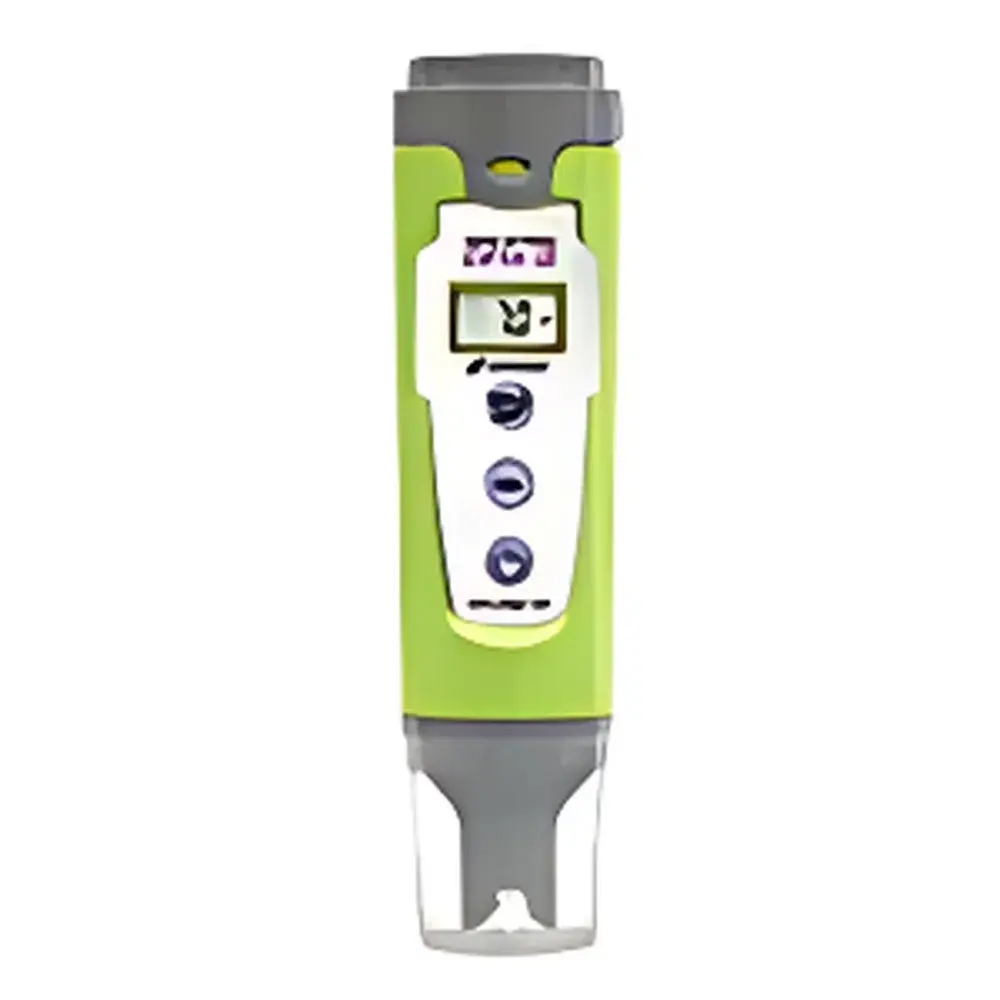
ATAGO DPH-2 Digital Portable pH Meter
| Brand | ATAGO |
|---|---|
| Origin | Japan |
| Model | DPH-2 |
| Instrument Type | Portable pH Meter |
| Parameter Type | Single-parameter (pH) |
| Measurement Range | 0.0 to 14.0 pH |
| Resolution | 0.1 pH |
| Accuracy | ±0.1 pH (at 2.0–12.0 pH, 25°C) |
| Calibration Points | 3-point (pH 4.0, 7.0, 10.0) |
| Temperature Compensation | Automatic (ATC), 0–50°C |
| Power Supply | Four LR44 button cells (1.5 V each) |
| Enclosure Rating | IP67 |
| Dimensions | 4.5 × 3.0 × 16.3 cm |
| Weight | 90 g (instrument only) |
Overview
The ATAGO DPH-2 Digital Portable pH Meter is a compact, field-deployable electrochemical instrument engineered for rapid, reliable pH measurement in non-laboratory environments. It operates on the principle of potentiometric measurement: a glass pH electrode generates a millivolt signal proportional to hydrogen ion activity in solution, which is converted and displayed as a digital pH value via an integrated solid-state amplifier circuit. Designed for operational robustness rather than benchtop precision, the DPH-2 prioritizes ease of use, environmental resilience, and consistent repeatability across diverse sample matrices — including aqueous solutions, semi-viscous food slurries, buffered cleaning agents, and mildly conductive industrial fluids. Its sealed, waterproof housing (IP67-rated) enables safe operation in humid, dusty, or splash-prone settings — such as production floors, fermentation tanks, agricultural fields, and maintenance workshops — without compromising sensor stability or reading integrity.
Key Features
- True portable architecture: lightweight (90 g) and pocket-sized (4.5 × 3.0 × 16.3 cm), optimized for one-handed operation and extended field use.
- Three-point automatic calibration routine using standard NIST-traceable buffer solutions (pH 4.0, 7.0, and 10.0), ensuring traceable linearity across the full 0.0–14.0 pH range.
- Integrated Automatic Temperature Compensation (ATC) with a temperature-sensing element embedded in the electrode tip, correcting for thermal drift between 0°C and 50°C without manual input.
- High-stability glass pH electrode with low-drift junction design, minimizing liquid junction potential errors during sequential measurements.
- IP67-rated enclosure provides complete protection against dust ingress and immersion in water up to 1 m for 30 minutes — suitable for wet-process environments and outdoor sampling.
- Energy-efficient power system: four replaceable LR44 alkaline button cells deliver >10,000 measurement cycles under typical usage, with auto-power-off after 10 minutes of inactivity.
Sample Compatibility & Compliance
The DPH-2 is validated for use with aqueous and low-viscosity aqueous-based solutions exhibiting conductivity ≥200 µS/cm — including beverages, dairy products, brewing wort and beer, fruit juices, soil extracts (saturated paste method), alkaline cleaning formulations, coolant emulsions, and cutting oils diluted per ASTM D1150. It is not intended for non-aqueous solvents, highly viscous polymers, or samples containing suspended solids that may clog the reference junction. While the instrument itself does not carry CE, UKCA, or FDA 510(k) certification, its measurement methodology conforms to ISO 3696 (water for analytical use), ISO 7888 (water quality — determination of pH), and ASTM D1293 (Standard Test Method for pH of Water). Calibration protocols align with GLP documentation requirements when paired with certified buffer standards (e.g., NIST SRM 186, 187, 188).
Software & Data Management
The DPH-2 is a standalone, microprocessor-controlled meter with no onboard data logging, Bluetooth, or USB interface. All measurements are displayed in real time on a high-contrast LCD screen and must be manually recorded. This architecture eliminates firmware dependencies, cybersecurity risks, or validation overhead associated with connected instruments — making it compliant with environments where electronic data integrity (e.g., FDA 21 CFR Part 11) is not mandated, but procedural traceability remains essential. Users are advised to maintain calibration logs, electrode maintenance records, and environmental conditions (temperature, sample ID) in accordance with internal QA/QC procedures or ISO/IEC 17025 clause 7.7.
Applications
- Food & Beverage Quality Control: monitoring mash pH in breweries, titratable acidity in winemaking, post-pasteurization pH in dairy processing, and brine stability in pickling operations.
- Agricultural Field Testing: rapid assessment of soil extract pH for lime requirement calculations and irrigation water compatibility screening.
- Industrial Maintenance: verification of alkaline detergent concentration in CIP systems, pH stability of metalworking fluids, and neutralization endpoints in wastewater pre-treatment.
- Education & Training: introductory electrochemistry labs where students require intuitive, durable instrumentation to reinforce core concepts of acid-base equilibria and electrode response kinetics.
- Regulatory Screening: preliminary compliance checks against local discharge limits (e.g., EPA pH 6.0–9.0 for industrial effluent) prior to formal laboratory analysis.
FAQ
What calibration buffers are required for the DPH-2?
The DPH-2 requires three certified pH buffer solutions: pH 4.01, pH 7.00, and pH 10.01 (at 25°C), traceable to NIST or equivalent national metrology institutes.
Can the DPH-2 measure pH in non-aqueous solutions?
No. The instrument is designed exclusively for aqueous or predominantly aqueous media. Organic solvents, oils, or glycerol-rich solutions will produce unreliable readings due to altered liquid junction potentials and reference electrode instability.
Is the electrode replaceable or serviceable?
Yes. The DPH-2 uses a proprietary combination pH electrode (ATAGO part no. 3110) that is user-replaceable; the electrode body includes a refillable KCl electrolyte reservoir and a ceramic junction for consistent diffusion rates.
Does the DPH-2 support manual temperature input?
No. Temperature compensation is fully automatic (ATC) and sensor-coupled; manual temperature entry is not supported.
How often should the electrode be cleaned and stored?
Rinse with deionized water after each measurement. Store immersed in 3 M KCl storage solution (not distilled water) to maintain hydration of the glass membrane and reference junction integrity. Clean with mild detergent or 0.1 M HCl if fouled by proteins or precipitates.
Related Products





