
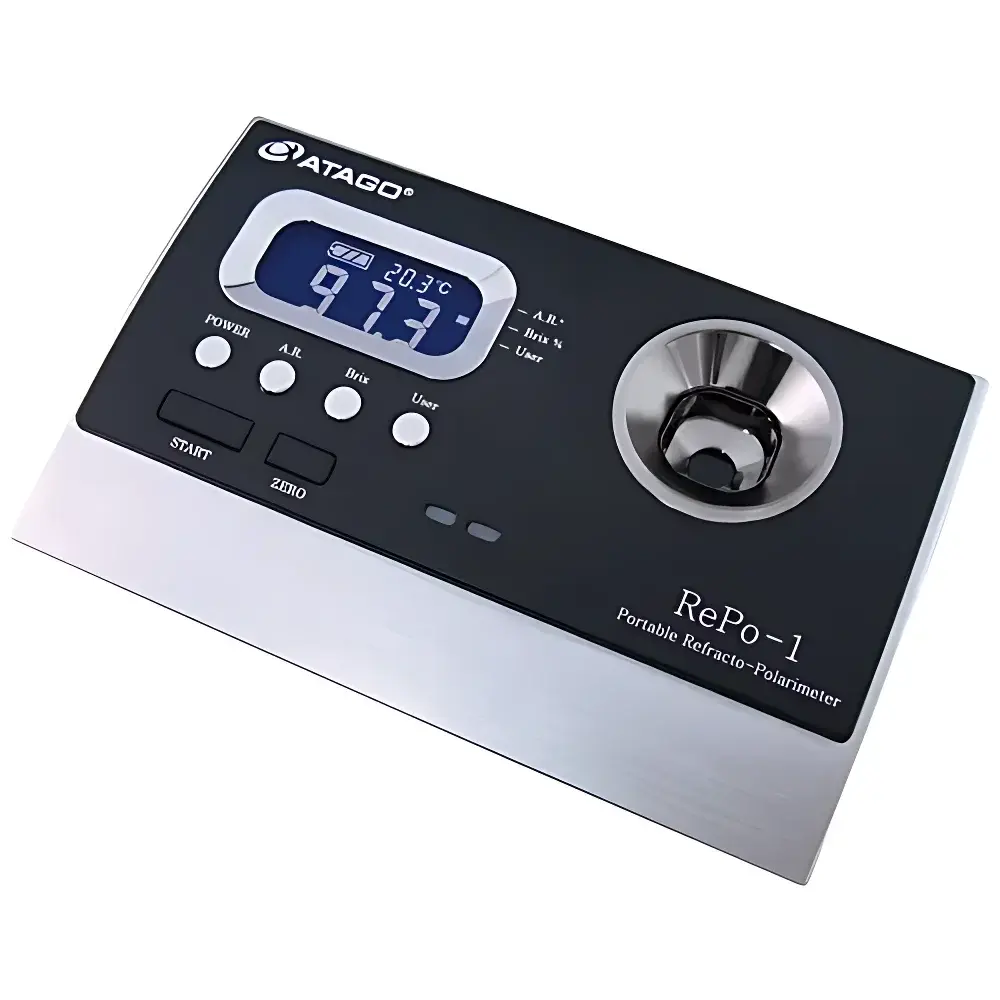

ATAGO RePo-1 Integrated Refractometer and Polarimeter for Sugarcane
| Brand | ATAGO |
|---|---|
| Origin | Japan |
| Model | RePo-1 (A Kit) |
| Measurement Principle | Simultaneous refractometry (589 nm LED) and polarimetry (Na D-line equivalent) |
| Measurement Range | AR: −5.00 to +5.00°, Brix: 0.0–85.0%, ISS: −130 to +130°Z, Temp: 15.0–40.0°C |
| Resolution | AR: 0.01°, Brix: 0.1%, ISS: 0.1°Z, Temp: 0.1°C |
| Accuracy | AR: ±0.1° (at 20°C), Brix: ±0.2%, ISS: ±3.0°Z (at 20°C), Temp: ±1.0°C |
| ATC Range | Brix: 10–40°C |
| ISS & Purity | 18–40°C |
| Light Source | 589 nm LED |
| Power | 4 × AAA alkaline batteries |
| IP Rating | IP67 |
| Dimensions & Weight | 10.1 × 16.0 × 3.8 cm, 325 g (instrument only) |
| Sample Volume | 3 mL |
| Accessories Included | 20 mL syringe (×3), 45 mm orange sealing gasket (×50), filter paper (×100), 100 mL beaker |
Overview
The ATAGO RePo-1 Integrated Refractometer and Polarimeter for Sugarcane is a field-deployable, dual-mode optical instrument engineered specifically for raw sugarcane juice analysis in sugar mills, agricultural cooperatives, and QC laboratories. It combines Abbe-type refractometry and sodium D-line polarimetry (589 nm LED source) into a single compact platform—enabling concurrent, non-destructive determination of Brix (% w/w sucrose equivalent), specific rotation ([α]D), International Standard Sugar Scale (ISS, °Z), and sample temperature. Unlike conventional polarimeters requiring decolorized, clarified solutions, the RePo-1 accommodates turbid, unprocessed cane juice via its proprietary sample interface—eliminating chemical decolorization steps that induce sucrose inversion and compromise Brix stability. Its measurement architecture adheres to the physical principles defined in ISO 2049:2021 (sugar analysis — determination of polarization), AOAC Official Method 932.12 (polarimetric sucrose assay), and ICUMSA Method GS7/3-11 (refractive index-based purity estimation). The device operates under ambient conditions without external calibration fluids, leveraging built-in temperature compensation algorithms compliant with ICUMSA temperature correction protocols.
Key Features
- Simultaneous dual-parameter acquisition: Brix and optical rotation measured in one 2-second cycle—no sequential mode switching or recalibration.
- Robust sample handling for raw cane juice: Integrated 45 mm orange sealing gasket and disposable filter paper enable rapid particulate removal without centrifugation or activated carbon treatment.
- True field-portability: IP67-rated enclosure, battery-powered operation (4 × AAA), and sub-330 g mass support use in mobile labs, roadside stations, and harvest-side quality checkpoints.
- Automated calculation engine: Instantly derives ISS (°Z), purity (%), specific rotation ([α]D), and concentration (g/100 mL) from raw AR and Brix inputs using ICUMSA-recommended polynomial coefficients.
- Configurable pass/fail thresholds: User-definable upper/lower limits for any displayed parameter trigger visual alarm (LED indicator) upon out-of-spec detection—supporting real-time process control.
- ATC-corrected readings: Automatic temperature compensation applied per ICUMSA guidelines—Brix compensated across 10–40°C, ISS and purity across 18–40°C—ensuring metrological consistency across tropical mill environments.
Sample Compatibility & Compliance
The RePo-1 accepts undiluted, unclarified sugarcane juice directly post-extraction—provided it is pre-filtered through supplied cellulose filter paper to remove coarse fiber and suspended solids (>10 µm). It is validated for samples with turbidity up to 400 NTU and suspended solids ≤ 0.8% w/v. No enzymatic, thermal, or chemical pretreatment is required, preserving native sucrose integrity and avoiding hydrolysis artifacts common in acid-decolorized preparations. The instrument meets the mechanical and optical requirements of ISO/IEC 17025:2017 for in-house reference measurement systems and supports GLP-compliant recordkeeping when paired with ATAGO’s optional data logging software. Its 589 nm LED source satisfies spectral fidelity requirements outlined in USP and Ph. Eur. 2.2.74 for optical rotation instrumentation.
Software & Data Management
While the RePo-1 operates as a standalone instrument, optional USB-to-serial connectivity enables integration with ATAGO’s PC-based Data Manager v3.2 software. This application supports audit-trail-enabled data export (CSV, PDF), calibration history tracking, and user-access-level configuration (admin/operator modes). All measurements include embedded timestamps, operator ID fields, and environmental metadata (ambient temperature, battery voltage). The software complies with FDA 21 CFR Part 11 requirements for electronic records and signatures when deployed with appropriate system validation documentation.
Applications
- Real-time assessment of cane juice purity at extraction points—correlating Brix and ISS to estimate sucrose-to-total-solids ratio per ICUMSA GS7/3-11.
- Harvest maturity evaluation: Field-based monitoring of [α]D drift to identify optimal cutting windows and detect microbial invertase activity.
- Process optimization in diffusion and clarification units—tracking sucrose loss vs. inversion product formation without lab turnaround delay.
- Contractual quality verification between growers and mills—providing legally defensible, traceable measurements aligned with national sugar grading standards (e.g., Brazil INMETRO Portaria 225/2020, Thailand TIS 552-2560).
- Teaching and method validation in food science curricula—demonstrating fundamental relationships among refractive index, optical rotation, and carbohydrate composition.
FAQ
Does the RePo-1 require sample decolorization prior to measurement?
No. Its optical path design and gasket-assisted sample containment allow direct analysis of turbid, unclarified cane juice—eliminating decolorization steps that cause sucrose hydrolysis and Brix drift.
How does the instrument ensure accuracy under variable ambient temperatures?
It applies ICUMSA-validated ATC algorithms: Brix values are corrected across 10–40°C; ISS and purity calculations use temperature-dependent coefficients calibrated per GS7/3-11 Annex A.
Can the RePo-1 be used for beet sugar or molasses analysis?
It is optimized for sugarcane matrix characteristics (pH 4.8–5.4, viscosity ≤ 12 mPa·s at 30°C). Beet juice requires separate validation due to differing impurity profiles and higher betaine content.
What is the expected lifetime of the LED light source?
The 589 nm LED is rated for ≥ 50,000 hours of operation—exceeding typical field deployment cycles by two orders of magnitude.
Is the RePo-1 compliant with international sugar trade standards?
Yes. Its measurement traceability aligns with ICUMSA Methods GS7/3-11 (refractometry) and GS2/3-10 (polarimetry), and results are accepted for contractual settlement in 12 major sugar-exporting countries.




