
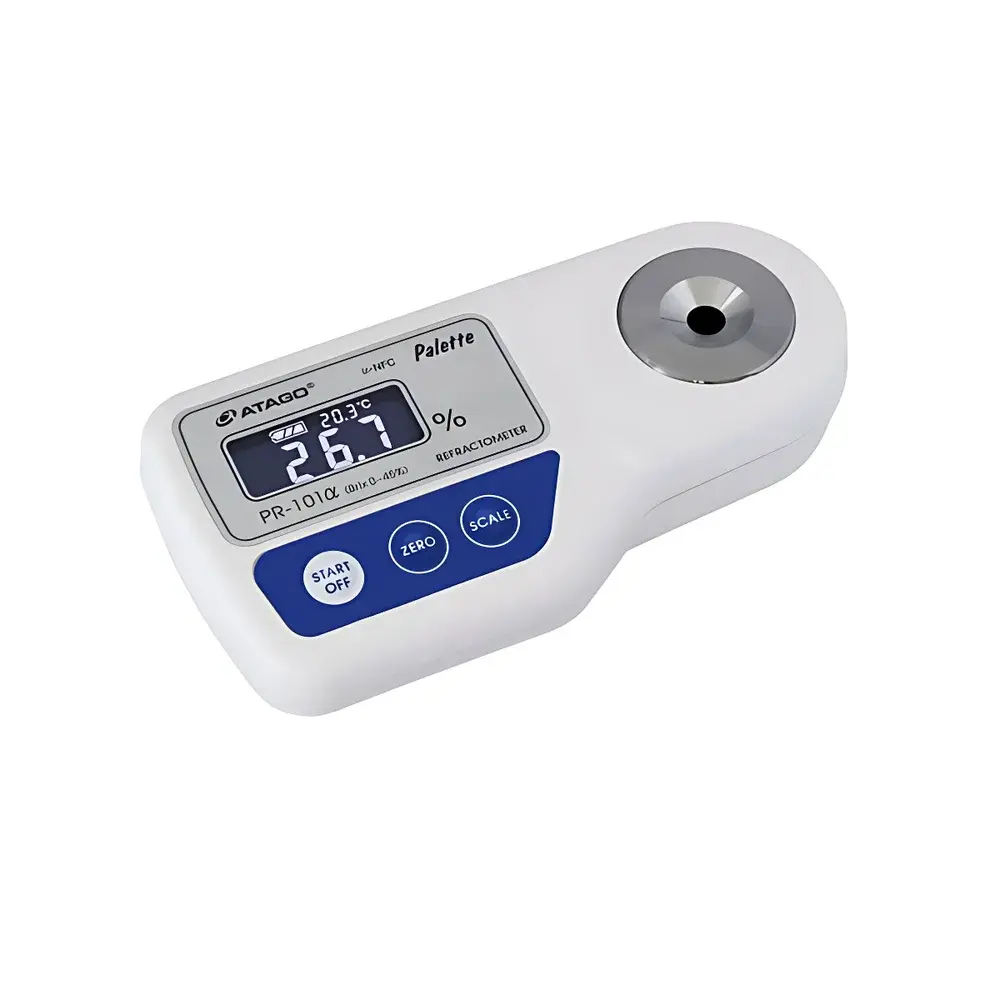
ATAGO PR-101α Digital Handheld Refractometer
| Brand | ATAGO |
|---|---|
| Origin | Japan |
| Model | PR-101α |
| Measurement Range | 0.0–45.0% Brix |
| Minimum Display Increment | 0.1% Brix |
| Accuracy | ±0.1% Brix |
| Temperature Compensation | Automatic (5–40°C) |
| Operating Ambient Temperature | 5–40°C |
| Power Supply | 006P 9V Alkaline Battery |
| Ingress Protection Rating | IP64 |
| Dimensions | 170 × 90 × 40 mm |
| Weight | 300 g (instrument only) |
| Sample Type | Liquid |
| Measurement Principle | Total Internal Reflection via Abbe-type Prism |
| Interface | NFC-enabled for wireless data transfer to iOS/Android devices |
| ELI Function | External Light Interference Suppression |
| Custom Scale Support | Up to 3 user-defined scales |
Overview
The ATAGO PR-101α is a precision-engineered, portable digital refractometer designed for rapid, field-deployable concentration measurement of transparent and semi-transparent liquid samples based on the optical principle of total internal reflection. Utilizing an Abbe-type prism assembly with temperature-compensated sapphire contact surface, the instrument determines refractive index and converts it to Brix (% w/w sucrose equivalent) in real time. Its core architecture adheres to internationally recognized optical metrology conventions—specifically aligned with ISO 2173:2003 (fruit juice analysis) and AOAC Official Method 932.12 (refractometric determination of soluble solids). The PR-101α operates within a validated thermal envelope (5–40°C ambient), employing built-in thermistor-based automatic temperature compensation (ATC) referenced to 20°C, ensuring measurement stability across variable environmental conditions without manual recalibration.
Key Features
- High-accuracy optical sensing with ±0.1% Brix repeatability under controlled laboratory validation protocols
- Three-user-configurable scale memory slots for direct readout in non-Brix units (e.g., NaCl %, glycol %, or custom polynomial-derived scales)
- ELI (External Light Interference) function—optically isolates the prism interface from ambient stray light, eliminating measurement drift during outdoor or high-glare use
- NFC (Near Field Communication) module compliant with ISO/IEC 14443 Type A/B, enabling secure, one-tap pairing with smartphones for timestamped data export (CSV format) without Bluetooth pairing overhead
- IP64-rated enclosure—dust-tight and protected against water splashing from any direction, suitable for production floor, warehouse, or agricultural field deployment
- Low-power consumption design powered by a single 9V alkaline battery (006P), supporting >5,000 measurements per charge under typical usage conditions
Sample Compatibility & Compliance
The PR-101α is validated for homogeneous aqueous solutions including fruit juices, soft drinks, dairy-based beverages, industrial coolants (e.g., water-soluble cutting fluids), antifreeze mixtures (ethylene/propylene glycol–water), and cleaning agents. It is not intended for highly viscous, opaque, or suspended-particle-laden samples (e.g., pulpy juices, emulsions, or slurries), as these violate the fundamental assumption of homogeneous optical path transmission required for Abbe-prism-based refractometry. Device compliance includes conformity with IEC 61000-4-2 (ESD immunity), RoHS Directive 2011/65/EU, and CE marking per EMC and LVD directives. While not a GLP/GMP-certified instrument per se, its audit-ready data export (with embedded timestamps and device ID) supports traceability requirements in quality-controlled environments operating under ISO 9001 or HACCP frameworks.
Software & Data Management
No proprietary desktop software is required. NFC-initiated data transfer delivers a structured CSV file containing: measurement timestamp (local device clock), Brix value, measured temperature, selected scale ID, and unit identifier. Files are auto-saved to the mobile device’s default download directory. Metadata fields conform to ASTM E2500-18 Annex A1 guidelines for raw instrument data archiving. For enterprise integration, exported CSVs are compatible with LIMS platforms (e.g., LabWare, Thermo Fisher SampleManager) via standard ingestion pipelines. Audit trails remain resident on the mobile device; the PR-101α itself retains no persistent storage—eliminating data residency concerns under GDPR or HIPAA-aligned policies.
Applications
- QC screening of incoming raw materials (e.g., fruit concentrate Brix verification prior to blending)
- In-process monitoring of syrup dilution ratios in beverage manufacturing
- Maintenance of coolant concentration in CNC machining centers per OEM specifications (e.g., minimum 8% glycol for corrosion inhibition)
- Field-based assessment of antifreeze protection level in automotive or HVAC service operations
- Educational laboratories demonstrating colligative property relationships between solute concentration and refractive index
FAQ
Does the PR-101α require calibration verification before each use?
No—daily verification using distilled water (expected reading: 0.0% Brix at 20°C) is recommended per ISO 5725-2; full two-point calibration (0% and 30% Brix standards) is advised weekly or after exposure to extreme thermal shock.
Can the NFC function operate without smartphone internet connectivity?
Yes—NFC is a passive, short-range radio protocol requiring no network infrastructure; data exchange occurs offline via electromagnetic induction.
Is the prism surface chemically resistant to acidic or alkaline solutions?
The sapphire prism (Mohs hardness 9) resists degradation from pH 2–12 solutions; however, prolonged contact with hydrofluoric acid or hot concentrated alkalis (>10% NaOH at >60°C) is not recommended.
What does “destructive type” indicate in the instrument classification?
This denotes that sample application requires direct physical contact with the prism surface—no flow cell or non-contact optical path is provided; residual sample must be manually wiped post-measurement.
How is temperature compensation implemented internally?
A platinum-resistance thermometer (Pt100-class) adjacent to the prism measures sample temperature in real time; compensation uses a third-order polynomial algorithm derived from ATAGO’s empirical Brix–temperature–refractive index database.





