
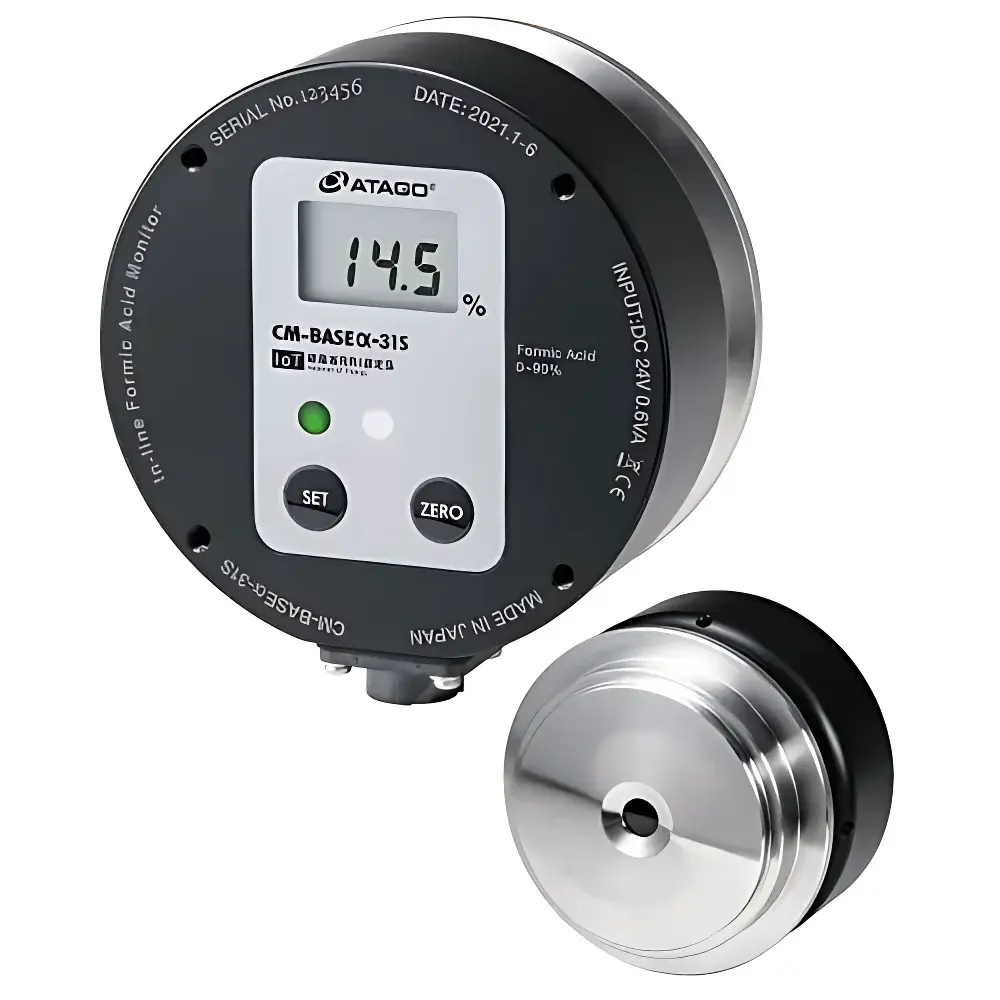
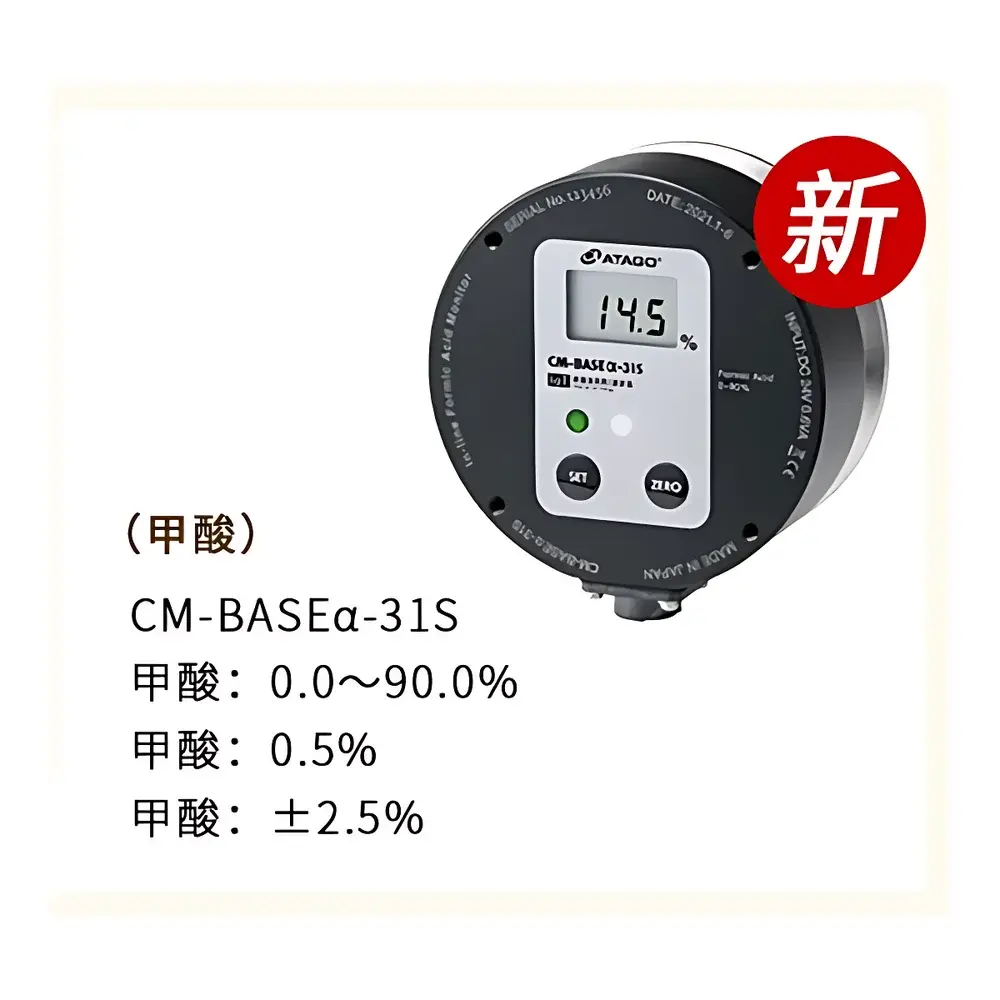
ATAGO CM-BASEα-31S In-Line Formic Acid Concentration Meter
| Brand | ATAGO |
|---|---|
| Origin | Japan |
| Product Type | In-Line Refractometer |
| Model | CM-BASEα-31S |
| Measurement Principle | Refractive Index (RI)-Based Concentration Determination |
| Measurand | Formic Acid Aqueous Solution |
| Range | 0.0–90.0 wt% |
| Accuracy | ±2.5 wt% (formic acid) |
| Temperature Control | Integrated Peltier-based Thermostatic Cell |
| Display | Digital LCD with Real-Time % Output |
| Compliance | Designed for Industrial Process Monitoring in Accordance with ISO 21748 (Refractometry Guidance) and Compatible with GLP/GMP Data Integrity Requirements |
Overview
The ATAGO CM-BASEα-31S is a purpose-engineered in-line refractometer designed for continuous, non-invasive concentration monitoring of formic acid (HCOOH) aqueous solutions in industrial chemical processing environments. It operates on the fundamental optical principle that the refractive index (RI) of a homogeneous liquid solution exhibits a monotonic, empirically calibrated relationship with solute mass concentration—here, formic acid—under controlled temperature conditions. Unlike offline titration or HPLC-based methods, the CM-BASEα-31S employs a high-stability LED light source and precision prism interface to measure RI in real time directly within the process stream via a sanitary flow cell (typically installed in bypass or main-line configurations). This eliminates sampling lag, operator-dependent variability, and analytical downtime. The instrument’s core architecture integrates a thermoelectric (Peltier) temperature stabilization module, ensuring measurement repeatability by maintaining the sample path at a fixed reference temperature—critical given the strong thermo-optic coefficient of formic acid solutions. Its design targets integration into continuous production lines where rapid feedback control of feedstock dilution, reaction quenching, or crystallization endpoints is required.
Key Features
- Real-time, continuous concentration output (0.0–90.0 wt% formic acid) with digital LCD display and analog 4–20 mA output for PLC/DCS interfacing
- Integrated Peltier temperature control system maintains sample path at user-selectable setpoint (±0.1 °C stability), minimizing thermal drift-induced RI error
- Stainless steel (SUS316L) wetted parts and IP65-rated housing for compatibility with corrosive chemical environments and washdown conditions
- Factory-calibrated using NIST-traceable formic acid reference standards; calibration verification supported via zero-point (deionized water) and span-point (certified standard) checks
- No consumables, no reagents, and no moving parts in the optical path—ensuring long-term operational reliability with minimal maintenance
- Configurable alarm thresholds and data logging capability (via optional RS-485 Modbus RTU interface) for audit-ready trend recording
Sample Compatibility & Compliance
The CM-BASEα-31S is validated for use with aqueous formic acid solutions across the full 0–90 wt% range, including common industrial grades containing trace impurities (e.g., iron, sulfate, or residual methanol from synthesis). It is not intended for highly turbid, emulsified, or suspended-solid-laden streams without prior filtration (<5 µm). The instrument complies with IEC 61000-6-2 (EMC immunity) and IEC 61000-6-4 (EMC emissions) standards. While not certified for hazardous area installation (e.g., ATEX/IECEx), it may be deployed in Zone 2 environments when housed in an appropriate explosion-proof enclosure. Its measurement methodology aligns with the foundational principles outlined in ISO 21748:2017 (“Guidance for the use of repeatability, reproducibility and trueness estimates in measurement uncertainty evaluation”) and supports data integrity practices required under FDA 21 CFR Part 11 when paired with compliant SCADA or LIMS systems featuring electronic signatures and audit trails.
Software & Data Management
The CM-BASEα-31S operates as a standalone field device but supports bidirectional communication via RS-485 Modbus RTU protocol for integration into plant-wide automation infrastructures. Optional PC-based configuration software (ATAGO RefractoLink™) enables parameter setup, calibration history review, and export of timestamped concentration logs in CSV format. All configuration changes and calibration events are internally timestamped and stored in non-volatile memory—providing a basic audit trail suitable for GLP-aligned operations. For GMP-regulated facilities, the device can be qualified (IQ/OQ) using standardized protocols covering optical alignment verification, temperature stability validation, and linearity assessment across the full range using certified reference materials.
Applications
- Continuous concentration control in formic acid synthesis reactors (e.g., methyl formate hydrolysis or CO–methanol carbonylation processes)
- Real-time monitoring of acid strength during purification steps such as vacuum distillation or solvent extraction
- Feed concentration verification prior to downstream catalytic hydrogenation or esterification units
- Quality assurance in bulk storage tank transfer operations to prevent off-spec blending
- Wastewater treatment stream analysis for acid recovery loop optimization
FAQ
Is the CM-BASEα-31S suitable for measuring other organic acids besides formic acid?
No—it is factory-calibrated specifically for aqueous formic acid using proprietary RI-concentration correlation algorithms. Cross-application to acetic, propionic, or oxalic acid requires full recalibration with certified standards and is not supported out-of-the-box.
What is the recommended minimum flow rate for accurate measurement?
A laminar, bubble-free flow of ≥0.3 L/min is required to ensure stable optical interface contact and thermal equilibrium in the sensing cell.
Can the device be calibrated onsite by the end user?
Yes—zero calibration using deionized water and span calibration using a certified formic acid standard (e.g., 50.0 ±0.1 wt%) are supported via front-panel menu navigation.
Does the instrument support automatic temperature compensation (ATC) for ambient fluctuations?
It does not rely on ambient ATC; instead, it actively controls the sample temperature at the prism interface via integrated Peltier regulation—delivering superior accuracy compared to passive compensation methods.
What is the typical service life of the optical prism under continuous industrial operation?
With proper installation (avoiding mechanical shock and particulate abrasion), the sapphire prism assembly is rated for >10 years of uninterrupted service, backed by ATAGO’s 24-month warranty on optical components.





