
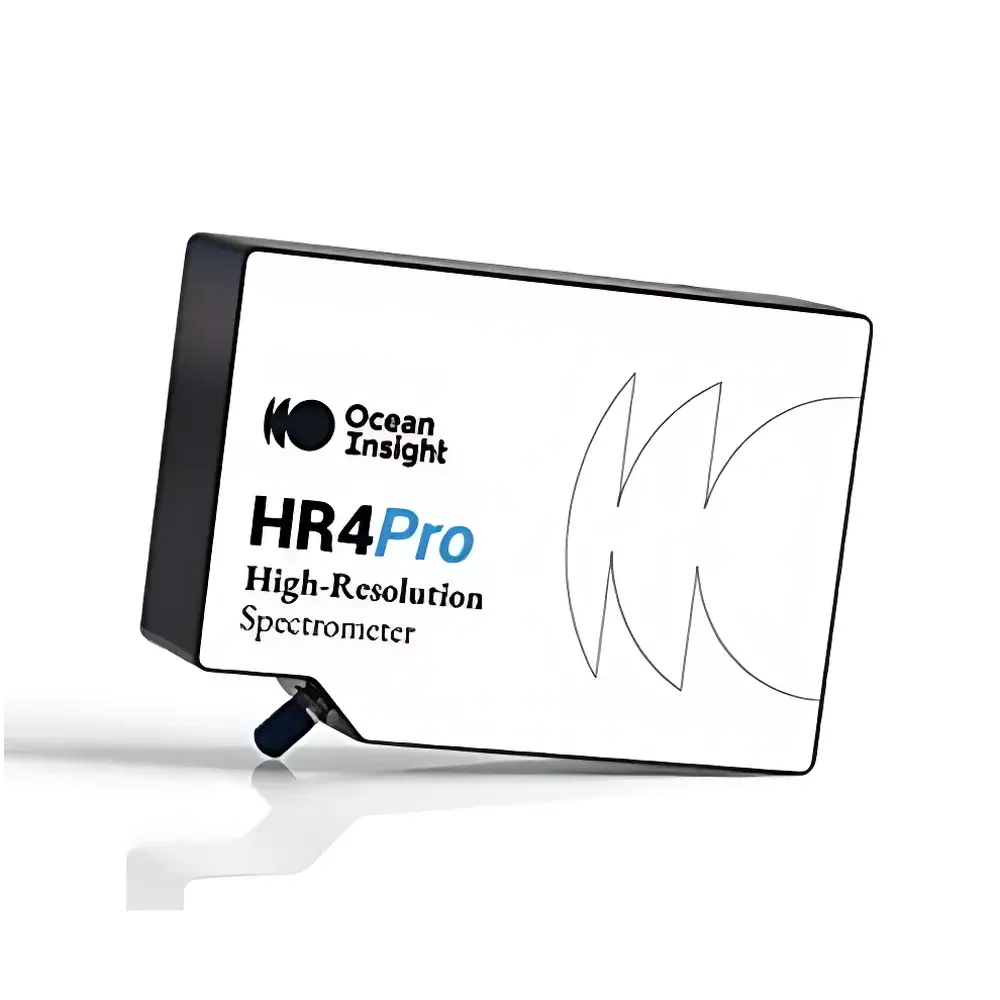
Ocean Optics HR4Pro High-Resolution Fiber Optic Spectrometer
| Brand | Ocean Optics |
|---|---|
| Origin | USA |
| Model | HR4Pro |
| Spectral Range | 190 nm – 1100 nm |
| Detector | Linear Silicon CCD Array |
| Optical Resolution (FWHM) | 0.47 nm (typical) to 0.66 nm (typical), configurable down to <0.1 nm with optimized grating/slit combinations |
| Sensitivity | 6 counts RMS dark noise |
| Signal-to-Noise Ratio | 250:1 to 300:1 (full signal) |
| Dynamic Range | 2 × 10⁹ (system) |
| 1300 | 1 to 2000:1 (single acquisition) |
| Stray Light | <0.05% at 600 nm |
| Thermal Stability | 0.03–0.06 pixels/°C |
| Slit Options | 5 µm, 10 µm |
| Grating Options | H13, H38, H48, HC1 |
| A/D Resolution | 14-bit |
| Integration Time | 3.8 ms – 10 s |
| Interface | USB 2.0 (480 Mbps), RS-232 (2-wire), I²C |
| Dimensions | 148.6 × 104.8 × 45.1 mm |
| Weight | 0.57 kg |
| Fiber Coupling | SMA 905 |
| Linearity | ±0.5% NL |
Overview
The Ocean Optics HR4Pro High-Resolution Fiber Optic Spectrometer is a compact, thermally stabilized benchtop spectrometer engineered for demanding spectral characterization tasks requiring high optical resolution, low stray light, and robust performance across laboratory, field-deployable, and industrial process environments. Based on the proven Czerny-Turner optical architecture, the HR4Pro employs precision-aligned reflective optics, high-efficiency holographic or ruled diffraction gratings, and a linear silicon CCD detector array to deliver consistent wavelength accuracy and radiometric stability. Its core design principle centers on minimizing thermal drift—achieving up to 10× improved thermal stability (0.03–0.06 pixels/°C) over legacy compact spectrometers—enabling reliable long-term monitoring without frequent recalibration. The instrument supports three preconfigured spectral bands: UV-Vis (200–875 nm), Vis-NIR (350–1025 nm), and extended range (200–1100 nm), all covering the full 190 nm – 1100 nm operational envelope with deep-UV sensitivity enabled by optional solar-blind coatings and UV-transmissive optics.
Key Features
- High Optical Resolution: Configurable FWHM resolution from 0.47 nm (typical) to <0.1 nm with optimized slit/grating combinations—ideal for resolving narrow atomic emission lines (e.g., Na D-lines, Hg 253.7 nm) and laser longitudinal modes.
- Ultra-Low Stray Light Performance: <0.05% at 600 nm and <0.10% at 435 nm, achieved via internal baffling, black-anodized optical housing, and proprietary grating blaze optimization—critical for Raman edge rejection and UV fluorescence measurements.
- Exceptional Thermal Stability: Precision-machined aluminum optical bench and stress-relieved mechanical layout reduce wavelength shift to ≤0.06 pixels/°C—validated per ASTM E275 and ISO 17025 traceable thermal cycling protocols.
- Flexible Triggering & Synchronization: Hardware-level TTL trigger input/output supports external event synchronization (e.g., pulsed lasers, shutter control, PLC signals), enabling time-resolved spectroscopy and gated acquisition.
- High-Speed Acquisition: Minimum integration time of 3.8 ms with full-frame readout, supporting real-time monitoring of transient phenomena such as plasma ignition, LED turn-on dynamics, or combustion intermediates.
- Modular Connectivity: Native USB 2.0 interface (480 Mbps) ensures plug-and-play operation under Windows, Linux, and macOS; optional RS-232 and I²C interfaces enable OEM integration into automated analytical platforms compliant with IEC 61131-3 or Modbus RTU architectures.
Sample Compatibility & Compliance
The HR4Pro is compatible with standard 200 µm or 400 µm core multimode silica fibers (SMA 905 connector), enabling seamless coupling to cuvette holders, integrating spheres, flow cells, plasma probes, and remote sampling arms. Its 5 µm and 10 µm entrance slits accommodate both high-resolution line profiling and higher-throughput broadband applications. The spectrometer meets electromagnetic compatibility requirements per FCC Part 15 Class B and CE EN 61326-1 for laboratory instrumentation. Data integrity workflows support 21 CFR Part 11-compliant audit trails when used with OceanView software’s secure user authentication and electronic signature modules—facilitating GLP/GMP-regulated QC environments in pharmaceutical, semiconductor, and environmental testing labs.
Software & Data Management
OceanView spectroscopy software (v2.5+) provides full instrument control, real-time spectral visualization, multivariate analysis (PCA, PLS), and automated peak detection with sub-pixel centroiding. Raw data export supports HDF5, CSV, and JCAMP-DX formats for interoperability with MATLAB, Python (via seabreeze SDK), and LabVIEW. Firmware updates are delivered via signed binaries with SHA-256 verification. For enterprise deployment, the HR4Pro integrates with SCADA systems through OPC UA drivers and supports MQTT publishing for IIoT-ready spectral telemetry—enabling cloud-based calibration tracking and predictive maintenance analytics.
Applications
- Atomic emission spectroscopy for elemental identification in inductively coupled plasma (ICP) and glow discharge sources.
- UV-Vis-NIR characterization of LEDs, laser diodes, and VCSELs—including center wavelength, spectral width (FWHM), and side-mode suppression ratio (SMSR).
- In-line monitoring of thin-film interference patterns during physical vapor deposition (PVD) and atomic layer deposition (ALD) processes.
- Gas-phase absorption spectroscopy for O₃, NO₂, SO₂, and CH₄ using differential optical absorption spectroscopy (DOAS) methodology.
- Photovoltaic material analysis—including quantum efficiency mapping, bandgap determination, and anti-reflection coating validation.
- Plasma diagnostics in fusion research and semiconductor etch chambers via Balmer series line-ratio thermometry.
FAQ
What spectral calibration standards are supported?
NIST-traceable mercury-argon and tungsten-halogen lamp calibrations are provided; users may perform custom wavelength and intensity calibration using OceanView’s built-in routines.
Can the HR4Pro operate in vacuum or controlled atmospheres?
The standard enclosure is rated for ambient lab conditions (5–40 °C, 20–80% RH non-condensing); for inert gas purging or low-pressure operation, optional sealed housing variants with purge ports are available.
Is firmware open-source or modifiable?
Firmware is proprietary but updatable via authenticated channels; low-level register access is restricted to maintain measurement integrity and regulatory compliance.
How is linearity validated across the dynamic range?
Linearity is verified per ISO 14393 using neutral density step filters and certified photodiode reference detectors, reporting ±0.5% nonlinearity across 99% of full scale.
Does the HR4Pro support time-gated or multi-channel averaging modes?
Yes—hardware-triggered gated acquisition and software-controlled ensemble averaging (up to 10,000 scans) are fully supported, with real-time SNR estimation and outlier rejection algorithms.
Related Products







