
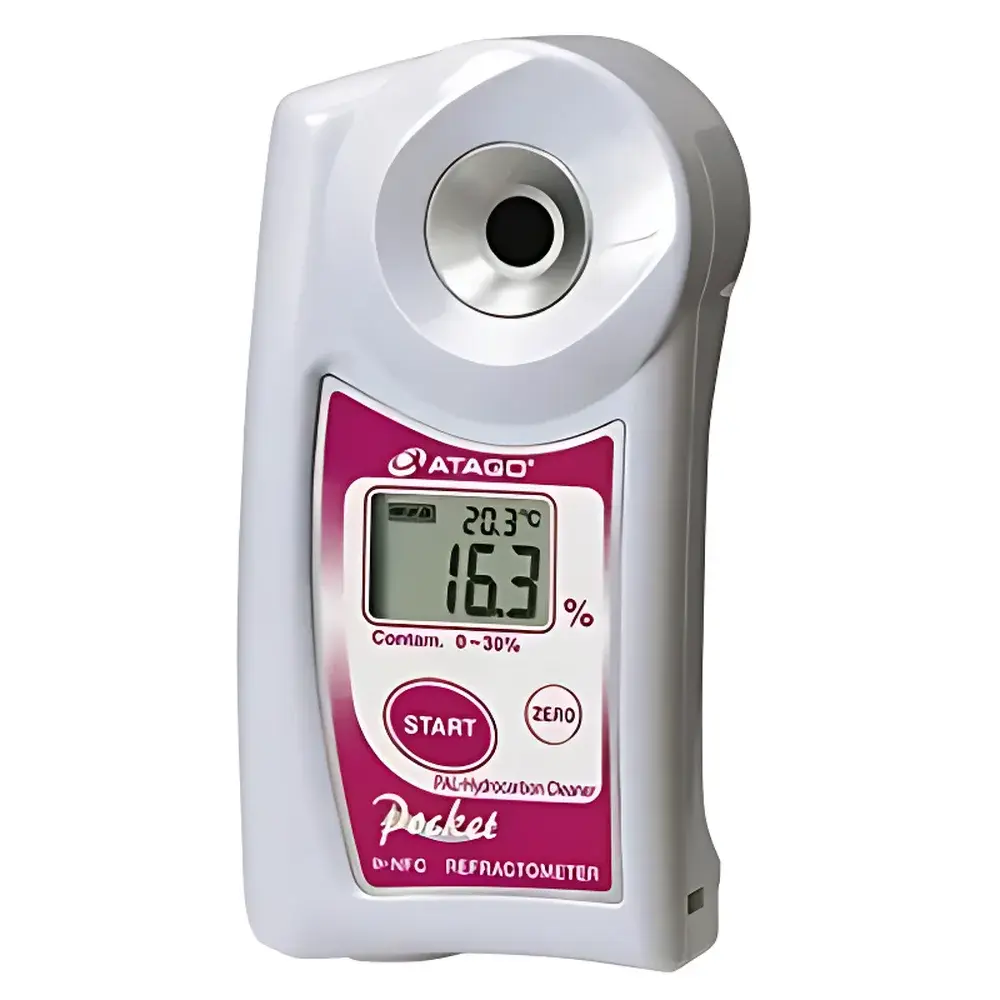
ATAGO PAL-Hydrocarbon Cleaner Portable Digital Refractometer
| Brand | ATAGO |
|---|---|
| Origin | Japan |
| Model | PAL-Hydrocarbon Cleaner |
| Product Type | Handheld Refractometer |
| Temperature Compensation | Automatic (ATC, 10–100°C) |
| Display | Digital LCD |
| Measurement Range | 0.0–30.0% w/w hydrocarbon cleaner concentration |
| Accuracy | ±0.1% |
| Resolution | 0.1% |
| Operating Ambient Temperature | 10–100°C |
| Power Supply | 2× AAA batteries |
| IP Rating | IP65 |
| Dimensions | 5.5 × 3.1 × 10.9 cm |
| Weight | 100 g (main unit) |
Overview
The ATAGO PAL-Hydrocarbon Cleaner is a compact, handheld digital refractometer engineered for rapid, on-site quantification of hydrocarbon-based cleaning agent concentration in industrial aqueous solutions. It operates on the principle of total internal reflection at the prism-solution interface, where the refractive index—linearly correlated with solute concentration—is optically measured and converted into % w/w concentration via a pre-calibrated algorithm specific to common hydrocarbon cleaning formulations (e.g., naphthenic, paraffinic, or aromatic solvent blends used in metal degreasing and precision parts cleaning). Unlike generic refractometers, the PAL-Hydrocarbon Cleaner employs a proprietary calibration curve optimized for the refractive index dispersion characteristics of hydrocarbon/water mixtures across the 0.0–30.0% range, ensuring traceable accuracy without user recalibration. Its built-in Automatic Temperature Compensation (ATC) system maintains measurement integrity over a wide operational temperature span (10–100°C), critical for monitoring hot rinse tanks, ultrasonic cleaning baths, or inline circulation loops where thermal drift would otherwise compromise repeatability.
Key Features
- Optimized optical path design with high-stability sapphire prism for abrasion resistance and long-term refractive index stability
- Digital LCD display with backlight for legibility under low-light workshop conditions
- IP65-rated enclosure ensures protection against dust ingress and water jets—suitable for wet industrial environments
- ATC functionality compliant with ISO 21748:2017 guidelines for temperature-dependent measurement correction
- No external power supply required: powered by two standard AAA batteries with >10,000 measurements per set (typical usage)
- Zero-adjustment function using distilled water reference, supporting routine verification per internal quality protocols
- Compact form factor (5.5 × 3.1 × 10.9 cm) and lightweight construction (100 g) enable one-handed operation during line-side audits or shift inspections
Sample Compatibility & Compliance
The PAL-Hydrocarbon Cleaner is validated for use with aqueous-based hydrocarbon cleaning solutions containing typical surfactants, corrosion inhibitors, and stabilizers found in OEM-approved formulations (e.g., Shell S200, ExxonMobil Solvex, and JXTG Nippon Oil HCS series). It is not intended for pure solvent analysis or non-aqueous systems. The instrument meets CE marking requirements for electromagnetic compatibility (EN 61326-1) and safety (EN 61010-1). While not certified for hazardous area use (ATEX/IECEx), its battery-powered, non-sparking architecture makes it suitable for Zone 2 environments when operated per site-specific risk assessments. Data generated supports compliance with ISO 9001:2015 clause 8.5.1 (control of production and service provision) and automotive IATF 16949:2016 requirements for process monitoring of cleaning efficacy.
Software & Data Management
This model operates as a standalone field instrument with no onboard data logging or Bluetooth connectivity. However, its consistent ±0.1% accuracy and 0.1% resolution enable reliable manual entry into electronic batch records, LIMS, or paper-based QC checklists. Users may integrate readings into structured reporting workflows aligned with FDA 21 CFR Part 11 principles by pairing the device with validated SOPs that define measurement frequency, operator qualification, and record retention—particularly relevant for Tier 1 automotive suppliers operating under AIAG CQI-9 heat-treat or CQI-22 plating system assessments. Calibration verification logs (using distilled water at 20°C) are recommended weekly or per shift change, in accordance with GLP-aligned internal procedures.
Applications
- Real-time monitoring of hydrocarbon cleaner concentration in multi-stage metal parts washing lines (e.g., pre-coating, post-machining, or before electroplating)
- Verification of bath replenishment ratios during maintenance cycles in automotive engine component cleaning cells
- Process validation support for ASME BPE-compliant cleaning validation protocols in precision machining facilities
- Root cause analysis of residual oil contamination failures via correlation of refractometer readings with FTIR or gravimetric residue testing
- Training tool for shop-floor personnel on quantitative process control fundamentals per Lean Six Sigma methodologies
FAQ
Does the PAL-Hydrocarbon Cleaner require factory recalibration?
No—ATAGO instruments are shipped with NIST-traceable calibration certificates. Field verification using Type II distilled water (refractive index 1.3330 at 20°C) is sufficient for daily confidence checks.
Can it measure non-aqueous hydrocarbon solvents like pure mineral spirits?
No. The calibration is strictly for aqueous hydrocarbon emulsions; pure solvents fall outside the 0.0–30.0% w/w range and lack the necessary water-phase refractive index response.
Is the ATC system compatible with steam-heated tanks above 80°C?
Yes—the ATC sensor functions reliably up to 100°C ambient, but sample temperature must be stabilized prior to measurement to avoid thermal shock-induced prism stress or condensation artifacts.
How often should the prism surface be cleaned?
After every 3–5 measurements in high-residue environments; use lint-free wipes moistened with isopropyl alcohol (IPA), followed by dry wipe—never abrasive cloths or acetone.
Does this model comply with ASTM D115 or ISO 2878 standards?
It does not claim direct conformance to those standards (which govern laboratory-grade benchtop refractometers), but its performance parameters meet the technical intent of ASTM D115 Annex A1 for field-use concentration verification in industrial cleaning applications.




