
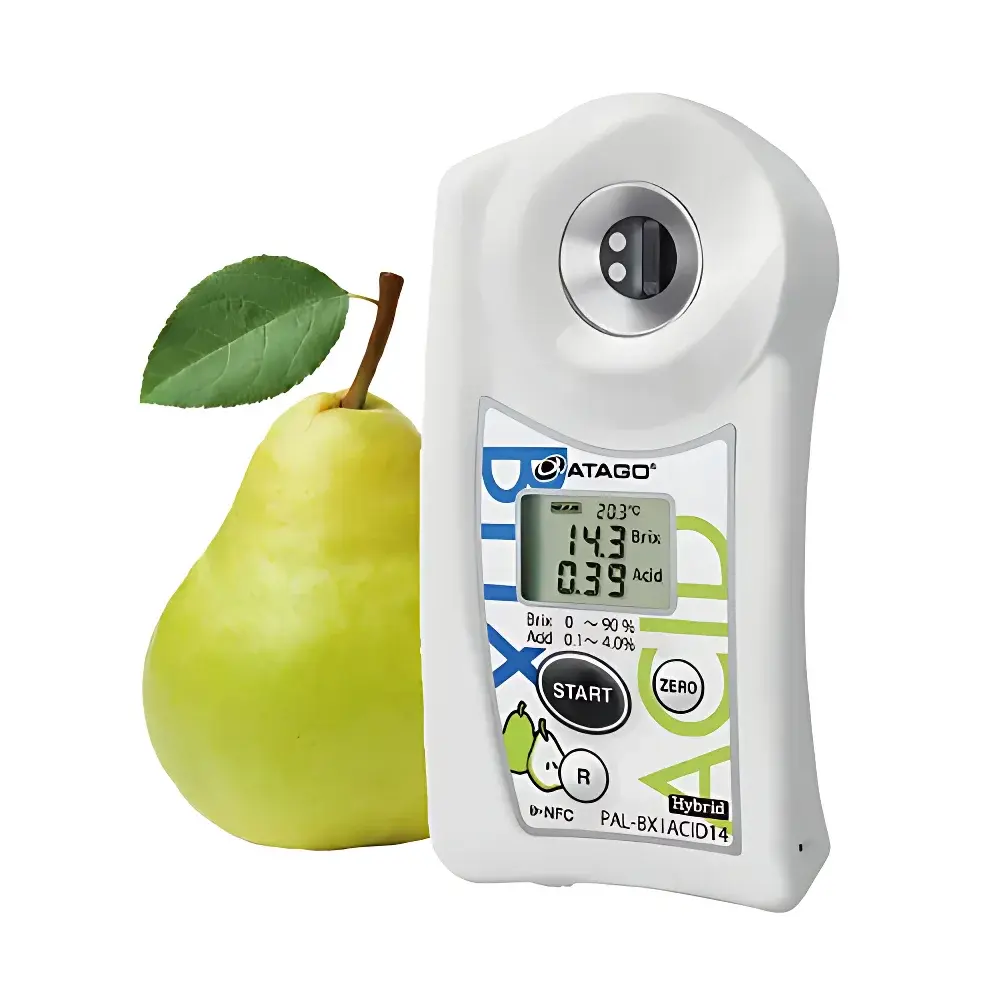
ATAGO PAL-BX/ACID 14 Pear-Specific Refractometric Brix and Titration-Free Acidity Analyzer
| Brand | ATAGO |
|---|---|
| Origin | Japan |
| Model | PAL-BX/ACID 14 |
| Measurement Principle | Refractive Index (Brix) + pH-Compensated Conductivity-Based Acidity Estimation |
| Instrument Type | Destructive Sampling Analyzer |
| Brix Range | 0.0–90.0% |
| Acidity Range (as Citric Acid) | 0.10–4.00% |
| Brix Accuracy | ±0.2% |
| Acidity Accuracy | ±0.10% (0.10–1.00%), ±10% rel. (1.01–4.00%) |
| Temperature Compensation | 10–40°C |
| Resolution | Brix 0.1%, Acidity 0.01% (≤9.99%), 0.1% (≥10.0%), Ratio Display Format: 0.00 / 00.0 / 000 |
| IP Rating | IP65 |
| Power | 2×AAA Alkaline Batteries |
| Dimensions | 5.5 × 3.1 × 10.9 cm |
| Weight | 100 g (instrument only) |
Overview
The ATAGO PAL-BX/ACID 14 is a handheld, dual-parameter optical analyzer engineered specifically for rapid, field-deployable assessment of pear fruit quality. Unlike conventional benchtop systems requiring solvent extraction, titration, or enzymatic assays, this instrument integrates refractometric Brix measurement with a proprietary conductivity-pH correlation algorithm to estimate total titratable acidity (TTA) as citric acid equivalent—without chemical reagents or laboratory infrastructure. Its core design addresses the physiological interdependence of soluble solids content (SSC) and organic acid concentration in Rosaceae fruits, particularly Pyrus pyrifolia (Nijisseiki, Hosui, and other Asian pear cultivars), where optimal flavor perception correlates strongly with the Brix-to-acid ratio (BAR). The device operates on a destructive sampling principle: a small volume of expressed juice is measured directly for Brix; for acidity, a standardized 1:50 (w/w) dilution with deionized water is prepared prior to analysis—enabling reproducible quantification under variable harvest conditions, storage environments, or postharvest handling protocols.
Key Features
- Pear-optimized optical calibration curve with built-in OFFSET function for empirical correction against reference titration data or alternative acid quantification methods (e.g., AOAC 942.15 or ISO 750)
- Simultaneous dual-parameter readout: Brix (% w/w sucrose equivalent), acidity (% w/w citric acid), and calculated BAR via dedicated [R] key
- Automatic temperature compensation (10–40°C) compliant with ISO 2173 and AOAC Official Method 932.12 for refractometric sugar analysis
- Rugged, IP65-rated enclosure suitable for orchard, packinghouse, cold storage, and transport vehicle use
- Low-power operation (2×AAA alkaline batteries) supporting >10,000 measurements per set under typical ambient conditions
- No consumables required beyond deionized water for dilution—eliminating reagent costs, waste disposal, and technician training overhead associated with potentiometric titration
Sample Compatibility & Compliance
The PAL-BX/ACID 14 is validated for intact juice expressed from fresh, chilled, or refrigerated pears—including Nijisseiki (Shinseiki), Hosui, Kosui, and Ya Li varieties—as well as pear purees, nectars, and clarified juices with suspended solids <50 µm. It is not intended for high-viscosity syrups, fermented products, or samples containing particulate matter exceeding filtration grade 0.45 µm. Measurement traceability aligns with ISO/IEC 17025 requirements when used within its specified operating range and calibrated per ATAGO’s recommended 6-month interval using certified Brix standards (NIST-traceable SRM 84d) and citric acid reference solutions. While not FDA 21 CFR Part 11 compliant as a standalone unit, audit-ready records can be generated when paired with ATAGO’s optional PAL-Link software and external barcode-scanned sample logging.
Software & Data Management
Data export is supported via optional USB cable connection to Windows-based PAL-Link software (v3.2+), enabling batch export of timestamped Brix, acidity, BAR, and ambient temperature values in CSV or Excel-compatible formats. The software supports GLP-compliant user account management, calibration history tracking, and deviation flagging against predefined specification limits (e.g., BAR ≥ 25.0 for premium-grade Hosui at commercial harvest). No cloud synchronization or remote firmware updates are implemented—ensuring data sovereignty and minimizing cybersecurity exposure in regulated agricultural QA/QC environments.
Applications
- Real-time harvest timing decisions based on dynamic BAR thresholds across pear cultivars
- In-line sorting and grading in packinghouses using BAR as a non-destructive proxy for sensory acceptability (aligned with USDA FGIS Grade Standards for Pears)
- Postharvest physiology studies assessing acid metabolism during controlled-atmosphere storage
- Rootstock–scion interaction trials evaluating carbohydrate–organic acid partitioning efficiency
- Quality assurance documentation for export consignments requiring phytosanitary and organoleptic compliance (e.g., JAS, GAP, GlobalG.A.P.)
- Research validation of NIR or hyperspectral prediction models where PAL-BX/ACID 14 serves as ground-truth reference instrumentation
FAQ
Is the PAL-BX/ACID 14 suitable for apple or citrus fruit analysis?
No. Its optical and algorithmic calibration is specific to pear matrix characteristics—including juice viscosity, organic acid profile (predominantly malic acid with minor citric contribution), and refractive index dispersion behavior. Use of non-pear samples will yield non-representative BAR values.
Why is a 1:50 dilution required for acidity measurement?
This dilution standardizes ionic strength and minimizes matrix interference from sugars and polyphenols that affect conductivity–pH correlation accuracy. It replicates the effective dilution factor used in AOAC titration protocols for pear juice, ensuring method comparability.
Does the instrument require daily recalibration?
No. ATAGO specifies calibration verification before first use each day using distilled water (Brix = 0.0%) and a 10.0% sucrose standard. Full recalibration is recommended every six months or after 2,000 measurements, whichever occurs first.
Can BAR values be exported with ISO timestamp and operator ID?
Yes—when used with PAL-Link software and configured user profiles, each measurement record includes UTC timestamp, operator login ID, instrument serial number, and calibration status flag.
What maintenance is required to sustain IP65 integrity?
Routine cleaning with a soft, damp cloth and periodic inspection of the prism seal and battery compartment O-ring are sufficient. Avoid alcohol-based cleaners or ultrasonic baths, which may degrade optical coatings or gasket elastomers.





