
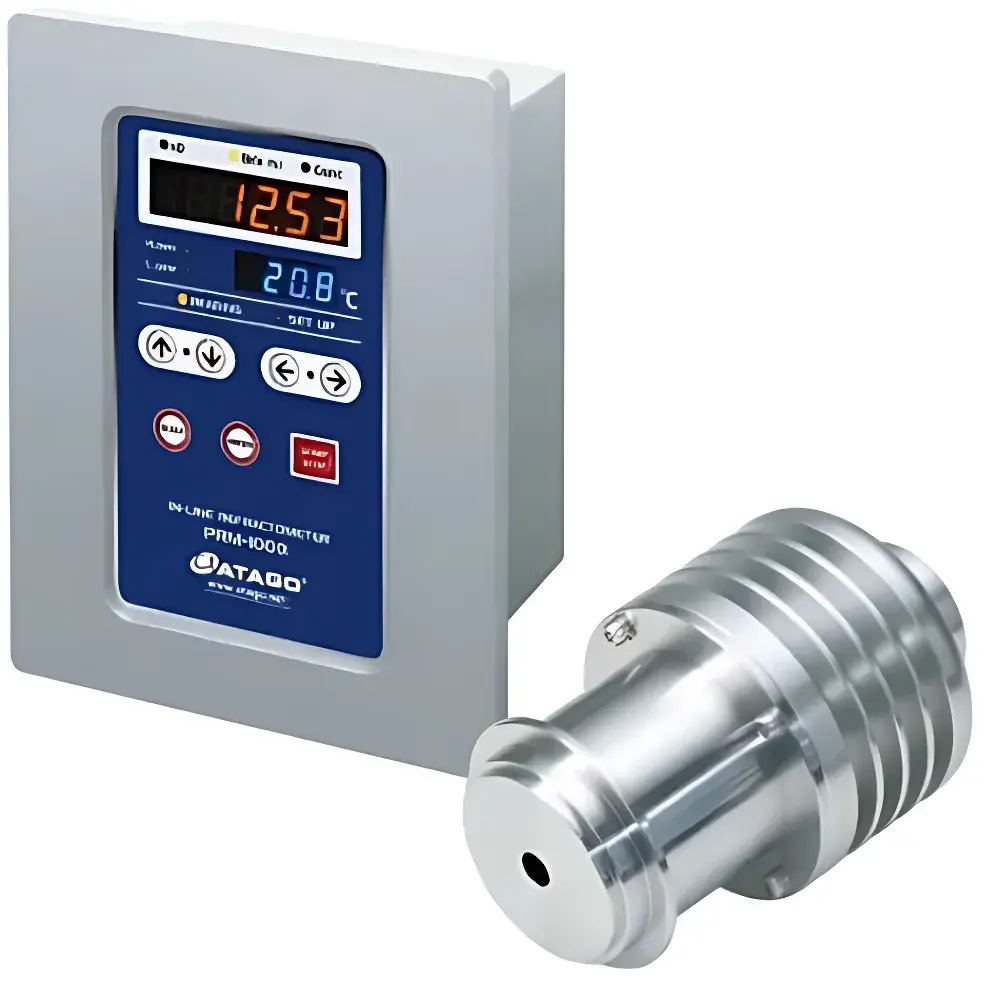
ATAGO PRM-100α DX In-line Refractometer for Biopharmaceutical Concentration Monitoring
| Brand | ATAGO |
|---|---|
| Origin | Japan |
| Model | PRM-100α DX |
| Measurement Range | nD 1.32000–1.55700 |
| Accuracy | ±0.00010 (nD), ±0.05% (Brix) |
| Temperature Range | −5.0–160.0 °C |
| Auto-Temperature Compensation | 5–100 °C |
| Output | 4–20 mA, RS-232C |
| IP Rating | IP67 |
| Pressure Rating | 0.98 MPa |
| Sample Cell Material | SUS316L |
| Prism Material | Synthetic Sapphire |
| Display | 7-segment LED |
| Power | AC 100–240 V, 50–60 Hz |
| Cable Length | Standard 15 m (extendable to 200 m) |
Overview
The ATAGO PRM-100α DX is a high-precision in-line refractometer engineered for continuous, real-time monitoring of refractive index (nD) and concentration—expressed as Brix (%) or user-defined concentration units—in biopharmaceutical manufacturing processes. It operates on the principle of critical-angle refractometry, where light passes through a sapphire prism in direct contact with the process stream; the resulting refraction angle is converted into a highly stable nD value, which is then translated into concentration via pre-calibrated polynomial algorithms. Unlike offline benchtop instruments, the PRM-100α DX integrates directly into sanitary or industrial piping systems (e.g., tri-clamp or flanged connections), enabling non-invasive, flow-through measurement without sample extraction, bypass loops, or moving parts. Its design complies with hygienic process requirements common in biologics manufacturing, including resistance to CIP/SIP cycles and compatibility with USP Class VI materials (SUS316L wetted parts and synthetic sapphire prism). The instrument delivers traceable, repeatable data at one-second intervals—critical for closed-loop process control, batch consistency validation, and PAT (Process Analytical Technology) implementation per FDA Guidance for Industry.
Key Features
- High-resolution refractive index measurement with ±0.00010 nD accuracy and ±0.05% Brix repeatability under controlled temperature conditions
- Automatic Temperature Compensation (ATC) across 5–100 °C, ensuring stable output despite thermal fluctuations in production environments
- Robust mechanical architecture rated to 0.98 MPa (10 bar), suitable for pressurized bioreactor recirculation lines, tangential flow filtration (TFF) skids, and downstream purification trains
- IP67-rated electronics enclosure and chemically inert wetted surfaces (SUS316L + synthetic sapphire) for reliable operation in humid, washdown-intensive cleanrooms (ISO Class 5–8) and industrial settings
- Dual-resolution mode: configurable display and output resolution (0.0001 / 0.00001 nD; 0.1% / 0.01% Brix) to match data logging and regulatory reporting granularity requirements
- Integrated 7-segment LED display with high-brightness output—optimized for readability at distances up to 15 meters in large-scale production halls
Sample Compatibility & Compliance
The PRM-100α DX is validated for aqueous and semi-aqueous solutions commonly encountered in biopharmaceutical processing: cell culture harvests, protein-containing buffers, viral vector formulations, monoclonal antibody (mAb) eluates, polysaccharide solutions, and excipient blends. It supports real-time tracking of critical quality attributes (CQAs) such as solute concentration during diafiltration, buffer exchange, formulation dilution, and final fill concentration adjustment. The instrument meets key regulatory expectations for process instrumentation: its analog 4–20 mA and digital RS-232C outputs support integration with DCS/SCADA systems compliant with ISA-88 and ISA-95 standards. While the device itself does not carry FDA 21 CFR Part 11 certification (as it lacks embedded audit trail functionality), its raw output is fully compatible with validated data acquisition platforms that enforce electronic signature, change control, and audit trail requirements under GMP Annex 11 and ICH Q5E.
Software & Data Management
The PRM-100α DX functions as a stand-alone sensor node; no proprietary software is required for basic operation. However, its analog and serial outputs enable seamless connection to third-party SCADA, MES, or LIMS platforms. The 4–20 mA signal can be assigned to nD, Brix, temperature, or derived concentration values—facilitating direct input into PID controllers for automated feed-forward or feedback concentration control. RS-232C communication allows bidirectional configuration (e.g., calibration offset adjustment, ATC setpoint modification) and real-time data streaming at 1 Hz. When integrated into a validated system, all measurement timestamps, sensor diagnostics (e.g., prism fouling detection via signal stability metrics), and configuration changes are recorded within the host platform’s audit trail—ensuring full ALCOA+ compliance (Attributable, Legible, Contemporaneous, Original, Accurate, Complete, Consistent, Enduring, Available).
Applications
- Real-time Brix monitoring during ultrafiltration/diafiltration of therapeutic proteins to maintain target conductivity and osmolality
- Continuous verification of buffer composition in chromatography column equilibration and regeneration steps
- In-process concentration control of vaccine antigen solutions prior to lyophilization or liquid fill
- Verification of cleaning solution strength (e.g., NaOH, citric acid) during CIP cycle validation
- Monitoring of media concentrate dilution ratios in seed train expansion and bioreactor inoculation
- Tracking of polysaccharide or plasmid DNA concentration in purification pool hold steps
FAQ
Is the PRM-100α DX suitable for sterile applications?
Yes—the sensor head uses USP Class VI-compliant materials (SUS316L and synthetic sapphire) and withstands repeated SIP cycles at ≤121 °C. Installation requires appropriate aseptic connection hardware (e.g., tri-clamp ferrules with EPDM or FKM gaskets).
Can it measure non-Brix solutions, such as sodium chloride or sucrose-free formulations?
Yes—users may define custom calibration curves using known reference standards. The instrument accepts up to three-point polynomial equations for arbitrary concentration units (e.g., g/L, % w/v, molarity).
What maintenance is required to ensure long-term accuracy?
No routine recalibration is needed if operated within specified temperature and pressure limits. Prism surface integrity should be verified periodically using certified refractive index standards; optional automatic prism cleaning modules are available for high-fouling streams.
Does ATAGO provide installation support for GMP-compliant validation?
ATAGO supplies technical documentation (IQ/OQ templates, material certifications, and factory calibration reports) but does not perform site-specific PQ or 21 CFR Part 11 validation—these responsibilities reside with the end-user’s qualified validation team.







