
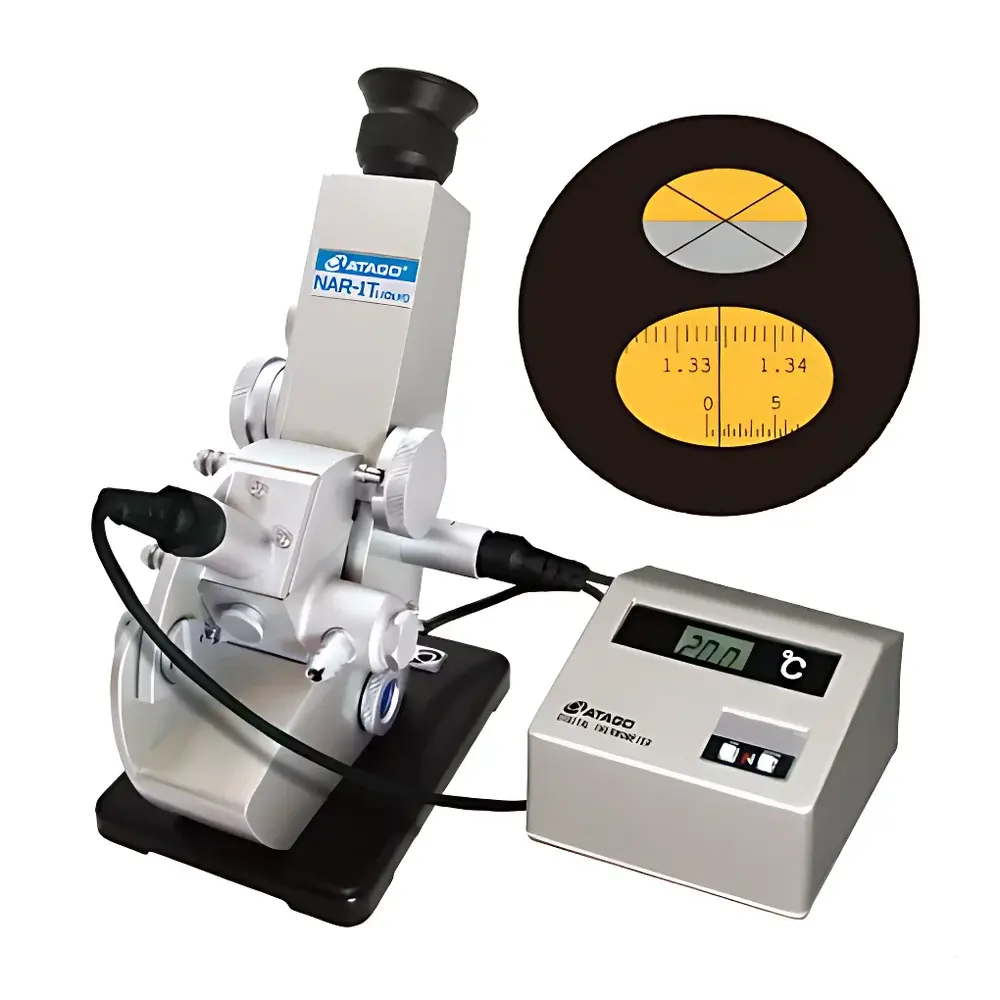
ATAGO NAR-1T-LO Low-Range Abbe Refractometer
| Brand | ATAGO |
|---|---|
| Origin | Japan |
| Model | NAR-1T-LO |
| Type | Benchtop Abbe Refractometer |
| Refractive Index Range | 1.1500–1.4800 |
| Refractive Index Accuracy | ±0.0002 |
| Refractive Index Resolution | 0.001 |
| Brix Range | 0.0–95.0% |
| Brix Resolution | 0.05% |
| Temperature Measurement Range | 5–50°C |
| Temperature Display Range | 0.0–50.0°C |
| Power Supply | AC 100–240 V, 50/60 Hz |
| Dimensions (Main Unit) | 13 × 18 × 23 cm |
| Weight (Main Unit) | 1.8 kg |
| Dimensions (Temperature Display Unit) | 10 × 11 × 7 cm |
| Weight (Temperature Display Unit) | 0.5 kg |
| Power Consumption | 5 VA |
Overview
The ATAGO NAR-1T-LO is a precision benchtop Abbe refractometer engineered for high-accuracy measurement of low-refractive-index transparent and semi-transparent liquids. Based on the classical Abbe principle—utilizing critical angle refraction at the prism-sample interface—the instrument delivers traceable, repeatable nD values across an extended low-range spectrum (1.1500–1.4800). This range is specifically optimized for applications involving organic solvents (e.g., acetone, ethanol, hexane), fluorinated fluids, silicone oils, low-concentration polymer solutions, and specialty optical coatings—materials where conventional Abbe refractometers (typically starting at nD ≈ 1.3000) lack sufficient sensitivity or linearity. The NAR-1T-LO employs a temperature-stabilized glass prism assembly and a calibrated sodium-D spectral line (589.3 nm) light source to ensure compliance with ISO 21147:2022 (Refractometers — Specifications and methods of testing) and ASTM D1218–21 (Standard Test Method for Refractive Index and Refractive Dispersion of Hydrocarbon Liquids). Its mechanical optical path design eliminates electronic drift, making it suitable for GLP-compliant laboratories requiring long-term calibration stability without active temperature control.
Key Features
- Extended low-range refractive index capability (1.1500–1.4800), uniquely addressing underserved measurement needs in solvent R&D and optical material characterization
- Mechanical analog scale with vernier reading system providing direct nD readout to 0.001 resolution and certified accuracy of ±0.0002
- Dual-unit configuration: main optical base unit (1.8 kg) with integrated prism stage and collimator optics, plus a dedicated external digital temperature display module (0.5 kg) for independent ambient or sample-block temperature monitoring
- Passive thermal design—no Peltier or liquid-circulation cooling required—reducing maintenance complexity and power dependency while maintaining operational integrity between 5°C and 50°C ambient conditions
- Robust all-metal housing with anti-vibration damping feet; designed for permanent installation on optical tables or QC lab benches
- Compliance-ready documentation package includes factory calibration certificate traceable to JCSS (Japan Calibration Service System) standards
Sample Compatibility & Compliance
The NAR-1T-LO accommodates samples with viscosity up to 500 mPa·s and volatility compatible with standard Abbe handling protocols (e.g., closed-cell application for volatile organics). It supports both homogeneous liquids and stable colloidal dispersions with minimal light scattering. Sample volume requirement is ≤0.2 mL per measurement. The instrument meets essential regulatory expectations for method validation under ISO/IEC 17025:2017 (General requirements for the competence of testing and calibration laboratories) and supports audit trails when used with documented SOPs. While not equipped with active temperature control, its specified operating temperature range (5–50°C) and included temperature display enable manual thermal equilibration per USP guidance for refractometric assays. It is routinely deployed in quality control workflows compliant with GMP Annex 11 (for non-automated instrumentation) and FDA 21 CFR Part 11 (when paired with paper-based recordkeeping systems).
Software & Data Management
As a fully analog optical instrument, the NAR-1T-LO does not incorporate embedded microprocessors, digital displays, or data output interfaces. All measurements are manually recorded from the calibrated ocular scale, ensuring immunity to firmware obsolescence, cybersecurity vulnerabilities, or software validation overhead. This architecture aligns with ALCOA+ principles (Attributable, Legible, Contemporaneous, Original, Accurate) for handwritten analytical records. Users may integrate readings into LIMS or ELN platforms via secondary transcription using standardized templates aligned with ISO/IEC 17025 documentation requirements. Optional accessories—including a calibrated reference oil set (nD 1.1500, 1.2500, 1.3500, 1.4500) and a precision sample spreader—facilitate routine performance verification and operator training.
Applications
- Characterization of low-nD solvents in pharmaceutical synthesis and cleaning validation (e.g., isopropyl alcohol, methyl tert-butyl ether)
- Quality assurance of fluorinated heat-transfer fluids and dielectric coolants in semiconductor fab tooling
- Batch release testing of silicone-based release agents and anti-reflective coating precursors
- R&D of photonic polymer blends and liquid crystal monomer formulations
- Concentration monitoring of dilute aqueous-organic mixtures in electroplating bath management
- Educational use in university physics and materials science labs for fundamental optics instruction
FAQ
Does the NAR-1T-LO support automatic temperature compensation (ATC)?
No. It requires manual temperature measurement using the supplied external digital thermometer, and corrections must be applied per published temperature-refractivity coefficients for the analyte.
Is this instrument suitable for measuring opaque or highly scattering samples?
No. It is designed exclusively for optically transparent or mildly translucent liquids. Turbid, emulsified, or particle-laden samples will yield unreliable critical angle detection.
Can the prism be cleaned with acetone or chloroform?
Yes—ATAGO specifies compatibility with common organic solvents for prism cleaning; however, prolonged exposure or abrasive wiping must be avoided to preserve surface polish.
What calibration standards are recommended for daily verification?
ATAGO recommends traceable reference oils with certified nD values spanning the low-range spectrum (e.g., 1.1500, 1.2500, 1.3500), verified annually against national metrology institute references.
Is technical support available outside Japan?
Yes—ATAGO maintains authorized service centers in North America, Europe, and APAC regions offering calibration, repair, and application consultation aligned with ISO/IEC 17025-accredited practices.




