
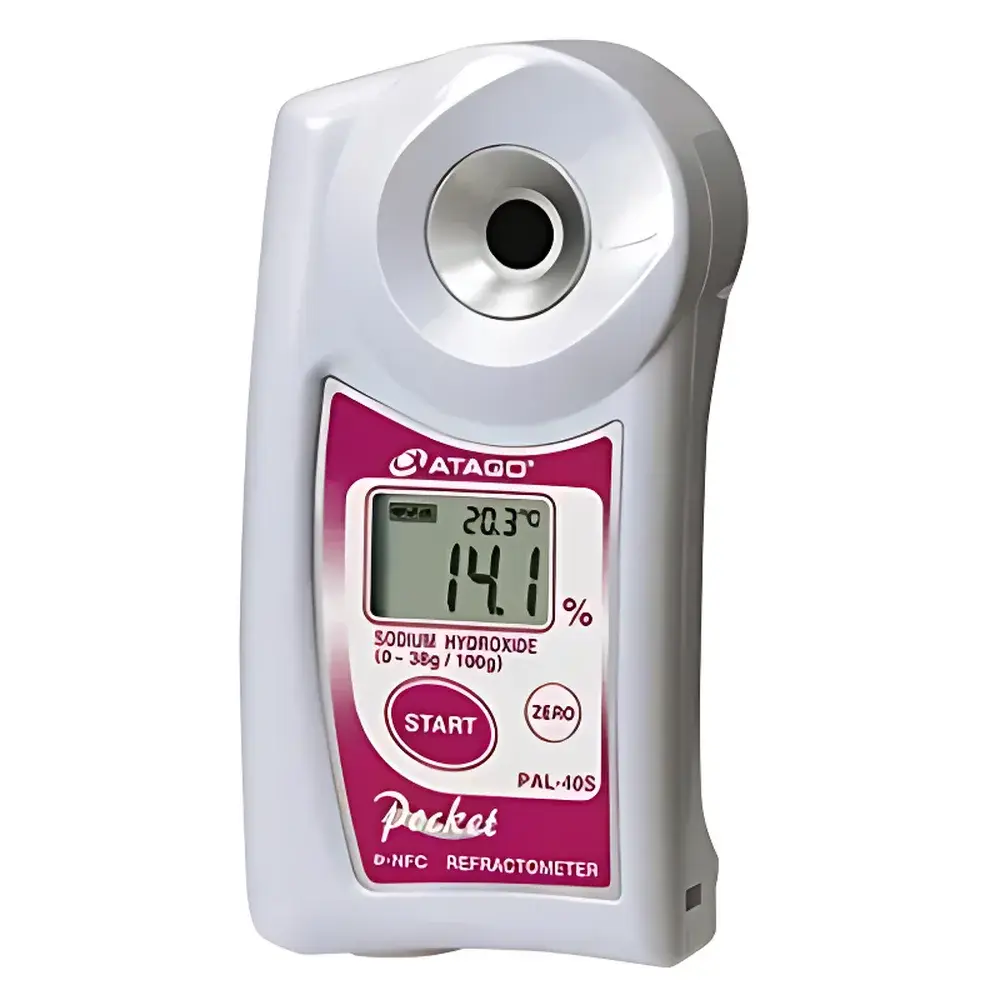
ATAGO PAL-40S Sodium Hydroxide Digital Handheld Refractometer
| Brand | ATAGO |
|---|---|
| Origin | Japan |
| Model | PAL-40S NaOH |
| Measurement Range | 0.0–38.0% w/w NaOH |
| Accuracy | ±0.2% |
| Resolution | 0.1% |
| Temperature Range (with ATC) | 10–35°C |
| Display | Digital LCD |
| IP Rating | IP65 |
| E.L.I. (External Light Interference) Function | Yes |
| Auto Temperature Compensation | Yes |
| Zeroing Method | Distilled Water Calibration |
| Power | 2×AAA batteries |
| Dimensions | 5.5 × 3.1 × 10.9 cm |
| Weight | 100 g (instrument only) |
Overview
The ATAGO PAL-40S Sodium Hydroxide Digital Handheld Refractometer is a precision optical instrument engineered for rapid, field-deployable quantification of aqueous sodium hydroxide (NaOH) concentration in industrial process control and quality assurance environments. Based on the fundamental principle of critical-angle refractometry, the PAL-40S measures the refractive index of NaOH solutions and converts it—via factory-calibrated polynomial algorithms—into mass percent concentration (w/w %). Unlike generic refractometers, the PAL-40S employs a NaOH-specific calibration curve traceable to NIST-traceable reference standards, ensuring metrological integrity across its full operational range of 0.0–38.0% w/w. Its solid-state optical path, sapphire prism surface, and integrated thermistor enable high reproducibility under variable ambient conditions without manual temperature correction.
Key Features
- NaOH-specific optical calibration: Optimized for sodium hydroxide’s unique refractive index–concentration relationship, minimizing cross-sensitivity to other alkalis or contaminants.
- Automatic Temperature Compensation (ATC): Real-time compensation across 10–35°C using an embedded thermistor; eliminates user-induced errors from thermal drift.
- IP65-rated enclosure: Dust-tight and protected against low-pressure water jets, enabling reliable operation in humid, outdoor, or semi-industrial settings (e.g., chemical dosing stations, effluent monitoring points).
- E.L.I. (External Light Interference) technology: Active optical shielding suppresses ambient light artifacts during daylight or uncontrolled lighting conditions—critical for consistent readings in field use.
- One-hand operation: Ergonomic form factor (5.5 × 3.1 × 10.9 cm, 100 g), tactile button layout, and instant 0.1% resolution display support efficient workflow in glove-compatible environments.
- Distilled water zeroing: Simplified calibration protocol requiring only deionized or distilled water—no proprietary reagents or software required.
Sample Compatibility & Compliance
The PAL-40S is validated for clear, homogeneous, non-viscous aqueous NaOH solutions free of suspended solids, oils, or emulsifiers. It is not suitable for molten NaOH, slurry-phase systems, or highly turbid effluents. While the instrument itself does not carry formal regulatory certification (e.g., ISO/IEC 17025), its measurement methodology aligns with principles referenced in ASTM D1120 (Standard Test Method for Boiling Point of Engine Coolants) and ISO 21748 (Guidance for the use of repeatability, reproducibility and trueness estimates in measurement uncertainty evaluation). For GLP/GMP-regulated environments, users may document calibration history, operator ID, and environmental conditions manually or via external loggers; the device supports audit-ready traceability when integrated into controlled procedural workflows.
Software & Data Management
The PAL-40S operates as a standalone, embedded-system instrument with no Bluetooth, USB, or cloud connectivity. All measurements are displayed in real time on a high-contrast LCD screen; no data storage or export capability is built-in. This architecture prioritizes robustness, battery longevity (>10,000 measurements per battery set), and immunity to electromagnetic interference—key requirements in electrically noisy plant environments. For laboratories requiring electronic recordkeeping, users typically pair the PAL-40S with external digital logbooks or LIMS-integrated capture via manual entry or barcode-scanned result logging. No firmware updates or driver installation is required—consistent with ATAGO’s design philosophy of long-term hardware stability and minimal maintenance overhead.
Applications
- Chemical manufacturing: In-line verification of NaOH stock solution strength prior to dilution or blending in caustic soda production lines.
- Water treatment: Monitoring residual NaOH dosage in pH-adjustment loops for municipal or industrial wastewater neutralization.
- Pulp and paper: Controlling alkali concentration in kraft pulping liquor or green liquor analysis during recovery cycle optimization.
- Food processing: Validating caustic wash concentrations used in CIP (Clean-in-Place) systems for dairy, beverage, and meat processing equipment.
- Metal finishing: Ensuring correct NaOH concentration in alkaline degreasing baths for aluminum or steel surface preparation.
- Academic & vocational labs: Teaching core concepts of solution optics, colligative properties, and industrial analytical method validation.
FAQ
Does the PAL-40S require periodic recalibration with certified NaOH standards?
Yes. While factory-calibrated, ATAGO recommends verification against traceable NaOH reference solutions at least daily in high-precision applications or after exposure to extreme temperatures or mechanical shock.
Can the PAL-40S measure other alkalis like KOH or Na₂CO₃?
No. Its optical calibration is mathematically specific to NaOH’s refractive index profile. Using it for other solutes introduces systematic bias beyond ±1.0% error.
Is the sapphire prism resistant to NaOH corrosion at 38% concentration?
Yes. The sapphire (Al₂O₃) prism surface exhibits negligible etching even after repeated contact with saturated NaOH at ambient temperature, supporting multi-year service life under routine use.
What is the minimum sample volume required for measurement?
Approximately 0.3 mL—sufficient to cover the prism surface completely without overflow; no sample cell or capillary tube is needed.
How does ATC affect measurement uncertainty at temperature extremes within the 10–35°C range?
The ATC algorithm reduces temperature-related bias to ≤±0.05% w/w per °C deviation from 20°C, maintaining overall accuracy within the stated ±0.2% specification across the full compensated range.




